When “skunk” is mentioned, the strong, foul-smelling odor is usually the first thing that comes to our minds. This odor is so bad we can almost smell it at just the mention of the word. Despite their strong, unpleasant odor, skunks are beneficial to us as they help control insects and rodent populations.
There are two species of skunks found in Missouri, the striped skunk and spotted skunk. The striped skunk is found throughout Missouri and is one of our most recognizable wild mammals. The body is black with a white stripe down each side of the back that merges just above the shoulders and ends with a patch of white fur on the head, some have varying amounts of white. Spotted skunks are rarely seen in Missouri, they have black fur with white spots and are found in small numbers in south Missouri.
Striped skunks prefer forest borders, edges of fields and open grassy fields. They have adapted to live in towns and suburbs. Sometimes they can take up residence under homes where they have a food source nearby. Skunks are mostly nocturnal but can be seen during the day, they are often inactive for long periods of time during cold weather. However, warm winter weather may bring them out at night to hunt for food. Several skunks often occupy the same den during the winter months.
Skunk odor can be one of the most troublesome of all wildlife nuisance problems. Skunks can emit this odor any time of the year but more commonly in late February during mating season. When the musk odor is emitted under a house, it can be strong enough to cause people to miss work or temporarily move out of their house. The striped skunk has the strongest and most disagreeable smelling musk of any animal in Missouri. The musk of the spotted skunk has a different smell but is just as disagreeable. Skunk musk has been used for years by trappers to make trapping lures for foxes, coyotes and other animals and was once used by the perfume trade as a fixative. The skunk itself has very little, unpleasant odor about its body or den. The musk or odor is secreted by paired glands located on either side of the anus that are discharged when frightened, threatened or injured. When skunks are threatened, they may stamp their feet, throw their tail up and turn their backside toward the enemy. If the skunk throws its tail up and backs toward you, stop all movement until it calms down. Make sure all movements are slow and methodical as this should help the skunk remain calm.
The best preventive measures to keep skunks from digging under a house include:
✓ keeping the area free of brush and debris piles
✓ sealing all openings in the foundations of houses and outbuildings
✓ installing a welded-wire apron around foundations.
If you have skunks under your house or outbuildings, sealing holes in the foundations should be done only if you are certain that there are no skunks under the house. By sprinkling flour in front of all access holes and leaving it for a few days, you can tell whether skunks are still using the site, and whether they are in or out.
For more information in skunks visit https://huntfish.mdc.mo.gov/hunting-trapping/species/striped-skunk.
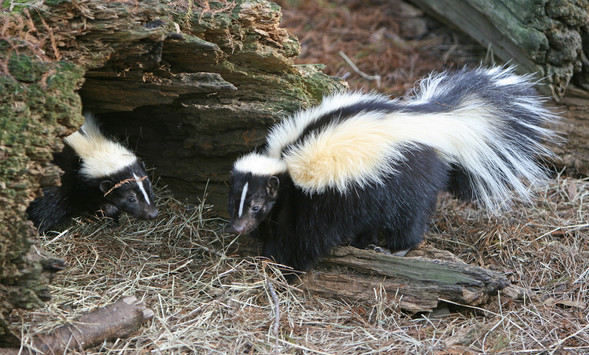 Skunks at opening to den.
|