|
An intensive,
three-week purge eliminated 85% of the invasive fish from the suburban lake.
MARYLAND HTS., Mo.—Anglers,
kayakers, paddle boarders and others may notice something missing from Creve
Coeur Lake now—those annoying, intrusive, and invasive Asian carp.
The lake, once packed full of these non-native interlopers,
is now largely free of them thanks to an experimental removal project conducted
by the Missouri Department of Conservation (MDC), the U.S. Geological Survey,
the U.S. Fish and Wildlife Service, and St. Louis County Parks last month.
Invasive Asian carp, primarily bighead carp and silver carp,
entered Creve Coeur Park Lake by way of Missouri River flooding prior to
2009. They quickly began to compete with
native species for food and space, reducing numbers of natives and severely
curtailing sport fish like crappie.
Asian carp also caused conflicts by leaping at and striking lake users,
and have been the source of several nuisance fish kills.
Conventional attempts to eliminate the invasive fish had
failed in the past. It turns out that
the solution came from the same origin as the problem.
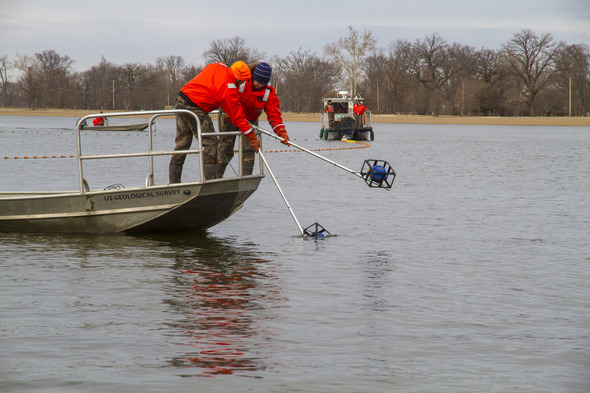
“We tried a new experimental method from Asia, called the
Unified Method, to push all the Asian carp to one end of the lake where we able
to harvest almost 50,000 of them,” reported MDC Fisheries Management Biologist
Kevin Meneau. Meneau coordinated MDC’s
involvement in the effort.
The Unified Method was adapted from techniques previously
tried and proven in Asia. It’s a process
of systematically driving and herding fish with boats utilizing electrical and
acoustic stimulation. The technique was
still experimental, but biologists had high hopes it would work.
“One of the things that get Asian carp really fired up is
the sound of outboard motors. We were
able to isolate that sound and broadcast it underwater,” Meneau said. “We could project that sound and the Asian
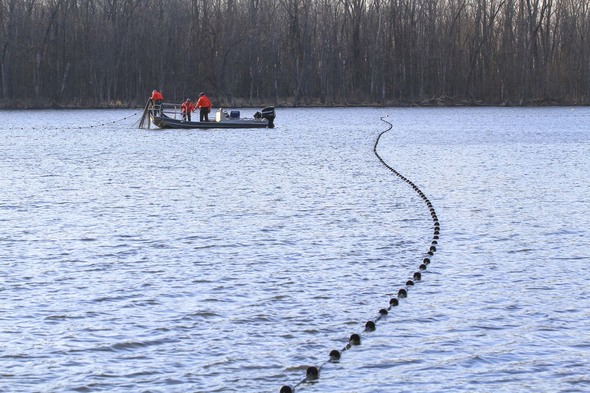
carp would leave that area, then we could quickly block off those areas they
left with giant nets.”
The multi-partner team spent an intense three weeks clearing
and blocking the lake, cell-by-cell, as they gradually herded the fish to a
final collection point. Along the way,
they had to overcome challenges including cold wind and weather, ice sheets
forming on the lake, and frozen nets.
Meneau explained that winter was the best time to perform the operation
because the fish are less active and easier to contain.
Since native fish tend not to respond to the acoustic
stimuli in the same way, the process proved successful in being highly
selective to moving only the target fish.
“We excluded Asian carp from about 95% of the lake, and
pushed them to an area where we could set up for harvest at the north part of
the lake near Sailboat Cove,” Meneau explained.
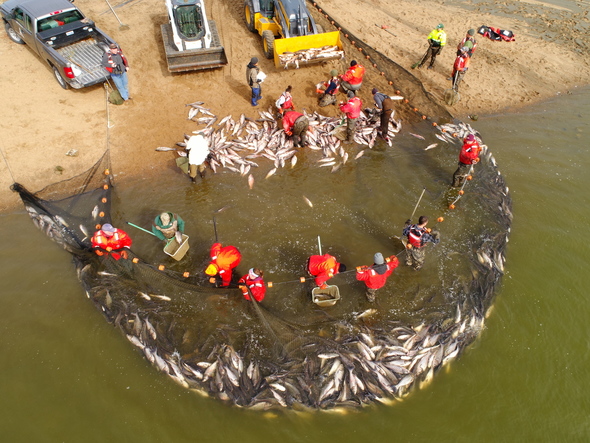
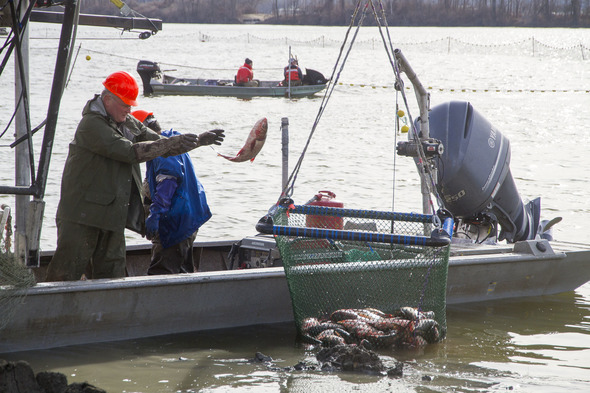
Once confined to that limited area, biologists were able to
use seining nets to remove the fish from the water. Altogether, biologists took out around
47,000, or about 119 tons, of the unwanted invasive fish from the lake. Population estimates indicate that
approximately 85% of the Asian carp population was eradicated.
Now that the majority of the invasive Asian carp are gone,
there is no possibility that those remaining fish could eventually reclaim the
lake. This is because Asian carp require
flowing water, such as that found in the Missouri and Mississippi rivers, for
their eggs to be viable. Those conditions do not exist in Creve Coeur
Lake.
“I think our harvest efforts showed that. We caught no young fish, they were all
adults,” confirmed Meneau.
So the future looks good for Creve Coeur Lake. Biologists say that the dramatically lower
density of Asian carp will greatly reduce interactions with lake users like
rowers and paddlers. At their current
level, the Asian carp will no longer compete with native fish as severely as
before, which should enable the crappie to come back on their own in the next
couple years.
Meneau stresses that the rigorous project, which pushed on
non-stop for the entire three weeks, was a true team effort.
“All the partners pulled together resources and expertise from
all over the Midwest to achieve this goal,” said Meneau.
Asian carp are a pervasive problem for many waters in the
U.S. Perhaps even more important than
the recovery of Creve Coeur Lake is the hope these new techniques will offer to
other lakes throughout the Missouri and Mississippi River basins.
“The Unified Method was experimental, only components were
used in other parts of the country. We
brought it all together for this project and it was successful,” Meneau
said. “We’re going to spread the word to
other conservation entities throughout the country that maybe this will work
for them. “
|