|
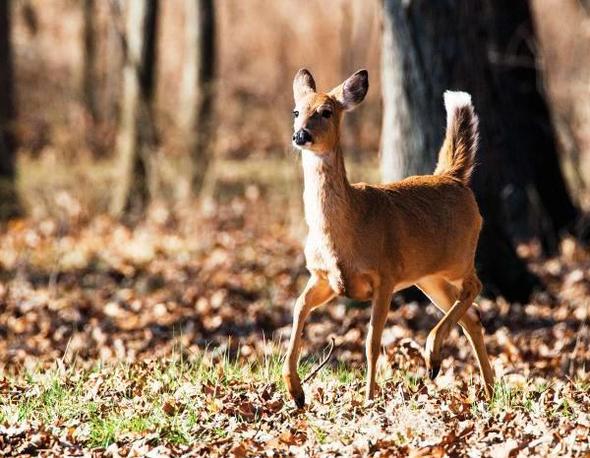
Hunters can help increase deer numbers in
areas by limiting doe harvest where needed.
JEFFERSON
CITY, Mo. – With deer hunters gearing
up for fall hunting, experts with the Missouri Department of Conservation (MDC)
offer their insights on Missouri deer numbers and factors that can impact fall
deer hunting.
According to MDC Deer Biologists Emily
Flinn and Jason Sumners, deer populations in the northern, western, and central
parts of the state remain below desired levels. However, they note that populations
in these areas should be slowly rebounding because of recent cuts in firearms
antlerless permit allocations and hunters voluntarily reducing antlerless
harvest. In southern Missouri, deer populations range from stable to slowly
increasing. In southeastern counties, deer populations have increased.
REGIONAL
RECOMMENDATIONS
NORTHWEST:
Some of the most dramatic deer
population declines in Missouri over the last 10-years have occurred in the
northwest region, explained Flinn. However, because deer populations vary
locally, not all areas have low deer numbers.
“Decreased deer populations are a result
of naturally occurring hemorrhagic disease (HD) outbreaks, previous liberalized
harvest regulations, and land-use changes,” she said. “The most significant
declines have occurred in Atchison, Buchanan, Clinton, DeKalb, and Holt
counties. However, deer populations should be slowly rebounding because of
recent cuts in firearms antlerless permit allocation and hunters voluntarily
reducing antlerless harvest. However, some counties -- including Worth,
Harrison, and Mercer -- continue to exhibit fairly stable harvest trends
compared to other northwest counties.”
Flinn explained that biting midge flies
spread viruses that cause HD. The disease hit the region particularly hard in
2012. In areas where deer numbers are still below desired levels from HD and
other factors, she advised hunters to reduce their antlerless harvests to allow
deer populations to rebound.
“Additionally, if crop harvest is
delayed then it could impact early deer hunting by providing more cover and
food sources, causing deer to be distributed more widely throughout the
landscape,” she said.
KANSAS
CITY AREA: While populations vary
throughout the Kansas City area, rural population declines are a result of
long-term high doe harvest and the 2012 hemorrhagic disease outbreak. Across
much of the Kansas City region, deer numbers should begin to slowly increase
over the next few years with continued conservative antlerless harvest. Flinn
advised that in rural areas where the deer population is not increasing as
quickly as desired, hunters should reduce the antlerless harvest to allow the
population to rebound.
SOUTHWEST: Deer numbers in southwestern counties are slowly increasing
due to conservative antlerless harvest regulations implemented in 2009. The
region includes rural, suburban, and urban areas along with varying habitat.
“So it’s important to be aware of local
conditions when determining the appropriate antlerless harvest in accordance
with population goals,” Flinn said. “As the deer population in the southwest
region increases, some future liberalization of antlerless harvest
opportunities may be necessary to maintain deer populations at desired
levels.”
OZARKS:
Deer numbers in the Ozarks have
remained generally stable to slightly increasing, noted Flinn. In
forest-dominated areas such as the Ozarks, acorn production can significantly
influence harvest based more on where deer are than how many deer may be an
area. Early indications of acorn production for this fall show a good red-oak
production and an average white-oak production.
“Harvest doesn’t always reflect
population numbers in these areas, but often is a reflection of annual acorn
production,” explained Flinn. “For example when acorn production is high, deer
are more widely distributed on the landscape and have to travel less to acquire
food. This can result in a reduced potential for encountering hunters.”
SOUTHEAST:
According to Sumners, deer
populations are relatively diverse in this region due to varying habitat cover
and use, and the impact of harvest regulations. Several counties have
experienced gradual population increases including Bollinger, Butler, Cape
Girardeau, Madison, and Stoddard.
“However, Ste. Genevieve County has
experienced deer population declines due to high hunting pressure, coupled with
a shift in harvest from bucks to does that resulted from the
antler-point-restriction, or APR,” Sumners said. “Therefore, the APR has been
removed, starting with this fall’s hunting season, to allow the population to
grow.”
ST.
LOUIS AREA: Deer numbers in the St.
Louis region have generally remained stable for the past several years. However,
deer populations can vary among and within a county as result of varying hunter
densities and hunting limitations in urban areas.
“In urban areas, archery methods,
hunting access, adequate doe harvest, and public education are important for
successful deer management to lower or maintain deer numbers as needed,”
explained Flinn. “In rural counties, antlerless harvest drives population
trends, so if local deer numbers are below desired levels, then hunters need to
reduce their antlerless harvest.”
NORTHEAST: Deer populations in the northeast region have generally
declined over the last 10-years as a result of hemorrhagic disease (HD) outbreaks
and previous liberalized harvest regulations. However, deer populations should
be slowly rebounding because of recent cuts in firearms antlerless permit
allocation and hunters voluntarily reducing antlerless harvest.
“Biting midge flies spread viruses that
cause HD and disease outbreaks occurred locally throughout several counties in
2012, 2013, and 2015,” Sumners explained. “In areas that have had HD outbreaks,
we encourage hunters to reduce their antlerless harvests this year as needed to
help increase local deer numbers. However, this is not representative of all
northeast areas as deer populations vary locally due to hunter density and
goals, hemorrhagic disease outbreaks, habitat cover and use.”
He added that hunters should evaluate
local conditions and work with neighbors to determine and harvest the
appropriate number of does to meet population goals. Additionally, if crop
harvest is delayed then it could impact early deer hunting by providing more
cover and food sources, causing deer to be distributed throughout the
landscape.
CENTRAL
MISSOURI: “Deer numbers vary among
counties in central Missouri,” said Sumners, “however, most populations in
these areas should be slowly rebounding because of recent cuts in firearms
antlerless permit allocations and hunters voluntarily reducing their antlerless
harvests. Reducing the number of does being harvested will help increase deer
numbers by having more does left to produce more fawns.”
CWD
IN CENTRAL AND NORTHEAST MO
In contrast
to a desire to generally increase deer numbers in central and northeast
Missouri, MDC implemented two new deer-hunting regulation changes in eight
central and five northeast counties starting this fall to reduce or stabilize
deer numbers. The changes are an effort to help limit the spread of Chronic
Wasting Disease (CWD) in the areas. The disease has been found in Adair, Linn, and
Macon counties in northeast Missouri and in Cole County in Central Missouri.
The regulation changes eliminate the
antler-point restriction (APR) and increase the availability of antlerless
permits from one to two in the Department’s recently expanded CWD Management
Zone in northeast Missouri of Knox, Putnam,
Schuyler, Scotland, and Shelby counties. The same regulation changes
were implemented in 2012 in MDC’s original CWD Management Zone in the region of
Adair, Chariton, Linn, Macon, Randolph, and Sullivan counties. The regulation
changes also apply to the central-Missouri counties of Boone, Callaway, Cole,
Cooper, Miller, Moniteau, Morgan, and Osage.
Sumners explained that the APR
regulation change is aimed at no longer protecting young bucks from harvest. “Young
bucks can potentially spread the disease to new areas as they search for new
territories and mates,” he said. “And the additional antlerless harvest
opportunities can help prevent undesired population increases in local deer
numbers in and around where CWD has been found,” said Sumners.
To help slow the spread of CWD, MDC also
strongly encourages deer hunters not to move whole carcasses out of the 11
northeast and eight central counties that make the Department’s CWD Management
Zone.
“CWD can be spread to new areas and
infect new deer through infected carcass parts or soil contaminated by infected
carcass parts,” he explained. “We recommend removing meat in the field and
leaving the carcass behind. If hunters must move a carcass before processing, place
the remaining carcass parts after processing in trash bags and properly dispose
of them through a trash service or landfill.”
MDC also asks hunters and landowner to
not feed deer or place minerals because CWD is transmitted from deer to deer
and can spread more easily when deer gather in unnaturally concentrated
numbers.
Sumners also asks hunters who harvest deer
in the 11 northeast and eight central counties of the MDC CWD Management Zone
to have their deer tested for CWD. Participating locations can be found on
pages 8-9 in the Department’s 2015 Fall
Deer & Turkey Hunting Regulations and Information booklet, or on the
MDC website at www.mdc.mo.gov. It only takes
a few minutes to collect a sample, and there is no charge to the hunter for
testing. Hunters can also receive test results for their harvested deer.
“And report any deer that look sick or
are acting strange to MDC staff,” he added.
MORE
INFORMATION? Get more information on
deer numbers and trends from the MDC Deer Population Status Report at mdc.mo.gov/sites/default/files/resources/2015/06/2014_15deerstatus.pdf.
NEED
PERMITS? Buy and print hunting
permits online at mo.wildlifelicense.com/start.php or through MDC’s FREE Mo Hunting mobile app. Get more
info on Mo Hunting at mdc.mo.gov/mobile/mobile-apps/mo-hunting.
DID
YOU KNOW? Missouri offers some of the
best deer hunting in the country for more than 500,000 deer hunters and deer
hunting is an important part of many Missourians' lives and family traditions.
Deer hunting is also an important economic driver in Missouri and gives a $1
billion annual boost to the state and local economies.
|