|
May 14 training, health care waste, evaporation |
|
|
Payments for 2026/2027 licenses are due April 30. You’ll receive your new license automatically via email shortly after paying your fee.
Sign up for May 14 virtual hazardous waste training
Generators are invited to participate in a webinar about managing hazardous waste in Ramsey County. The training will cover licensing, storage, documentation, emergency planning and more. Attendees will receive a certificate of completion.
Thursday, May 14 | 9 – 11:30 a.m. | Teams Webinar
|
|
How to prepare for routine inspections
 |
Routine inspections are generally unannounced during normal business hours to evaluate real-time compliance. To make sure you’re ready for an inspection, follow these tips.
Take a basic hazardous waste training.
Ramsey County offers online self-paced trainings in English and Spanish, and live trainings are offered twice a year.
Use self-assessments to ensure consistent compliance.
With versions for VSQGs, SQGs and LQGs, these checklists are based on what is evaluated during an inspection.
Designate a backup point person.
If hazardous waste responsibilities are assigned to one person, choose a backup who can fill in during an inspection, understands waste management at your facility, and can access disposal records.
Make sure documentation is available and organized.
At least three years of disposal records and weekly container inspections must be accessible on-site. Depending on your generator size, you also may need to retain records for staff training and emergency preparedness. Learn more
Know how an inspector will identify themselves.
Upon arrival, an inspector will introduce themselves by stating their name, showing their Ramsey County-issued badge and explaining the purpose of the visit. You can contact Ramsey County Environmental Health at 651-266-1199 to verify as well.
Contact your inspector anytime with questions.
You don’t have to wait for an inspection to ask questions. Feel free to email or call your inspector as needed. They are a year-round resource.
Tips for managing hazardous waste in health care
Although health care settings are busy with many competing priorities, proper hazardous waste management is very important. The following tips can help.
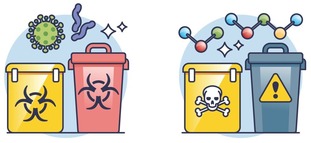
Know the difference between infectious and hazardous waste. Infectious (or biohazard) waste poses a risk because of its biological properties, such as containing regulated bodily fluids or contaminated sharps. This waste is often stored in red bags or containers (learn more).
Hazardous waste poses a risk due to its chemical or physical properties. A waste is hazardous if it has one of six characteristics (flammable, corrosive, etc.) or is on one of five lists (learn more). Hazardous waste in health care settings usually refers to pharmaceutical, lab or building maintenance wastes.
Both hazardous and infectious waste should never go in the regular trash.
Assume all pharmaceutical waste is hazardous unless evaluated as otherwise. Use this flow chart to evaluate waste medicine. There are special considerations for chemotherapy drugs (page 4), controlled substances (page 6) and reverse distributed pharmaceuticals.
Label pharmaceutical waste containers with the words “Hazardous Waste: Pharmaceutical Waste”, and make sure they are closed. Often, the sliders or flip tops on “black boxes” are left open. You do not need an accumulation start date.
Keep disposal records for at least three years. All hazardous waste shipments need a hazardous waste manifest. You can access your manifests on the EPA’s e-Manifest system.
Bookmark factsheets from the Minnesota Pollution Control Agency on pharmaceutical waste and other hazardous health care wastes. You don’t need to remember it all. You just need to know where to look.
Regulation Reminder
Don’t intentionally evaporate hazardous waste.
In general, hazardous waste cannot be disposed of by evaporation, such as leaving a container open. There are some exceptions for water based hazardous wastes without volatile hazardous substances (see MN Rule 7045.0665 Subp. 1b). A small amount of natural evaporation during routine handling of hazardous waste is okay. Learn more about hazardous waste regulations
|
|
News Flash
Celebrate Earth Day at the Ramsey County Environmental Center on April 18. Ramsey County is hosting an Earth Day open house as the Environmental Center marks one year of operation. The event is Saturday, April 18, from 9 a.m. to 3 p.m. at the Environmental Center. Learn what happens after accepted items are dropped off and enjoy activities, like story time and upcycled crafts. All are welcome. Learn more
Use e-Manifest to access your manifests. Small and large quantity generators must have an active account on the EPA’s e-Manifest system. Very small quantity generators are strongly encouraged to have an account. The official record for all hazardous waste manifests is stored in e-Manifest. Generators are responsible for ensuring their waste information is recorded accurately in e-Manifest.
Did you know?
Developed by the Environmental Protection Agency, waste codes identify hazardous waste characteristics and components. For instance, D001 indicates a waste is flammable.
Pro tip: Bookmark a reputable website that lists waste codes (see example). Use Ctrl+F to quickly find what a waste code means, or to find a waste code based on a known characteristic or chemical.
|
|
|
April 18 | 9 a.m. - 3 p.m.
Earth Day Open House
Ramsey County Environmental Center
April 30
2026/2027 license fees due.
Pay now
May 1
2026/2027 license year begins.
Post your new license.
May 14 | 9 - 11:30 a.m.
Virtual hazardous waste training
Register
|
|
Hazardous Waste
Technical Assistance
Grants
Contact Us
Inspector Territories
-
Terese Bordeau: 55108, 55421, 55449.
-
Nate Gahr: 55112, 55113, 55432.
-
Mindy Lang: 55110, 55126, 55127 (Contact RamseyHazWaste@ramseycountymn.gov.)
-
Madison Staecker: 55114, 55116, 55117, 55414.
-
Elizabeth Walsh: 55107.
-
Fei Xiong: 55101, 55102, 55103, 55104, 55105, 55130.
-
Bee Yang: 55106, 55109, 55118, 55119, 55144.
|
|
|
|
|