The Minnesota legislature approved the 2025 Pension and Retirement Bill, Senate File 2884, and Governor Walz signed the bill on May 23, 2025.
The bill includes the following changes to PERA plans:
Privatization Withdrawal Liability
Effective July 1, 2027, privatizing entities will be assessed a withdrawal liability that covers the entity’s unfunded liability.
Probation Officer & 911 Telecommunicators New Plan Working Group
The bill established a working group to consider a new plan for public-safety-adjacent positions, such as probation officers and 911 telecommunicators. The working group must complete their recommendation about a new plan by January 2026.
Other Administrative Changes Affecting Employers
-
Membership Eligibility Salary Threshold. Clarifies that defined benefit plan membership is mandatory from the date of hire for employees who are expected to earn more than $425 in a month. All full-time and most part-time employees must be enrolled immediately if no other exclusions apply.
-
Election Period for Optional Membership. Clarifies that the 30-day period to elect optional coverage applies to both defined benefit plans and the Defined Contribution Plan (DCP).
-
Elected Public Officials. Amends language so that the 30-day period to elect optional coverage begins when an individual takes office, rather than the date they are elected.
-
Optional Membership Election Forms. Clarifies that completed DCP election forms must be received by PERA within 60 days of the individual taking office or starting employment. Employers have 30 days to submit the completed membership form after the individual’s 30-day election period.
No Additional Contribution Rate Changes
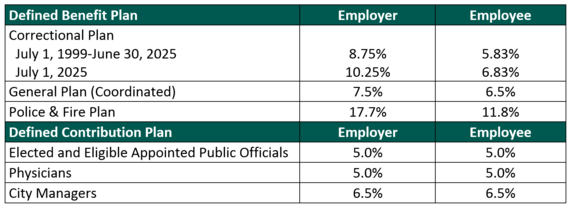
There were no contribution rate increases for any PERA plan during this session. The July 1, 2025 Correctional Plan increase was passed in the 2024 session. Refer to the article “Contribution Rate Increased for Correctional Plan July 1, 2025” in this newsletter for more information about that change.
|
As part of the legislation passed during the 2024 session,
- Employer contributions for the Correctional Plan increased by 1.5%, from 8.75% to 10.25%.
- Employee contributions for the Correctional Plan increased by 1%, from 5.83% to 6.83%.
Rates for the General (Coordinated), Police & Fire, and Defined Contribution Plans did not change.

Employers must determine if new employees are current PERA benefit recipients; employees who return to governmental employment while collecting a benefit payment could be excluded from PERA’s defined benefit plans (DBPs), such as the Coordinated, Correctional, and Police & Fire Plans.
To determine if a new employee is exempt,
- Use the Benefit Recipient Search tool in ERIS to determine if an employee receives a PERA benefit.
- Employees of any age can receive benefits.
- Report the earnings of certain benefit recipients in PERA’s Exempt Plan (Plan ID 99).
- The Exempt Plan is not for all employees who are excluded from PERA participation. Refer to the inclusion and exclusion information below for eligibility guidelines.
The Exempt Plan includes:
-
Certain re-employed PERA disabilitants. Members receiving monthly disability benefits from PERA can return to governmental service; however, the individual may or may not pay PERA contributions, depending on the type of disability benefit they receive. Refer to the Employer Manual, Chapter 3, pages 22–23 for details.
-
Employees working under the Phased Retirement Option (PRO). The PRO allows Coordinated members to begin collecting a PERA benefit as early as age 62 while working a reduced schedule. Employers choose to offer the PRO to eligible employees. The PRO creates a flexible environment where employees can transition into retirement and employers can better navigate the necessary knowledge transfer. Refer to Employer Manual, Chapter 6, pages 15–16 for details.
-
Certain PERA retirees. PERA retirees are members of the Exempt Plan if they returned to work in a DBP-eligible position and are younger than full Social Security Administration (SSA) retirement age.
The Exempt Plan excludes:
-
Retirees who reach full SSA retirement age. However, employers can continue reporting employee earnings if it is difficult to stop the process in their system.
-
Members who terminate from a PERA DBP-covered position. In that case, employers must enter the termination for the Exempt Plan in ERIS.
PERA must monitor member earnings of retirees who returned to work in a DBP-eligible position and are younger than full SSA retirement age to ensure they do not exceed the annual limits set by the SSA. If a member’s earnings exceed the limit, their monthly PERA benefit must be reduced or possibly suspended.
- For each $2 over the limit, there is a $1 reduction in benefits.
- Reductions are payable to the retiree at a later date.
- The SSA earnings limit can change annually. To find current limits, refer to the Working After Retirement publication.
DCP Contributions May Still Be Required
DCP participation with a governmental subdivision is permanent for all current and future service with the same governmental subdivision.
Retired PERA members must continue paying DCP contributions if
- the member retires from a PERA DBP (including the Coordinated, Correctional, or Police & Fire Plans) but remains active in the DCP position and
- the member receives DCP-eligible earnings working for the same governmental subdivision they worked for while enrolled in the DCP.
If a DBP retiree or disability recipient begins a DCP-eligible position and previously had PERA coverage with the same employer, they must participate in the DCP.
Exceptions to DCP Participation:
- Elected county sheriffs who are retired Police & Fire Plan members with the same county are excluded.
- Positions that would otherwise require Coordinated Plan membership may also be an exception. Contact PERA with any questions.
- PRO participants must not serve as public officials.
|

Two important annual reports are due this summer from school employers: the Annual Leave Report and the Annual Exclusion Report.
Annual Leave Report Due July 31, 2025
Employers with one or more active PERA member(s) must complete the Annual Leave Report. The report must list all authorized leaves that occurred in fiscal year 2025 that resulted in any missed or ineligible salary. Employers must complete an Annual Leave Report even if there were no employees with an authorized leave during the year.
To learn more about annual leave reporting, refer to the following resources:
Annual Exclusion Report Due August 31, 2025
All PERA-eligible school employers must complete the Annual Exclusion Report. The report must list employees and elected officials who worked any amount in fiscal year 2025 and did not have PERA contributions withheld from their earnings.
The Annual Exclusion Report must list all public officials who are not participating in PERA. Use exclusion code 201 for elected officials, such as school board members.
To learn more about annual exclusion reporting, refer to the following resources:
Questions About the Reports?
Email eligibility@mnpera.org or call the employer response line at 651–296–3636 or 1–888–892–7372, then select option 3 for Eligibility.
|
Individuals are not excluded from PERA plans based on their age. However, some membership exclusions are more common at certain ages. If no exclusions apply, individuals must participate in PERA.
Individuals are excluded from PERA membership if:
- They are a retired member of a PERA defined benefit plan (DBP).
- PERA members who receive benefits from Social Security, TRA, or MSRS but are not retired from a PERA DBP must participate in PERA if no other exclusions apply.
- PERA members who reach full Social Security retirement age but are not retired from a PERA DBP must participate in PERA if no other exclusions apply.
- They are younger than age 23 and a full-time student.
- Employees younger than age 23 who are not full-time students must participate in PERA if no other exclusions apply.
To use the exclusion for a full-time student under the age of 23, employers must verify the employee's full-time student status. To verify an employee’s full-time student status, the employee must provide one of the following to the employer each semester:
Employers must keep this information on file. Do not send it to PERA unless requested.
Refer to the Employer Manual, Chapter 3 for more information about exclusions.
- All employee exclusions start on page 7.
- The full list of exclusion codes starts on page 38.
|