|
February 2015
The Basin Alliance
for the Lower Mississippi in Minnesota (BALMM) will meet Wednesday, Feb. 18,
from 9 a.m. to noon at the People’s Energy Cooperative in Oronoco. (NOTE
LOCATION CHANGE)
Agenda as follows:
-
9 a.m.: Southeast Minnesota Nitrogen BMP Outreach Program, Dawn Bernau, Water Quality Coordinator, Minnesota Dept. of Agriculture
- 9:45 a.m.: University of Minnesota – Extension Southeast Regional Sustainable Development Partnership, Erin Meier, Director
- 10:30 a.m.: Break
- 11 a.m.: Estimating the Costs of Nitrate Groundwater Contamination in Southeastern Minnesota, Jesse Gourevitch, Research Scientist, Natural Capital
Project University of Minnesota
- Noon: Adjourn

Groundwater contaminated by nitrates is a growing concern in southeast
Minnesota. Reducing this threat by helping crop producers is the goal of the
Southeast Minnesota Nitrogen BMP Outreach Program. At the Feb. 18 meeting, Dawn
Bernau, water quality coordinator for the Central Karst Region of the Minnesota
Dept. of Agriculture, will explain how the project will help producers
adapt nitrogen fertilizer BMPs. Assistance will consist of:
-
On-farm nitrogen fertilizer BMP demonstrations;
- On-farm nitrogen management assessments;
- Advanced scientific on-farm nitrogen fertilizer BMP trials; and
- Farmer-to-farmer nitrogen management learning groups.
This program will be active in Goodhue, Wabasha, Olmsted, Winona, Fillmore,
and Houston counties. The two nitrogen management specialists housed at the county
SWCDs will also work on this project. A portion of the funding for this project
helps support these two positions with half their time dedicated to this
project.
|
The Regional
Sustainable Development Partnerships connect greater
Minnesota communities to the University of Minnesota in order to help solve
problems and take advantage of new opportunities. As part of University of
Minnesota Extension, these partnerships bring together local talent and resources with
University of Minnesota knowledge and seed funding to drive sustainability in
four areas:
-
Agriculture and food systems;
- Tourism and resilient communities;
- Natural resources; and
- Clean energy.
Erin Meier, director of the Southeast Regional Sustainable Development Partnership,
will speak on the local effort at the Feb. 18 BALMM meeting. This partnership
has served the region since 1997. The mission is to work with citizens in
southeastern Minnesota to create and sustain healthy ecosystems, strong local
economies and vibrant, self-reliant communities. The partnership supports
projects that demonstrate public purpose and are committed to building
partnerships that connect the citizens of southeastern Minnesota to local
assets and the educational, research and outreach resources of the University
of Minnesota.
At the Feb. 18 BALMM meeting, Jesse
Gourevitch, research scientist with the University of Minnesota Natural Capital Project,
will discuss estimating the costs of nitrate groundwater contamination in southeastern
Minnesota. This research presents spatially-explicit cost estimates for
groundwater contamination due to nitrogen fertilizer application. Using these
damage cost estimates, decision-makers can better target policy interventions for
improved nitrogen fertilizer management.
Read
about the University of Minnesota study that estimated that residents,
businesses and governments in the southeast region could be forced to pay up to
$12 million dollars in the decades ahead to deal with a potential new surge of
nitrates in groundwater on the Minnesota
Public Radio website.
The Minnesota Pollution Control Agency (MPCA) continues accepting applications for Clean Water Partnership (CWP) funding. These grants and loans are for local government units interested in leading a nonpoint source pollution control project for protection or restoration of Minnesota’s water bodies. Applications are due March 6.
As part of a grants framework pilot program, the 2015 CWP Notice of Grant Opportunity is being published electronically via the CWP website and Waterfront Bulletin. In addition, application and related information will be accepted through an email address listed in the notice. Note, as part of the pilot, the MPCA is not using the State Wide Integrated Financial Tools (SWIFT) system for publishing and response as it has for past funding rounds.
The MPCA uses the CWP program to support the leadership efforts of local units of government and citizens to address nonpoint sources of pollution. The programs provide financial and technical assistance to study water bodies with pollution problems, develop action plans to address the problems, and plan implementation to fix the problems. Priorities for funding this year will be focused on protection projects, loan projects requesting up to a $10,000 grant for administrative costs, and Green Infrastructure loan projects.
Nonpoint pollution comes from many individual sources, such as storm sewers, construction sites, animal feedlots, paved surfaces, failing septic systems and over-fertilized lawns. When taken together, these sources contribute huge quantities of phosphorus, bacteria, sediments, nitrates and other pollutants to the environment. They also represent the largest combined threat (an estimated 86 percent) of the state's water pollution.
For further information see the notice on the MPCA’s website at Financial assistance for nonpoint source water pollution projects: Clean Water Partnership and Section 319 Programs.
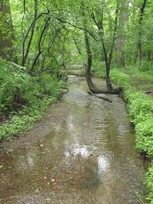 Valley Branch Creek, a major tributary to the St. Croix River along the eastern edge of Minnesota, offers exceptional water quality. Its riparian corridor – plants growing along the creek – remains intact (photo at right), helping to filter pollutants from runoff to the creek and providing habitat for fish and wildlife. Compared with many streams in the state, this cold-water creek supports higher quality communities of fish and other aquatic life. In fact, it's one of the better trout-producing creeks in Minnesota.
In south-central Minnesota, King Creek (photo below) is a tributary to the South Fork Crow River. To facilitate drainage, people have legally altered its hydrology over several decades. These changes decrease its potential to support higher quality aquatic life.
|
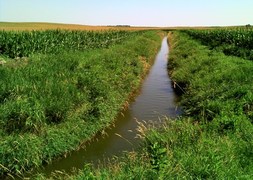 These two creeks differ in location, historical changes, ecology and surrounding land uses. Yet, under current rules, both are expected to meet the same water quality goals of supporting aquatic life and recreation or being fully “fishable and swimmable.”
The MPCA is proposing to change the state’s water quality rules to allow a more tailored approach. The intent is to better ensure protection of high-quality waters and set attainable goals for waters affected by past practices such as ditching. This means expectations for the health of the biological community, and associated pollution controls, will depend on how streams are classified within the Tiered Aquatic Life Uses (TALU) framework.
|
Minnesota has seven beneficial use classifications for streams, including drinking water, aquatic life, recreation, industrial, and agriculture. Under current rules, all streams, including ditches, must meet the Class 2 standards of supporting aquatic life and recreation.
Under TALU, the agency would divide all Class 2 streams into the following categories, based on the health of fish and macroinvertebrate (bugs and creatures like snails) along with a habitat assessment:
- Exceptional use: High quality waters with fish and invertebrate communities at or near undisturbed conditions.
-
General use: Waters with good fish and invertebrate communities that meet or should meet minimum goals.
- Modified use: Waters with legally altered habitat that prevent fish and invertebrate communities from meeting minimum goals.
The proposed changes would also:
- Clarify how goals apply to each TALU classification.
- Incorporate numeric goals for fish and macroinvertebrates into rule.
- Re-format the list of existing beneficial uses for specific waters.
The changes would not:
- Eliminate or change current chemical standards for water quality.
- Create additional authority to regulate ditches.
- Relax pollution controls or remove waters from the list of waters known to be impaired.
The agency started work on TALU several years ago and is now drafting the rule changes for public comment in spring 2015. The MPCA’s watershed approach makes this method possible by examining the biological health of streams in addition to chemical and physical properties. The agency now follows a 10-year cycle of intensely examining the health of major watersheds, including fish and macroinvertebrates. By examining a stream’s biological health, scientists and local partners can determine the impact of human changes on aquatic resources.
For more information, visit the TALU framework webpage.
| 



