October 2015
The Basin Alliance for the Lower Mississippi in Minnesota (BALMM) will meet Wednesday, Oct. 15, from 9 a.m. to noon at the Minnesota Pollution Control Agency (MPCA) office, 18 Wood Lake Drive S.E., Rochester.
Agenda as follows:
-
9 a.m. – "Recent Minnesota DNR Groundwater Efforts," Scot Johnson, Southeast Groundwater Specialist, Minnesota DNR
-
10 a.m. – Break
-
10:20 a.m. - "Springshed Assessment and Mapping in Southeast Minnesota," Jeff Green, Springshed Mapping Hydrologist, Minnesota DNR
-
11:20 a.m. – "Watershed Updates," Donna Rassmussen of the Root SWCD, Bev Nordby of the Mower SWCD, Sheila Harmes of the Whitewater Watershed Project and Laurie Svien of the Zumbro Watershed Partnership
-
Noon - Adjourn
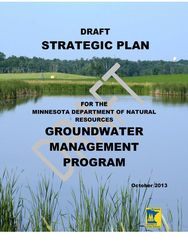
"Water is critical to Minnesota’s economies and ecosystems. Minnesota has a well-deserved image of having abundant water resources; nevertheless, water is not evenly distributed across the state. Despite our popular image, water is becoming scarce in parts of Minnesota," reads the prologue to the Minnesota Dept. of Natural Resources (DNR) strategic plan for its groundwater management program.
"Unprecedented water use conflicts are arising between businesses, towns, and residents. Periods of drought have accentuated these issues and provided a ‘wake-up call’ for Minnesota. In parts of the state businesses are at risk of shutting down operations in the face of water shortages. Wells are drying up as drought increases competition for scarce water. Water-based recreation and valued ecosystems are being impacted.
"Nevertheless, in most areas of the state we are not yet in 'crisis' mode when it comes to water availability. We have time to address these issues and ensure that Minnesota’s economies and ecosystems have adequate water supplies in the future."
Scot Johnson, southeast Minnesota groundwater specialist for the DNR, will speak about the draft plan at the Oct. 15 BALMM meeting. The draft plan and surveys about it are available on the DNR website.
Johnson will also discuss DNR approval of high capacity well installations, silica sand mining trout stream setback permits, and expansion of the DNR observation well network.
|
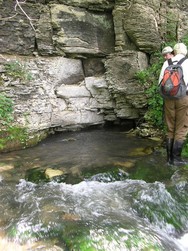 At the Oct. 15 BALMM meeting, DNR hydrologist Jeff Green will speak about the recent study he was a lead author on: "Springshed Assessment Methods for Paleozoic Bedrock Springs of Southeastern Minnesota."
"Southeast Minnesota’s many springs provide baseflow to all of its streams and rivers. The flow from those springs comes from precipitation. It reaches the springs by a variety of paths through the groundwater system. Surface water that flows varying distances before sinking can be mapped with watershed mapping tools, most recently LiDAR elevation models. Groundwater recharged by precipitation infiltrating more or less directly to the shallow groundwater flow system can be mapped with dye tracing, hydrogeologic and geomorphic mapping, and continuous water-quality monitoring," according to the report. "Regional groundwater flow that may have recharged at more distant locations and at much earlier times is the most problematic to map."
|
Environmental Initiative and the seven state agencies responsible for implementing the Clean Water Fund have completed "Minnesota's Clean Water Roadmap." The roadmap articulates high-level goals for the 25 years of the Clean Water Legacy investment. In combination with other, including local water plans, the agencies will use the roadmap to guide their activities under the Clean Water Fund to protect and restore Minnesota's water resources. The roadmap is posted on the MPCA website. The agencies will be presenting the roadmap Oct. 20 at the Clean Water Council meeting.
 The Whitewater River Watershed Project will hold a citizen-led conversation at a dinner Nov. 12 to gather input on a proposed 10-year action plan for the Mississippi River-Winona watershed. This action plan is the culmination of a holistic approach to protecting and restoring streams in the watershed, which included:
- Intensive water monitoring throughout the watershed;
- Assessing the waters to determine if they meet water quality standards;
- Identifying conditions that stress stream life; and
- Drafting strategies to protect healthy waters and restore impaired waters.
The dinner, from 5-8:30 p.m., will be held at the Tau Conference Center, 511 Hilbert St., Winona. There is no charge for dinner but an RSVP to 507-457-6521 is required. For details, visit the watershed project’s website. Seating is limited so call soon if planning to attend.
The watershed approach and dinner are funded by the Clean Water Legacy Amendment, with the MPCA as a partner.
|
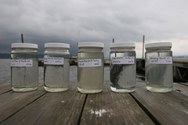
The MPCA is asking for your data to help assess the condition of our lakes and streams and build a national database of water quality.
The agency is specifically interested in the following priority watersheds because MPCA staff will be determining whether these water bodies meet state water quality standards in early 2015:
- Two Rivers
- Snake River
- Lake Superior – North
- Rum River
- Mississippi River – Headwaters
- Minnesota River – Mankato
- Watonwan River
The agency is also looking for:
- Data on the Mississippi River from the headwaters to St. Anthony Falls.
-
E. coli data for these large rivers: Minnesota, Rainy, Red, St. Croix, and Mississippi.
-
E. coli data for Lake Superior public beaches.
- Toxics data -- nitrates, pesticides, trace metals, and mercury – for streams throughout Minnesota.
If you have data from outside a priority watershed or one of these areas, the MPCA will also accept it. The agency will use additional data to:
- Help plan for future monitoring efforts including what to monitor for and where to monitor.
- Identify pollutant “stressors” that are causing or contributing to problems or threats to fishing, swimming, and recreational uses.
- Evaluate the success of ongoing activities to protect and restore water quality.
Deadline: Submit project, lab, and field data now through Nov. 3, 2014.
Deadline: By Dec.15, 2014 you will need to review the data entered.
Find out more on the MPCA's surface water data website.
Your role in collecting these data is important to Minnesota’s effort to identify impaired waters, as well as those waters in need of additional protection.
For more information on submitting data:
- Nancy Flandrick, 651-757-2361 (St. Paul, Rochester, and Mankato Regional Offices)
- Jean Garvin, 651-757-2378 (Willmar, Marshall, and Detroit Lakes Regional Offices)
- Lynda Nelson, 651-757-2601 (Duluth and Brainerd Regional Offices)
For more information about how the MPCA uses your data to assess lakes and streams see the MPCA’s water quality assessment website.
|
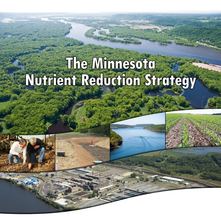 The report of the Minnesota Nutrient Reduction Strategy is completed and posted on the MPCA website. The report will guide the state in reducing excess nutrients in waters so that in-state and downstream water quality goals are ultimately met. Fundamental elements of the strategy include:
- Clear goals;
- Building on current efforts;
- Prioritizing problems and solutions;
- Supporting local planning and implementation; and
- Improving tracking and accountability.
Successful implementation of the strategy will require broad support, coordination, and collaboration among agencies, academia, local government, private industry, and citizens. Along with 11 other states represented on the Gulf of Mexico Hypoxia Task Force, Minnesota committed to develop a strategy to protect in-state waters and the Gulf of Mexico. An interagency coordination team, representing 11 agencies, helped develop the strategy.
|
The website for the Minnesota Agricultural Water Quality Certification Program has some new material, including a short video with interviews of farmers participating in several pilot watersheds. The voluntary program relies on farmers and agricultural landowners taking the lead in implementing conservation practices that protect our soil and water. Those who implement and maintain approved farm management practices will be certified and in turn obtain regulatory certainty for a period of 10 years. A new edition of the brochure and the summer 2014 newsletter can be found on the main page. There is also a link to the August issue of Prairie Grains magazine with an article by Dept. of Agriculture Assistant Commissioner Matthew Wohlman.
Mississippi River states prepare for an oil spill – not if, but when on Minnesota Public Radio
Little silica found in Winona air in the Rochester Post-Bulletin
Hikers, rejoice: New state forest land opens in Winona County in the Winona Daily News
Outstate cities plan to challenge state water regulations in the Star Tribune
Long-term approach, short-term results for City of Adams in MPCA’s On Point newsletter
Minnesota continues nation-leading effort to reduce mercury to protect Minnesotans’ health on the MPCA website
|




