|
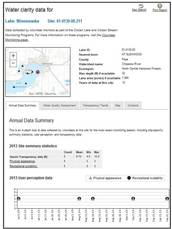 You can now view your 2013 Citizen Lake and Stream Monitoring Program data on the Citizen Monitoring Individual Site Report Tool. Use the clickable map or text search to find summary report information for every Citizen Lake or Stream Monitoring program site monitored during 2013. You can also link to water quality assessment information for your lake or stream, and review trend results to find out if transparency is improving or declining over time on your favorite waterbody.
For individuals who have requested paper communication, we will mail your individual site reports soon. If you have a chance to view the online presentation, you'll see some added features, such as maps, which aren't available in the paper format.
|
|
A big thanks to all the participants of this year's photo contest. You shared your photos with us and we were amazed with the results! We received some fantastic submissions, making the task of picking a winner quite difficult. CMP volunteers are a talented group with some serious photography skills!
We finally decided to pick two winners, each highlighting a different, yet important, aspect of how we value our waters.
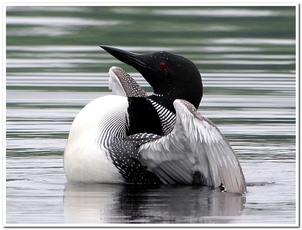
The first virtual trophy goes to Ed Steblay for his beautiful loon-in-motion photo.
|
|
 |
 |
|
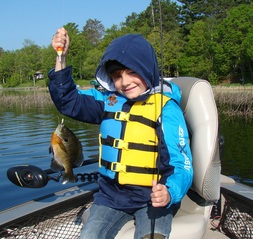
The second virtual trophy goes to Le Roy Bertsch for the wonderful photo of his grandson, Ayden, fishing on Inguadona Lake.
Keep those photo coming! We plan on using many of this year's photo contest submissions in future CMP newsletters and on our CMP web page. We will continue to add to our catalogue any additional photos you share with us (please let us know any limitations you would like to place on the photo's use).
We will credit the photographer when we use their photo, so be on the look out for your name and photo to appear in future publications!
|
|
Now that the 2014 monitoring season is swinging into full gear, we thought it would be a good time to provide a few sampling reminders to ensure that your data is the best quality possible. We posted a set of sampling reminders for both CLMP and CSMP on our website (Go to the "Toolbox" tab and scroll down to "Sampling reminders"), so that you can easily refer to them whenever you like .
You can also download the Electronic Data sheets for both CLMP and CSMP so that you can record your data electronically throughout the monitoring season (See 'Electronic data sheets available' on the right hand side of the page). This will make it easier to submit your data to us via email in the fall by reducing the amount of time spent on data entry at the end of the monitoring season.
Remember, if you ever have any questions about how to take your lake or stream measurements, don't hesitate to contact us at clmp.pca@state.mn.us (lakes) or csmp.pca@state.mn.us (streams).
|
|
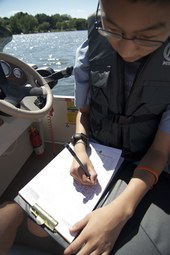 |
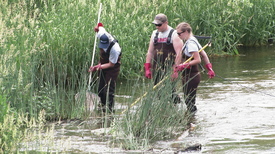 Monitoring crews from the Minnesota Pollution Control Agency (MPCA) are beginning the seventh of a ten-year effort to assess the condition of rivers, streams, and lakes in Minnesota. The majority of this summer's monitoring activities will take place in nine of Minnesota’s 81 major watersheds. Each watershed is comprised of a network of interconnected streams, lakes, and wetlands. The intent of this monitoring effort is to develop a complete picture of conditions of the various water bodies within each watershed.This work is funded by the Clean Water Fund from the constitutional amendment passed by voters in 2008.
To find out which watersheds the MPCA crews will be working in this year and to learn more about the monitoring, see the entire story on the MPCA website
|
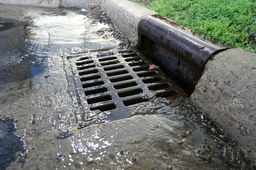
Concerned about stormwater run-off in your area? Worried about failing septics? The Minnesota Pollution Control Agency and the Minnesota Public Facilities Authority coordinate federal and state funding for municipal-sponsored stormwater and wastewater projects that protect or restore water quality. The funding runs on an annual cycle, with applications due each March, so now is the perfect time to start reaching out to your neighbors and talking with your local public officials to determine the most important projects for your community.
A mix of grants and low interest loans are available through the MPCA and other government entities. Previously funded projects include:
Wastewater: Septic surveys, wastewater planning, failed septic system fixes, new connections to existing sewer lines, cluster septic systems.
Stormwater: Rain gardens, treatment systems (ponds, bio retention swales), green streets.
As Citizen Lake and Stream Monitors you are acutely aware of how wastewater and stormwater management can affect the health of your favorite waters. If you are interested in seeing projects take place in your community, work with your neighbors, communicate your ideas at the city and county level and encourage them to apply for funding next year. Applications are due on the first Friday in March of each year. Funding could be available by the following September.
For further information on available funding, please visit the MPCA’s Wastewater and Stormwater Financial Assistance webpage. For specific questions, please contact Bill Dunn at bill.dunn@state.mn.us or (651) 757-2324.
|
 For 25 years, Jim Christianson and his wife have lived part time on Round Lake in Aitkin County, regularly making the 160 mile drive from Bloomington to spend time on what Jim describes as “a very clear, very nice lake.” With mostly sandy shores, good fishing and a steady number of year-round residents, the lake has provided not only a strong community, but a connection to the outdoors that both he and his wife desire.
Before moving to Round Lake Jim visited the MPCA’s St. Paul office to find out more about the lake’s water quality. Laughing as he relayed the story, Jim was promptly asked by the MPCA if he would like to take water clarity readings on the lake – getting more than he bargained for on his first trip to an MPCA office! Jim agreed to take the clarity readings and he’s still doing it 25 years later. “It’s been getting a little tougher the last few years, but I wanted to try and get at least 25 years in. I had an idea that it was a pretty clear lake and the program proved it out,” said Jim.
A born and bred Minnesotan who has spent countless hours fishing on Minnesota’s lakes, Jim is worried about new threats such as invasive species. “Too many people are not concerned about it. So far we know we don’t have any in our lake, but who knows.”
At 87 years old Jim still regularly rows out to his site to take clarity readings. He’s not sure how much longer he and his wife will continue to make the trip between Bloomington and their lake home, but for now he’ll continue to take clarity readings on Round Lake, all because someone asked him to.
|
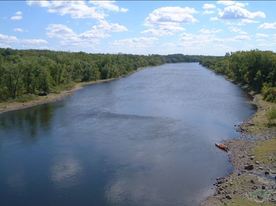 The Nebraska Watershed Network, an organization in conjunction with the University of Nebraska at Omaha (UNO) is launching "Lil' Miss Atrazine" - a study designed to use crowd sourcing to conduct atrazine tests along the entire Mississippi River all within one day. Atrazine is the second most commonly used herbicide in the U.S., specifically targeting broad leaf weeds. A simple strip test has been designed to test for atrazine at the US EPA's drinking standard of three parts per billion (ppb) or three micrograms per liter.
Atrazine can be detected in late spring and early summer, due to the time-frame in which it is applied to crops and coinciding with seasonal rains. Because of this, the study will be conducted near June 1, 2014. If the crowd sourcing is successful, UNO hopes this model of data gathering will be used for further studies on indicators or pharmaceuticals in other watersheds.
If you are interested in learning more about this monitoring opportunity, please send an email inquiry to unonwn@unomaha.edu or contact Jessica Edwards directly at jessicaedwards@unomaha.edu.
|
|
|




