|
Do you stockpile materials at your
facility, or have questions about whether you do? Some of the more common examples of material
stockpiling include:
-
Auto
parts in salvage yards;
-
Appliances
at solid-waste facilities;
-
Logs
and lumber at sawmills, flooring mills or wood-preserving facilities;
-
Corn,
sugar beets
or potatoes at food-processing or land-transportation and warehousing facilities;
-
Sand or salt for road de-icing at government or transportation
facilities;
-
Topsoil/soil/gravel from excavations at sand and gravel
facilities; and,
-
Coal from steam-generating facilities
If your facility
stockpiles these or similar raw materials, proper management and implementation
of BMPs is necessary to prevent
stormwater from washing across the exposed stockpile, becoming
contaminated and carrying particulates and contamination off the facility
property.
Some of the easiest
BMPs to implement can be the most effective in managing any type of raw
material stockpile:
-
Impermeable berms or channels located ‘upstream’ to route
surface flows away from the stockpiled material;
-
Berming the stockpile on all sides with a ramp for truck and
equipment access;
-
Curbing along the perimeter of the area to prevent
the run-on of uncontaminated stormwater from adjacent areas as well as runoff
of stormwater from the stockpile areas;
-
Covering small stockpiles at all times when work with the
stockpiles is not occurring;
-
If the stockpiles are so large that they cannot
feasibly be covered and contained, implement erosion control practices at the
perimeter of your site and at any catch basins to prevent erosion of the
stockpiled material off-site
Sample BMPs for
managing salt storage:
-
Place an impervious pad under salt storage and work
areas and cover the salt piles
-
Sweep up any salt that is tracked out of the salt-storage
area;
-
For cold weather activities, manually clear
sidewalks, driveways and parking lots prior to applying a de-icer; this activity may reduce or
eliminate the need for de-icing products;
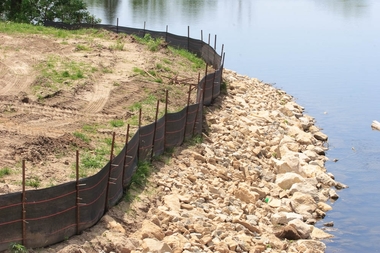
If you will be stockpiling
materials only for a very short duration of time (< 30 days), temporary BMPs
may be appropriate:
-
Tarps
-
Silt fence filters
installed around the perimeter of stockpiles
Note: These temporary measures are not substitutes for adequate
long-term coverage.
Though there are no major updates to report for the 2015
Industrial Stormwater Multi-Sector General Permit (see the June 2013 newsletter
article for the latest information), here are some developments related to
guidance and forms:
-
Stormwater
Monitoring Report forms: We expect
to offer electronic reporting (though this likely won’t happen before
2015).
-
Application: We are encouraging permittees to apply
electronically; this process will provide a faster turnaround for permit coverage.
We are adding commonly-asked questions and examples for permittees applying for
the No Exposure exclusion in order to clarify exposure sources that actually
occur at existing facilities.
-
Administrative
Change Form: We are evaluating whether
this form may used only for truly administrative changes such as facility name
and contact information.
Technical/non-administrative changes may require a new application, such
as adding/removing SIC codes, adding/removing monitoring locations (stay tuned;
this is still being discussed).
-
Sampling
Manual: We want to clarify requirements for holding times, temperatures,
instructions on what to do if a sample jar breaks after sample is collected and
before it is sent to the lab (and it stops raining).
If there are other guidance/form changes you would like to
have us consider, please contact Melissa
Wenzel or call: 651-757-2816. We
would like to hear from you and learn what it could take to make compliance
with the Industrial Stormwater Multi-Sector General Permit easier!
IMPORTANT! Use
the Administrative Change form when your facility has a contact change, a
monitoring location change or has new industrial activities. Find this form
here Administrative
Change Form. Take
time now to review your “Facility Details/Virtual Permit Information” page of
the Industrial Stormwater Permit
Information Access page to make sure your permit application information is
up to date. If not, fill out the administrative change form today.
NEW! The administrative change form may now be submitted
electronically! Just like the 2012
Annual Report for permittees, the administrative change form is a fill-inable
PDF document with a “Submit” button at the end.
If the “Submit” button doesn’t respond (which is usually related to the
permittee’s computer firewall settings), follow the form’s instructions to save
and email the document to the program.
Because the Industrial Stormwater Program communicates via
email, up-to-date facility site contact and email address information is very
important. Critical messages (annual
report mailings, “time to re-apply for permit coverage” messages) will still be
sent via the U.S. postal service in addition to email.
|