August 2013
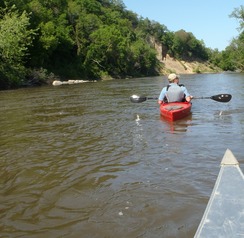 Citizens interested in forming a group to work on improving water quality in the Le Sueur watershed will meet Tuesday, Aug. 27, from 6-8 p.m. at the Amboy Cottage Café. At past events, citizens have identified several strategies to improve water quality in area lakes and streams:
- More stormwater management and in-ditch water storage;
- More experimentation and demonstrations of temporary water storage basins;
- More strategically placed buffers, terraces and grassed waterways;
- More communication and education;
- Less red tape;
- More maintenance of snags in the river channel that cause bank erosion or create major obstructions; and
- More stabilization of streambanks and ravines.
The Le Sueur River Watershed contributes a significant amount of sediment and nutrients to the Minnesota River. Many projects and studies have been completed in the watershed and changes in land use have been promoted and adopted, yet the waters remain polluted. Citizens hold the key for finding and implementing solutions that work and a citizen-led process with support from watershed partners is a promising route to cleanup.
With funding from the Minnesota Pollution Control Agency (MPCA), this watershed project is organized by the Water Resources Center at Minnesota State University-Mankato, Clean Up the River Environment, Rural Advantage, Soil and Water Conservation Districts, and counties.
To RSVP for the Aug. 27 meeting, contact Patrick Moore at 320-841-1487 or riverartisan@gmail.com.
|
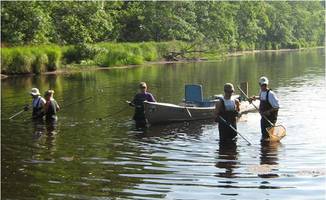 The Mississippi is the first of Minnesota’s five largest rivers to be targeted by the MPCA water quality monitoring effort.
MPCA monitoring crews are about half way through a 10-year effort to assess the condition of smaller rivers, streams and lakes throughout Minnesota’s 81 watersheds. The state’s largest rivers — the Mississippi, Minnesota, Rainy, Red and St. Croix — will be sampled over the next five years. During the 2013-14 monitoring seasons, the Mississippi River will be monitored from its headwaters in Itasca State Park down to St. Anthony Falls in Minneapolis.
To complement the smaller watershed monitoring, the large river monitoring will provide data to assess the aquatic life, aquatic recreation, and aquatic consumption designated uses in the main stems of these largest rivers.
As an example, the Mississippi River, from its headwaters to Minneapolis, has 15 smaller watersheds that flow into it. By combining the results of ongoing monitoring in these smaller watersheds with the results obtained by monitoring the Mississippi, the MPCA can obtain a more complete picture of the condition of our waterways, and help further identify potential problem areas.
This monitoring is designed to measure and evaluate the condition of rivers and streams by sampling fish, aquatic invertebrates, habitat, fish tissue, and water chemistry. Examples of aquatic invertebrates include insect larvae, crayfish, snails, small clams, worms and leeches. Stream water chemistry is monitored to provide information about the quality of the water in which these fish and invertebrates live. Fish tissue samples will be taken to update fish consumption advisories.
The sampling results will be compared to the appropriate MPCA standards. If samples do not meet those standards, the sampling location could be considered impaired. If that happens, the MPCA will look more closely at what could be causing the impairments and find ways to correct the problems.
To see monitoring teams in action, you can watch short videos on fish sampling and invertebrate sampling on the MPCA’s Biological monitoring webpage..
For more information about these monitoring program activities, visit the MPCA’s Water quality condition monitoring webpage.
For the Greater Blue Earth River, Minnesota River and South Metro Mississippi basins, the following monitoring and stressor identification reports are available.
|
The MPCA announces a public comment period, from Aug. 19 through Sept. 17, 2013, on proposed changes to the Minnesota Nonpoint Source Management Program Plan (NPSMPP).
This plan contains strategies that help protect and improve the quality of Minnesota’s water resources by identifying activities to reduce nonpoint sources of water pollution, such as runoff from agricultural lands and unregulated urban areas.
The MPCA is implementing a four-year, phased approach for revisions to the 2008 NPSMPP. The following are highlights from the phase currently open for public comment:
-
Watershed Planning and Management Framework,
-
Overall Strategy for Each Water Resource,
-
Monitoring,
-
Nine Key Elements of a Successful Nonpoint Source Management Program, and
-
Needs, priorities and milestones, action plan tables for several areas.
Updating the plan every five years is a requirement for Minnesota to remain eligible to receive federal Clean Water Act funds.
For more information and copies of these documents, visit the MPCA’s Nonpoint Source Management Plan webpage.
All comments must be received in writing at the MPCA’s St. Paul office by close of business on Sept. 17. Comments should be sent to Denise Leezer, MPCA, 520 Lafayette Rd. N., Saint Paul MN 55155-4194 or to denise.leezer@state.mn.us. Questions may be directed to Leezer at 651-757-2523.
 Through the efforts of the Mississippi Makeover project, a unique group of citizens, groups and technical experts came together to plan restoration for the river from Spring Lake in Pool 2 to Upper Lake Pepin and the Lower Vermillion River.
Starting in 2008, this group came together to study the river, envision its restoration, set targets to achieve, and formulate a plan. The Mississippi Makeover was an off-shoot of the Lake Pepin and Lower Vermillion River Total Maximum Daily Load (TMDL) studies as water in Pool 3 violates the state’s water quality standard for turbidity. The makeover project included ideas such as building islands and lowering water levels temporarily to establish plant life and improve water quality. To measure results of the project, citizen and technical advisers selected several indicators, including water clarity, plant life, invertebrates, fish and waterfowl.
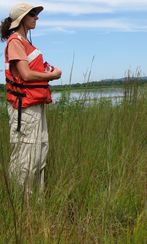
The Mississippi Makeover was funded by a grant from the MPCA and led by the Dakota Soil and Water Conservation District, most notably by Laura Jester, a watershed conservationist with the SWCD. (The photo above shows Laura on a tour of islands in Pool 5 in 2010.) The second phase of the project ended with the grant on June 30.
This project highlighted the need for restoration through tours, events, speakers, training and publications.
For example, a recent boat tour of Pool 3 and North and Sturgeon Lakes showcased the need for more islands and larger aquatic plant beds in this area to provide habitat and respite from wind-churned waters. A total of 23 residents, state and local officials, and Audubon members gathered to hear from experts and view the restoration needs first-hand. The Hastings Star Gazette also reported on the tour, “Mending the Mississippi: River tour highlights plans for backwater restoration.”
Another recent outcome of the project was an interim report card showing progress toward the Mississippi Makeover Targets. The report card shows that some indicator metrics have recently improved. However, these may be temporary results of low water during the drought years. It will take additional years of data collection to track the trends of the indicators.
“One thing is certain, there is much more work needed here – to continue making progress toward the targets and keep the attention of decision makers and agencies focused on this area. While there are no plans for a third phase of the Mississippi Makeover Project, there are many other organizations with activities and advocacy surrounding the Mississippi River in this area … It has been a pleasure working with you on this project. Take care and keep up the great work on the Great River!” Jester said in her farewell email to project members.
|
The Minnesota Department of Agriculture (MDA) recently released a draft revision of the Minnesota’s Nitrogen Fertilizer Management Plan (NFMP) for public comment. This plan is the state’s blueprint for prevention or minimization of the impacts of nitrogen fertilizer on groundwater.
In 2010, MDA began the revision process to reflect current activities, interagency water protection programs and implementation work, and to better align it with current water resource conditions and programs. MDA convened a multi-stakeholder Advisory Committee and conducted a detailed analysis of issues related to nitrates in groundwater. The revisions were based primarily on input from the committee with consideration for past experiences with implementing the plan, input from related programs, increased knowledge about occurrences of elevated nitrate in groundwater, and advances in agricultural technology and management practices.
The plan includes components promoting prevention and developing appropriate responses to the detection of nitrogen fertilizer in groundwater. The strategies in the plan are based on voluntary Best Management Practices (BMPs). The Nitrogen Fertilizer BMPs were developed in 1990 and updated in 2007-08. They are available as University of Minnesota Extension publications.
Supporting information includes MDA nitrate monitoring reports and a presentation to the Minnesota Legislature on nitrates and groundwater (PDF: 2.66 MB / 24 pages).
A draft of the 2013 Nitrogen Fertilizer Management Plan is available for public review. MDA is requesting comments on the 2013 plan. Comments will be accepted through Nov. 1, 2013.
To assist the public in understanding these issues and the plan, MDA will be hosting a series of public listening sessions across the state during the month of September. The meetings are free and open to the public:
Marshall, Minnesota
Thursday September 5, 2013
5:00 – 7:00 pm
Marshall Public Library
201 C Street, Marshall, MN 56258
Crookston, Minnesota
Monday September 16, 2013
6:00 – 8:00 pm
University of Minnesota Crookston Student Center Bede Ballroom
2900 University Ave, Crookston, MN 56716
Wadena, Minnesota
Tuesday September 17, 2013
6:00 – 8:00 pm
Wadena - Deer Creek High School Robertson Theatre
600 Colfax Ave. SW, Wadena, MN 56482
St Cloud, Minnesota
Wednesday September 18, 2013
1:00 – 3:00 pm
Great River Regional Library St Cloud
1300 W. St. Germain St, St. Cloud, MN 56301
Rochester, Minnesota
Monday September 23, 2013
6:00 – 8:00 pm
Cascade Meadow Wetlands & Environmental Science Center
2900 19th Street NW Rochester, MN 55901
Roseville, Minnesota
Wednesday September 25, 2013
1:00 – 3:00 pm
Roseville Public Library Community Program Room
2180 North Hamline Ave, Roseville, MN 55113
 Years of effort by groups and individuals working to improve the Minnesota River could receive a boost from a national recognition program highlighting major river basins. The Minnesota River Watershed Alliance has nominated the Minnesota River to become a “National Blueway.”
The U.S. Dept. of Interior established the National Blueways System in 2012 to promote a network of nationally significant rivers and their watersheds that are highly valued as economic, recreational, social, and ecological assets. The Connecticut River spanning four states in New England was the first to receive National Blueways designation.
The Minnesota River Watershed Alliance (MRWA) is a watershed-wide network of individuals from private organizations and public agencies, and citizens who meet quarterly and work on projects that support and benefit the Minnesota River basin. More than 50 public and private organizations from all sectors supported the nomination.
Recently, opposition to the Blueways program surfaced in Arkansas and Missouri, where the White River had been the second to receive the designation. Since local support and control is paramount, the Dept. of Interior accepted a request to withdraw the White River designation, and placed the program temporarily on hold. In response, the MRWA is expanding efforts to show local support, and disseminate accurate information.
A delegation from the Blueways nomination team will meet at noon, Monday, Aug. 26 at the Joseph Nicollet Tower and Museum in Sisseton, SD. There will be a visit to the Little Minnesota River source at Sica Hollow State Park, followed by an open house/community listening session from 4:30 to 7:30 p.m. at the City Hall Community Room in Sisseton. For more information about the event, contact Patrick Moore at riverartisan@gmail.com, or 320-841-1487.
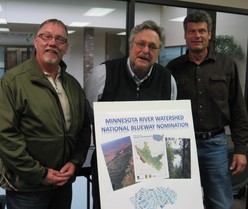
For more information about the proposal, visit the Minnesota River nomination website. In the photo above, alliance members Brad Cobb and Patrick Moore, with John Schueller, Redwood County commissioner and Minnesota River Board chairperson, show a poster on the nomination effort.
|
The Legislative-Citizen Commission on Minnesota Resources received 192 applications in response to its request for proposals for 2014 funding. This commission makes recommendations to the Legislature for grants from the Environment and Natural Resources Trust Fund, which is funded by Minnesota Lottery proceeds and investment income.
The proposals total about $111 million, far exceeding the $29.6 million expected to be available for grants starting July 1, 2014.
The commission is now selecting proposals to invite in for presentations and further review on Sept. 18-19. The proposals range from $39,967 for studying the “Economic Impact of Frac Sand Mining on Minnesota” (Labovitz School of Business and Economics) to $5.1 million for an “Accelerated Effort to Understand and Control Zebra Mussels” (Minnesota Dept. of Natural Resources). Among the proposals is one from the MPCA for $2.7 million for a multi-agency effort on “Identifying Causes of Exceptionally High Mercury in Fish.” The MPCA is also seeking $846,000 for “Building Environmental and Community Resilience to Extreme Weather.”
Proposals in the Minnesota River Basin include:
View the 191 proposals received or visit the M.L. 2014 Proposal and Funding Process page for more information and updates.
One of the roles of the MPCA is to assess the condition of Minnesota’s groundwater. Clean groundwater is vital to the state of Minnesota. Groundwater supplies drinking water to about 75 percent of all Minnesotans and almost all of the water used to irrigate the state’s crops. The inflow of groundwater also is important to Minnesota’s streams, lakes and wetlands.
In a new groundwater report, MPCA primarily looked at monitoring data from 2007-2011 that included traditional pollutants known to adversely affect groundwater such as nitrate, chloride and volatile organic compounds (VOCs or chemicals that participate in forming ozone). The report also included some newly-recognized pollutants, such as medicines, insect repellents, and fire retardants. The effects of these new pollutants, which are often referred to as contaminants of emerging concern or CECs, onto human and aquatic life are not fully understood at this point.
Highlights from “The Condition of Minnesota’s Groundwater, 2007-2011” include:
-
Shallow groundwater in the Twin Cities Metropolitan Area (TCMA) is impacted by high chloride concentrations with 27 percent of the TCMA monitoring wells in the sand and gravel aquifers having concentrations that were greater than drinking water guidelines set by EPA. The map at right shows chloride concentrations in groundwater from sand and gravel aquifers across Minnesota.
- If chloride continues to increase in the groundwater, additional waters will likely violate drinking water and water-quality standards in the future.
-
Nitrate contamination generally has not changed over the last 15 years; however concentrations remain high in certain parts of the state.
-
The highest nitrate concentrations occurred in the aquifers in Central and Southwestern Minnesota.
- CECs were detected in about one-third of the sampled wells in 2010. The most-frequently detected chemicals were the fire retardant tris phosphate, the antibiotic sulfamethoxazole, and bisphenol A and tributyl phosphate. No concentrations violated any applicable human-health guidance set by the state of Minnesota.
Monitoring is ongoing with additional wells being installed to increase the breadth of the monitoring network. This work will serve the state well into the future by detecting contamination problems that occur along with developing and tracking groundwater quality trends. To view the executive summary and full report on the condition of Minnesota’s groundwater, visit the MPCA’s Groundwater in Minnesota webpage.
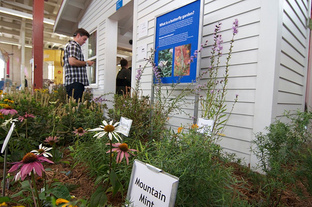
At this year’s State Fair Aug. 22-Sept. 13, take the plunge at the Eco Experience and learn all about the lakes, rivers, drinking water, and groundwater that make our state great Minnesota.
New this year, a 200-square-foot map will feature a satellite view of the Ramsey-Washington Metro Watershed District, with imagery so detailed that metro visitors will be able to find their own houses and locate places in the watershed where residents are working to improve water quality.
Also at Eco Experience:
- Young artists selected as finalists in the H2O for Life competition will have their winning posters on display. Budding water scientists will have a chance to try their hand at testing clarity of water from Lake Phalen and see Minnesota water bugs, some of which are more than 3 inches long.
- Salt is a problem for Minnesota lakes. Road salt keeps drivers safe, but it washes into lakes where it’s toxic to living things and cannot be removed. Learn how to use de-icing salt the right way so it keeps pavement clear with a minimal amount of waste.
- Native plants, rain gardens, and shoreline stabilization have become popular landscaping elements. Visitors can learn how to get started from a rain garden expert at the Blue Thumb gardening station. This exhibit will be staffed with knowledgeable landscapers, water educators, and nursery specialists who can answer questions about how to use plants to protect water quality.
|
|




