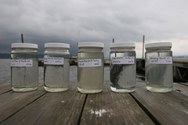
 Beginning Jan. 7, the Minnesota Pollution Control Agency (MPCA) will accept proposals for Clean Water Partnership (CWP) grant and loan funding. Proposals will be accepted from local governmental units interested in leading a nonpoint source pollution control project to protect or improve water bodies.
Priority for funding will be given to projects preventing degradation of unimpaired waters. For a project to be considered a protection/prevention project, proposers will need to document that the water body(ies) being addressed is currently meeting state water quality standards for a particular pollutant of concern, or has not been assessed but is known to be supporting beneficial uses.
The MPCA anticipates allocating about $1.1 million for grants and about $5 million for loans this year.
Eligible applicants for CWP grants and loans include:
- Watershed districts;
- Tribal authorities;
- Cities and counties;
- Joint powers organizations;
- Watershed management organizations; and
- Due to CWP statute changes, soil and water conservation districts are now eligible to directly sponsor a CWP proposal.
The MPCA will accept two types of proposals:
- Resource investigation projects that monitor, assess and develop a diagnostic study on the status of a water body(ies), and also develop an implementation plan to address the needs of the water body(ies). Resource investigation projects are only eligible for grant funding.
- Implementation projects that implement activities identified by a comprehensive assessment and planning process in the watershed or around the water body of concern. Such assessment must consist of an MPCA-approved CWP diagnostic study/ implementation plan, an EPA-approved Total Maximum Daily Load study/ implementation plan or an equivalent diagnostic study and implementation plan. Implementation projects are eligible for both grant and/or loan funding.
There is a $300,000 limit on each grant funding request. There is no limit for a loan request.
The due date for proposals is 4:30 p.m. Friday, March 8, 2013.
New process for submitting proposals
New this year is the process for submitting proposals. All information, questions and proposal submittal will be done electronically through Minnesota’s SWIFT e-submittal system. To access further information, including the SWIFT web address, visit the MPCA website. Under the SWIFT system, applicants need to register as a vendor to respond to the Clean Water Partnership request for proposals.
The MPCA will administer the Clean Water Partnership grants via a standard three-year grant agreement. Proposers who are awarded funds may be able to begin project work as early as spring 2013.
The Clean Water Partnership program was created in 1987 by the Minnesota Legislature to address surface and ground water pollution from agricultural and urban sources. Through the program, the MPCA supports the efforts of local partners by providing financial and technical assistance to diagnose problems and threats to water resources; develop solutions for addressing these problems; and implement these solutions to fix the problems that negatively impact lakes, streams and ground water, as well as to protect waters in good condition.
For more information, visit the Clean Water Partnership webpage.
Section 319 funding
The MPCA expects to open this year’s federal Section 319 funding round in the next couple of months. The agency apologizes for any confusion you may have concerning the Section 319 funding round posting that was recently placed in the State Register. It was a draft posting that was inadvertently added to the CWP funding round request and is being rescinded. Further information will be provided in a future Waterfront Bulletin and on the MPCA website.
|
The MPCA recently awarded more than $900,000 to local partners to conduct water monitoring work to gather long-term information at smaller scale streams and rivers in southern Minnesota. Water samples will be collected during snowmelt and rain events, when watershed runoff is high, and during base flow conditions – the typical flow in rivers when rain or snowmelt is not occurring.
The MPCA will combine these water quality data with stream flow information to estimate overall contaminant loading from a watershed.
This effort is part of agency-led Watershed Pollutant Load Monitoring Network, which collects data to provide information about the health of Minnesota watersheds – our rivers and what feeds into them. The information helps identify where excessive pollutants are entering river systems, from both point and nonpoint sources. Because this network is statewide and long-term, it can be used to identify trends over time and compare one part of the state to another. It is also useful for evaluating the effectiveness of remedial activities and to monitor for protection. For more information, please visit the network’s website.
For the recent funding round, the MPCA has awarded grants to:
- Cannon River Watershed Partnership;
- Chippewa River Watershed Project;
- Fillmore Soil and Water Conservation District;
- Hawk Creek Watershed Project;
- Minnesota State University-Mankato Water Resources Center;
- Redwood Cottonwood Rivers Control Area; and
- Zumbro Watershed Partnership.
These grants are funded by the Clean Water, Land and Legacy Amendment.
The next funding round for this program will be in August 2013 and target northwestern, north central, and northeastern Minnesota.
 The Minnesota Board of Water and Soil Resources (BWSR) voted Dec. 12 to approve $18 million in Clean Water Fund grants to local partners throughout the state to protect and restore lakes, streams and groundwater.
The grants include the following programs:
- $10.7 million in Clean Water Assistance to local partners throughout the state. Among the projects funded was $683,960 to the Nicollet Soil and Water Conservation District for target conservation work to ravines that contribute sediment to Seven Mile Creek in the Minnesota River Basin. In the metro area, the Scott County Water Management Organization received $701,430 for stormwater controls for the parking lot and access road at Cleary Lake Regional Park.
- $1.67 million for Livestock Waste Management to Dodge County and several SWCDs in central and southern Minnesota. Among the partners funded was $387,684 to the Wabasha SWCD.
- $1.6 million for On-Site Sewer Treatment System Imminent Health Threat Abatement to several counties and SWCDs throughout the state. Topping the list was $292,840 to Lac Qui Parle County in western Minnesota to develop a community sewer system for the City of Louisburg.
- $2 million for Accelerated Implementation to local partners throughout the state, including $946,167 to SWCDs in southeast Minnesota to continue feedlot technical positions to help fix animal waste runoff from small feedlots.
- $1.4 million to Community Partners throughout the state. Among the recipients is the East Otter Tail SWCD with $150,000 for empowering community groups to protect water resources, $150,000 to the Ramsey Conservation District for targeted stormwater best management projects, and $149,855 to the Cook SWCD for sub-grants to community groups to implement rain gardens.
- $942,000 for Conservation Drainage projects, including $333,590 to the Buffalo-Red River Watershed District for retrofitting three county ditches to better control sediment and filter drainage water.
According to a BWSR press release, the need still outweighs available funds. The board received more than 280 applications requesting almost $68 million dollars for the $18 million in available funds.
See a map of funded projects on the BWSR website.
|
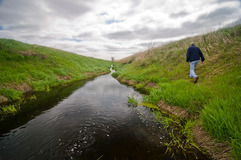 Minnesota may be the sixth largest contributor of nitrogen to the Gulf of Mexico, according to research led by MPCA senior hydrologist David Wall. He spoke on the research at the Iowa-Minnesota-South Dakota Drainage Research Forum in Waseca on Nov. 20. Wall also addressed the statewide plan to reduce nutrients in water resources that Minnesota is beginning to develop this year.
Hypoxia in the Gulf of Mexico is driving the nutrient-reduction plans for Minnesota and other states. However, Minnesota is also concerned about the impact of excessive nutrients to other downstream waters such as Lake Winnipeg in Canada as well as waters within the state.
While beneficial to crops, excess nutrients can be harmful to water resources, making drinking water unsafe for human consumption, fueling algal blooms in rivers and lakes, and using up oxygen in water, leading to fish kills.
While several state agencies and local partners are working to reduce excessive levels of nutrients in water resources, there is more to do. For example, agencies and partners can be more efficient in their work by targeting key areas and nutrient sources. Part of the MPCA study includes identifying the watersheds with the heaviest loads of nutrients in runoff. Also, the state has seen success in lowering phosphorus in some rivers, but rising nitrogen levels are a concern.
Minnesota’s plan will address both point and nonpoint sources. A group of state agencies plans to take input from stakeholders throughout the state and complete the plan by the end of 2013. Iowa currently has its plan on public notice.
Learn more about the Minnesota effort on the MPCA website and in a recent Agri-News story.
|
 Feel free to use this press release in your newsletters and on your websites:
For years doctors have told people to stick to a low-salt diet. According to the MPCA, our waters should follow the same advice.
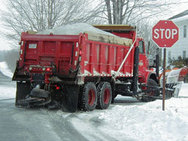
When snow and ice start to accumulate on Minnesota roads, parking lots and sidewalks, one of the more common reactions is to apply salt, which contains chloride, a water pollutant. When snow and ice melt, most of the salt goes with it, washing into our lakes, streams and rivers. Once in the water, there’s no way to remove the chloride, and it becomes a permanent pollutant.
According to Brooke Asleson, MPCA project manager for the Twin Cities Metro Area chloride project, “Salt is a real threat to water quality. It only takes one teaspoon of road salt to permanently pollute five gallons of water. We are trying to spread the word that less is more when it comes to applying road salt because at high concentrations, chloride can harm the fish and plant life in our waters.”
There are many ways to reduce salt use while maintaining high safety standards:
-
Shovel. The more snow and ice you remove manually, the less salt you will have to use and the more effective it can be. Break up ice with an ice scraper and decide whether application of a de-icer or sand is even necessary to maintain traction.
-
More salt does not mean more melting. Use less than four pounds of salt per 1,000 square feet (an average parking space is about 150 square feet). One pound of salt is approximately a heaping 12-ounce coffee mug.
-
15 degrees is too cold for most salt to work. Most salts stop working around this temperature. Instead, use sand for traction.
-
Sweep up extra salt. If salt or sand is visible on dry pavement, it is no longer doing any work and will be washed away.
To learn more about what you can to reduce chloride in our waters, or to read more about MPCA’s role on this issue, visit the agency’s road salt and water quality webpage.
|
 The Mankato Free Press recently marked the 50th anniversary of the one of the biggest environmental disasters in Minnesota. It was January 1963 when soy oil storage tank ruptured, sending millions of gallons of the oil into Minnesota River. Reporter Tim Krohn reports:
“The spill at the Mankato plant, the largest oil-processing facility in the world, couldn’t have happened at a worse time. Just a month earlier, pipes at an oil plant in Savage had ruptured, sending about 1 million gallons of petroleum oil into the Minnesota River.
“When the estimated 2.5 million gallons of soy oil from Mankato made its way down the river the following spring, it mixed with the petroleum oil. As the mass continued into the Mississippi River, it covered ducks and caused outrage among citizens, leading to water protection laws and the start of the Minnesota Pollution Control Agency.”
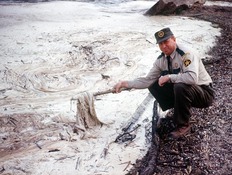
In the photo at right, a conservation officer shows the congealed vegetable oil mixed with petroleum oil that fouled the Mississippi River near Hastings. The photo was taken by retired Mankato DNR officer Dick Kruger.
Read the full story online at the Free Press website.
|
The Agricultural BMP Handbook for Minnesota outlines the state’s 32 most important conservation practices used for water quality and documents the advanced scientific research that supports these practices. The first of its kind, this handbook describes each practice and provides a review of the published pollutant removal mechanisms and the effectiveness of each BMP.
Thomas Miller, a water resources engineer with Emmons & Olivier Resources and principal investigator of the Agricultural BMP Handbook for Minnesota, will speak on the handbook at the Mississippi River Forum Jan. 25 at St. Cloud City Council Chambers and Feb. 15 at the McKnight Foundation in Minneapolis. Both forums will be held 8-9:30 a.m. RSVP to Lark Weller of the National Park Service.
The Dakota County Soil and Water Conservation District is seeking a full-time Water Resource Specialist. This position is responsible for providing technical expertise and program oversight to the SWCD’s surface and groundwater monitoring programs. The position will also be part of a team that develops and implements various conservation programs.
Applications are due 4:30 p.m. Jan. 25. Details available in the Dakota SWCD website.
|




