|
The last couple of years have seen a fair number of changes related to our Industrial Stormwater Program. In April 2020, the MPCA finalized and issued its latest Multi-Sector General Industrial Stormwater Permit. In 2021 and 2022 numerous improvements were made to our online services capabilities (eServices). Additionally, several new staff have joined our program.
Throughout this period, MPCA staff have appreciated your patience and efforts as we have transitioned through these developments. In this newsletter we will provide you with links to guidance materials, training offerings, and reminders to help you stay compliant with your permit.
Getting assistance from the MPCA’s Small Business Environmental Assistance Program can be a great way to stay in compliance with your stormwater permit. The staff in this program assist businesses in complying with environmental rules, reducing wastes and emissions, and reducing regulatory obligations. Business-specific information discussed during assistance with this program is kept confidential from enforcement, except in cases of imminent danger to human health and/or the environment.
The staff in this program are eager to help you and can reached at the following:
Helpline: 1-800-657-3938 or 651-282-6143
Email: smallbizhelp.pca@state.mn.us
Snowmelt Monitoring Opportunities
As we move closer to spring, the sunshine and warmth the season brings reminds us that days at the lake or other summertime activities are not too far away. This changing weather should also prompt us that we have opportunities to complete industrial stormwater permit sampling requirements.
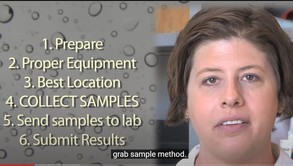
Please remember, a stormwater runoff sample is required to be taken once each calendar quarter whenever a runoff occurs at the benchmark monitoring location(s) identified in your permit. Sampling must be completed until four (4) consecutive quarterly samples average below the benchmark values in the permit. Gathering a snowmelt runoff sample during the late winter/spring season is a good opportunity to ensure you meet this requirement.
Note — Some industry sectors are required to have a snowmelt runoff sample at least once each year so check the sector-specific requirements in your permit to see if this applies to your site.
Ensuring Sample Collection and Quality
Each site has unique variables that can impact how and when stormwater runoff occurs. Some site variables include:
- Topography
- Pervious surface and soil characteristics
- The amount and intensity of precipitation events, even relative to each other
These factors can all play into whether a site has a runoff event. Please keep these factors in mind when trying to complete stormwater monitoring. There may be instances where one precipitation event leads to no runoff while the next instance with the same amount of rainfall does result in runoff. Additionally, some of your benchmark monitoring locations may not receive runoff while others do for the same precipitation event. Understanding your site variables will help you ensure you are able to complete your sampling requirements.
Sample timing is also an important part of ensuring we are capturing an appropriate sample. Permittees must sample according to the following:
- Collect stormwater samples within the first 30 minutes upon runoff reaching the benchmark monitoring location
- If that is not possible, collect the samples as soon as practical and note this on the stormwater Compliance Monitoring Report.
Completing monthly inspections is a vital requirement of the industrial stormwater permit. Completing these inspections help ensure your site’s best management practices (BMPs) are maintained and are achieving their intended purpose.
In addition, each monthly inspection allows your facility to review the significant materials and industrial activities that may have become newly exposed over the month. Including any of these new materials or activities into your SWPPP is a requirement and helps to ensure limited potential impact to stormwater.
Why aren’t my Compliance Monitoring Reports showing up in eServices?
Many permittees have contacted the MPCA recently related to stormwater Compliance Monitoring Reports not being available within their eServices accounts. The most common reason for this is because the facility has completed the required stormwater monitoring by meeting the benchmark values listed in the permit. To determine if your site has met the benchmark value(s), complete the following:
- Review sampling results for the last four (4) consecutive stormwater samples taken at each benchmark monitoring location
- Average the four (4) quarterly sample results for each parameter at each benchmark location separately
- Compare the result to the benchmark value in the permit
- If your average is below the benchmark value, you have completed your sampling requirements.
Another way to check if your facility has met its benchmark values is by checking in eServices. Identifying if you have met the benchmark values is easy within this online portal. Sign into your account. Go to your Industrial Stormwater Monitoring Reports submittal page. If the status shows “Benchmark Met,” the system has recognized that your submitted data has met the benchmark value and no more monitoring reports are required (see below).
 Annual reports required each year by March 31
Permittees with a general Industrial Stormwater Permit are required to submit an annual report for each year by March 31. Last year, the MPCA transitioned to accepting the Industrial Stormwater Annual Reports through our eServices portal and this year we are continuing to only accept these reports through this system.
If you are unsure how to complete this requirement, please use our guidance available on our website linked at the following:
https://www.pca.state.mn.us/sites/default/files/p-gen1-24.pdf
When completing the annual report, be sure to include all pertinent information to help explain the activities at your site.
Impaired waters annual review reminder
Your annual review process needs to include an assessment regarding newly identified impaired waters or new impairments to existing impaired waters. Check to see if any new impairments are located within a mile of any facility discharge locations.
A good way to ensure you are aware of any updates is by using the MPCA Industrial Stormwater Special and Impaired Waters Search Tool. Use this tool to locate your facility and then identify all the special and impaired waters within 1 mile of your site. If you find a new impairment, please review the requirements of the permit to determine your next steps.
You can find the MPCA Industrial Stormwater Special and Impaired Waters Search Tool here: ISW Special and Impaired Waters Mapper
The University of Minnesota Erosion and Stormwater Management Program is offering two on-demand, self-paced online Industrial Stormwater courses. One course is for people who are new to the field, and a different course is available for those who need to meet their annual training requirement.
New to industrial stormwater?
For people who are new to the Industrial Stormwater Permit or who would like a detailed refresher of the industrial stormwater requirements, the University Erosion Program is offering ISW 2202, an approximately 7-hour online course. Topics include no exposure, SWPPP development and implementation, stormwater sampling and monitoring, inspections, SWPPP modification, and annual training requirements.
Learn more at:https://erosion.umn.edu/courses-registration/isw2202-industrial-stormwater-regulations-swppps-sampling-and-monitoring
Register for the course at: https://learning.umn.edu/portal/events/reg/participantTypeSelection.do?method=load&entityId=38177543
Refresher/Annual Training
For people who are familiar with the 2020 Industrial Stormwater Permit and would like to take an online course to meet the permit's annual training requirement, the University Erosion Program is offering an approximately 1-hour online course that reviews permit basics and discusses topics specific to 2023.
Learn more at: https://erosion.umn.edu/courses-registration/isw1202-industrial-stormwater-annual-training-online
Register for the course at: https://learning.umn.edu/portal/events/reg/participantTypeSelection.do?method=load&entityId=38177405
For questions, contact the Erosion Program at erosion@umn.edu or call 612-625-9733.
|
General industrial stormwater permittee’s who discharge directly into a regulated Municipal Separate Storm Sewer System (MS4) are required to notify the MS4 operator of the stormwater discharge into their storm sewer system. To identify if your facility discharges stormwater directly to a regulated MS4 systems, use the MPCA MS4 Map Tool. Additionally, consider including a copy of the MS4 notification within your stormwater pollution prevention plan (SWPPP) to document the notification occurred.
|