|
Feb. 17, 2012
You are receiving this email because you have served on the stakeholder advisory committee, technical advisory committee or science advisory panel for one or more of the following Total Maximum Daily Load (TMDL) projects for turbidity:
- Greater Blue Earth River;
- Minnesota River;
- South Metro Mississippi River (Lake Pepin).
To keep you informed of these projects and related efforts, such as research and public participation, the Minnesota Pollution Control Agency (MPCA) has started this monthly email newsletter:
-
If you would like to continue receiving this newsletter, please add mpca@public.govdelivery.com to your address book or safe sender list.
- If you would NOT like to continue receiving this newsletter, then click the “Unsubscribe” button below and follow the instructions to change your account settings.
This newsletter link will also be available on the following TMDL project webpages:
We thank you for your past service and look forward to working with you as the MPCA prepares these projects for public notice.
The MPCA invites comments on the draft TMDL reports the South Metro Mississippi and the Minnesota River from Feb. 27 to April 27. The notice for public comments is scheduled to be published in the State Register on Feb. 27.
The agency is scheduling informational meetings for the public, stakeholder advisory committee members and science advisers. The MPCA will announce details of these meetings in this newsletter and on the MPCA website.
 |
|
To encourage dialogue about TMDL projects in southern Minnesota, the MPCA has worked with Clean Up the River Environment (CURE) and several other partners, including InCommons, a community-based initiative to connect people to share credible tools, knowledge and resources to solve community problems. With funding from private foundations, CURE has worked with local partners to organize citizen-led conversations about water quality goals.
|
The first conversation was held Dec. 6 in Mankato with a focus on the South Metro Mississippi, Minnesota River and Greater Blue Earth River, with more than 100 people attending. The second was held Feb. 2 in Owatonna with a focus on the Cannon and Straight rivers. Again, more than 100 people attended, shown in the photo above (photo courtesy of Anne Queenan).
At these citizen-led conversations, participants eat dinner with at least one representative from agriculture, government, education, environmental advocacy, business, community, and one table host, who is trained in facilitation, at each table. After dinner and a facilitated conversation, participants move to different tables to meet new people and continue the discussions.
The MPCA will use the ideas and suggestions from these conversations to develop implementation plans for TMDL projects in southern Minnesota. Some common themes include changing policies, educating the public more, interacting more with the rivers, collaborating more, making personal commitments, developing new incentives for farmers, and using Legacy funds to address water quality issues.
A third citizen-led conversation is being scheduled for Red Wing in March. Stay tuned to this newsletter for details.
|
As the South Metro Mississippi, Minnesota River and Greater Blue Earth River TMDL reports reach their final phases, research continues on the sources of sediment in these river systems.
One study completed in the past year examined the amount of sediment in the Le Sueur River watershed within the Greater Blue Earth River system.
|
|
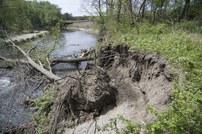 |
The geological history of the Le Sueur watershed leaves it primed for erosion. Even before European settlement, the Le Sueur’s three main branches were major contributors of sediment to the main part of the Minnesota River – about 60,000 metric tons a year. Since European settlement, that amount has increased to 225,000 metric tons per year. That increase derives from changes in land surface, vegetation and hydrology.
“Effective management will require a combination of actions to reduce erosion at its source and more effectively control the physical drivers of erosion, requiring management of peak flows. If only sediment sources are addressed, management actions will risk addressing the symptom but not a dominant causal factor. As high flows in the river are the underlying, systemic driver of near-channel erosion, increased water retention in uplands will reduce sediment loads over the long-term and can help mitigate on-going and future changes in precipitation,” the project report says.
The MPCA and several partners are also working to engage citizens in the Le Sueur watershed in plans to clear up the river. Look for updates on these efforts in future editions of this newsletter.
South Metro Mississippi
Robert Finley
Regional Manager, Watersheds
MPCA
12 Civic Center Drive, Suite 2165
Mankato, MN 56001
507-344-5247
Minnesota River
Larry Gunderson
Minnesota River Basin Coordinator
MPCA
520 Lafayette Road N
St. Paul, MN 55155-4194
651-757-2400
Greater Blue Earth River
Paul Davis
Project Manager
MPCA
12 Civic Center Plaza, Suite 2165
Mankato, MN 56001
Cathy Rofshus
Public Information Officer
MPCA-Rochester-Mankato
507-206-2608
Forrest Peterson
Public Information Officer
MPCA-Willmar-Marshall
320-441-6972
| 



