|
The Lessard-Sams Outdoor Heritage Council expects to open
its funding round April 1 this year for Fiscal Year 2020 projects. Applicants
will then have until May 31 to complete their proposals for Clean Water Fund
grants. Check the council’s website
for updates.
Proposals are due April 11, 2018, for funding from the Legislative-
Citizen Commission on Minnesota Resources. This commission funds projects
of all sizes that aim to protect, conserve, preserve, and enhance Minnesota’s
air, water, land, fish, wildlife, and other natural resources. About $59
million is anticipated to be available for projects beginning July 1, 2019.
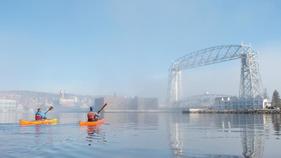
Few U.S. urban areas can boast of having anything close
to Duluth’s 16 state-designated trout streams and 43 named streams within the
city’s boundaries. Unfortunately, urban streams often suffer predictable
consequences: 11 of Duluth’s trout streams are impaired by human-related
activities. These impairments are the focus of two Minnesota Pollution Control
Agency (MPCA) draft reports open for public through April 18.
The reports are the Total
Maximum Daily Loads (TMDL) study and the Watershed
Restoration and Protection Strategies (WRAPS) report. They are companion
documents that quantify pollutant levels, identify pollution sources, and
propose ways to return water quality to an acceptable level.
The WRAPS Report summarizes information, tools and
stakeholder input that can be used by local governments, landowners and others
to decide on the best strategies and most effective places for those strategies
to protect and restore water quality.
The watershed’s problems are related to a
highly-developed environment that includes impermeable roofs, paved streets, and
parking lots. As a result, the collective runoff generates water temperatures
too warm for cold-water fish, bacteria, sediment, stormwater and road salt.
Other streams’ fates include passage through concrete culverts, human-made
ditches, or being buried underground.
Some have more favorable conditions. Most Duluth-area
trout streams start out in natural, nearly flat wetland areas before rapidly
descending rocky cliffs into the St. Louis River and Lake Superior. Several
manage remarkably well and still support native populations of fish species.
The two Duluth Urban Area Streams Watershed draft reports
are available on the MPCA’s Duluth Urban
Area Streams Watershed webpage or at MPCA’s Duluth office, 525 Lake
Avenue South, Suite 400. Written comments should be submitted by April 18, 2018 to Brian Fredrickson, MPCA, 525
Lake Avenue South, Suite 400, Duluth, MN 55802, or by email to brian.fredrickson@state.mn.us.
No comments will be accepted by telephone. However, if you need further
assistance or clarification, contact Fredrickson at 218-302-6604.
Written comments must include a statement of your
interest in the draft TMDL or WRAPS report, a statement of the action you wish
the MPCA to take, including specific references to sections of the draft TMDL
or WRAPS reports you believe should be changed, and, specific reasons
supporting your position.
|

It started in 1998 with 17 volunteers monitoring the health
of 22 streams sites in southeast Minnesota. Today there are more than 400 volunteers
and 500 stream sites across Minnesota. The data they collect are indispensable
to the Minnesota Pollution Control Agency (MPCA).
“Where else do you have continuous data like that? It’s
really rare … That citizen component is really important,” said Donna
Rasmussen, director of the Fillmore Soil and Water Conservation District, where
the Citizen Stream Monitoring Program started 20 years ago.
Volunteers in this program adopt a stream site, tracking how
clear the water is weekly during the summer. They use a simple tool called a
Secchi tube to measure the clarity, reporting the measurements and their
observations to the MPCA. The agency then uses the information to help assess
whether the streams meet water quality standards designed to make sure they’re
fishable and swimmable.
The MPCA is celebrating the 20th anniversary of
the Citizen Stream Monitoring Program this year, and produced a video program to
recognize volunteers and their contributions to cleaner water. For many
volunteers, their observations and opportunities to bring attention to streams
are just as important as the data collected.
One of the volunteers in the video program is Richard Betz,
a nine-year monitor on a Flute Reed River site in Cook County. “I can report things
like this slumping bank I’ve got here. If I wouldn’t have been here, the county
soil and water wouldn’t know about this,” he said.
Ruthann Yaeger, an 11-year volunteer on Silver Creek in
Olmsted County, said, “More importantly, the Citizen Stream Monitoring Program
gives me a base to speak to people about water. And to be able to show them in
ways that this impacts our watershed. And it will impact your well.”
With 69,000 miles of streams and more than 14,000 lakes in
Minnesota, the MPCA cannot monitor all that water on a continual basis. For
some lakes and streams, citizen data are the only data available. For all waterbodies
monitored, the data are crucial to tracking long-term trends in water quality,
to see if lake and stream health is getting better or worse over time.
If you’d like to be part of this program to help ensure
clean water in Minnesota, go to the program’s
webpage, or call the MPCA at 651-296-6300 (Twin Cities) or 1-800-657-3864
(Greater Minnesota). The MPCA provides equipment and training, and no
experience is needed.
|
A
traveling exhibit exploring Minnesotans’ emotional connections with water will
be on display at the Historical and Cultural Society of Clay County through
June 17. “We Are Water Minnesota” employs
a variety of multimedia and hands-on displays to both inform viewers and
celebrate the role of water in what makes Minnesota such a special place.
The museum is located in Moorhead, Minn.,
on the banks of the Red River of the North. In partnership with the Moorhead-based
nonprofit River Keepers, the museum will create a series of panels about
Moorhead’s history related to water and ecology of the Red River watershed.
The Red River Valley is the defining
feature of northwest Minnesota. Historically a tallgrass prairie, the valley is
the flattest, driest, most fire-prone region of Minnesota. It is also prone to
seasonal and event-based flooding.
From fishing to farming to flooding, there
are many water stories to tell in Moorhead. Listen to stories from parents,
children, fishers, famers, indigenous Minnesotans, immigrants to Minnesota,
water professionals, and people who just love to be out on the water. Visitors
can add their stories to the exhibit and read each other’s.
Water was a dominant theme when the MPCA recently
refreshed its Strategic
Plan for the next five years. The agency selected 16 goals that cover air,
water, land, cross agency, and excellence. The water goals focus on:
- Reducing chloride (salt) entering lakes, streams and groundwater
- Reducing nutrient pollution of lakes and stream through targeted strategies with local partners
- Reducing pollutants in wastewater and maximizing investments
in public infrastructure
As part of the refresh, the agency gathered input from staff
and external stakeholders. Some of the key themes shared by external
stakeholders and staff included better communication and efficiency.
Based on input from external and internal stakeholders,
senior leadership selected a targeted set of goals where the agency can make a
difference in the next five years. In addition to water-related goals, they
include increased diversity in the agency’s work force, acceleration of data
availability online, and improving air quality in population centers. The
agency is also focusing on reducing permitting backlogs in air and nutrient
pollution in watersheds.
The U.S. EPA recently approved Total Maximum Daily Load study
reports for the following watersheds. These studies determine the total amount
of a pollutant that a water body can receive on a daily basis and still meet
water quality standards.
Zumbro River: Some waters in good shape while many need work
Some waters are in good shape while many need work in the Zumbro River Watershed
in southeastern Minnesota, according to the TMDL
report and accompanying WRAPS document.
This watershed drains 909,000 acres in Olmsted, Dodge,
Wabasha, Goodhue, Steele and Rice counties. The landscape is diverse, with most
of it used for agriculture. Yet its cities are growing, most notably Rochester,
home of the Mayo Clinic. The lakes and streams vary in water quality and the
groundwater is sensitive to pollution.
Trout streams here tend to be in good shape and protecting
them is critical. Common problems in the watershed include degraded habitat for
fish and bugs, increasing levels of nitrogen in streams and springs, and high
levels of bacteria and sediment in streams at times.
Recommended strategies include improving fertilizer
efficiency, adding perennial and cover crops, controlling erosion, managing
stormwater, protecting drinking water, managing waste, and protecting perennial
lands.
The MPCA approved the Zumbro WRAPS report in November 2017.
Missouri River Basin: Most streams, lakes fail to meet water
quality standards
The majority of monitored stream sections and lakes in the
Minnesota portion of the Missouri River
Basin fail to meet water quality standards for fishing and swimming,
according to the TMDL
report and accompanying WRAPS
document.
The Minnesota portion includes 1.14 million acres of drainage
area from four watersheds that flow into South Dakota and Iowa to the Big Sioux
River: Upper Big Sioux, Lower Big Sioux, Rock and Little Sioux rivers. These
watersheds include parts of Jackson, Nobles, Murray, Rock, Pipestone and Lincoln
counties in southwest Minnesota. The land is mainly used for agriculture, with
80% in cultivated crops.
Common problems include excessive levels of sediment, algae
and bacteria. Recommended strategies to restore water quality include grassed
waterways, reduced tillage, cover crops, improved fertilizer and manure
management, increased crop diversity, buffers, and improved pasture management.
The MPCA approved the Missouri River Basin WRAPS report in January
2018.

As Minnesota’s weather patterns change, bringing long periods
of drought and flooding rains, the need for resilient yards is increasing. This
is especially true for urban areas where impermeable surfaces retain the sun’s
heat while contributing runoff to lakes and streams. Resilient yards help shed
and shade the sun’s heat, soak up and infiltrate stormwater, and use the
stormwater to cool the surrounding landscape.
Metro Blooms, a non-profit
group that coordinates the Blue Thumb
program, is offering two types of workshops at many places and times this
spring:
- Resilient Yard Workshops (2.5 hours): Provide a framework to understand the importance of resilience and how it can be fostered in yards through a variety of practices, including how to install rain gardens. Following the presentation, attendees receive one-on-one design assistance from Blue Thumb Landscape Designers, Hennepin County Master Gardeners, and Master Water Stewards to create a plan for your own yard.
- Turf Alternatives Workshops (1.5 hours): Cover advantages of using perennial ground covers to minimize the need for irrigation and chemical inputs while maximizing ecological benefits. It also demonstrates handy how-tos for replacing traditional turf by installing and maintaining two popular types of turf alternatives: Low Maintenance Lawns and Bee Lawns,
which support pollinators and clean water.
All
workshops attendees receive information about installation cost-share programs
and Blue Thumb resources to help get a project in the ground.
Workshops
are scheduled for 11 locations in the Twin Cities and one in Prescott, Wis.,
starting March 28. For details and registration, visit the Metro Blooms workshop webpage
or call 651-699-2426. The cost is $15 per household,
though some locations have no fee because of local sponsorship.
Related
media story:
|
- April 12-14: State of the Water Conference, Freshwater Society, Breezy Point Resort, Brainerd.
- April 21: Earth Day festival, Prairie Woods Environmental Learning Center, Spicer.
- April 22: Wild and Scenic Film Festival at Sheldon’s Theater in Red Wing, 2 p.m., hosted by the Red Wing Environmental Learning Center.
- April 26: Watershed Professionals Network, 9:30 a.m., Mankato Pizza Ranch.
- May 17: 10th Minnesota River Congress, Kato Ballroom, Mankato.
The city of Worthington and several partners are using a unique
approach to protecting drinking water that results in additional benefits. The Worthington
Wells Wildlife Management Area protects the city’s wells, filters runoff to surface
waters, and provides pheasant habitat.
Worthington is in southwest Minnesota, where groundwater sources
can be scarce. The city uses a system of 10 wells to provide water for drinking
and other purposes to 13,000 people. Most of those wells are seven miles from
Worthington because that’s where the city found water to tap. But that means the
surrounding land is out of the city’s jurisdiction as far as mandating protective
measures. So the city is working with the Minnesota Department of Natural Resources,
Okabena-Ocheda Watershed District, E.O. Olson Trust, and Pheasants Forever to
purchase land for permanent conservancy. The partnership has made great strides
in securing the land around the wells and planting it to pheasant habitat. The
tall grasses and other vegetation also help filter out sediment and nutrients
from surrounding cropland that runs off to surface waters that can impact
groundwater.
This project was recently highlighted as one of the state’s
invisible heroes as part of a series by the Minnesota Department of Health,
which helps with Worthington’s ongoing efforts to protect its water sources and
address its water shortage.
In order to keep the public, stakeholders and members of the
media closely informed of progress and developments related to the Twin Cities
East Metro 3M Settlement, the MPCA and Department of Natural Resources (DNR)
recommend newly created resources to interested audiences:
- Sign up for email updates. Anyone interested in getting regular updates about Twin Cities East Metro 3M Grant activities should sign up the MPCA/DNR email update list. Receive emails by subscribing to “3M East Metro Settlement Updates” list.
- Visit the 3M
Settlement webpage. The MPCA and DNR will share the 3M settlement webpage. This is a one-stop-shop for
all information relating to Twin Cities East Metro 3M activities.
|



