
Gov. Mark Dayton recently released a report
summarizing key findings from 10 Water Quality Town Hall meetings held last
year across the state. The report, which summarizes more than 3,500 suggestions
from more than 2,000 meeting participants, recommends strategies to boost water
quality education efforts, empower local action and collaboration, and increase
investments in local clean water infrastructure, among other ideas. Improving
education and reducing runoff ranked among the top themes and comments.
Holding more water on the land was also a top
concern across the state. Participants in the town hall meetings, who rotated
among small group discussions, suggested a wide range of strategies,
reflecting regional topographic differences along with the assertion that
solutions to hold water on the land need to be site specific. Many of the recommended
strategies provide multiple benefits. For example, rain gardens not only slow
the flow of water, but also provide habitat for pollinators and can serve as
educational tools for communities. Cover crops another example. They help
reduce erosion and build soil health, further reducing the need for fertilizer
and other inputs.
Top strategies suggested for agricultural areas:
- Expand cover crops
- Reduce tillage
- Increase crop diversity
- Increase perennial crops
- Improve drainage management for better water retention
-
Improve soil health
Top strategies suggested for urban areas:
- Expand rain gardens
- Improve storm water management
- Expand green and permeable infrastructure
- Increase native landscaping
When releasing the report, the
governor emphasized the need for his proposed $1.54 billion bonding packing,
which includes money for water infrastructure and resources. See
the governor’s website for a
full list of projects included his public works proposal.
This will be the final session for the two-term governor, who has
made water quality a top issue of his time in office. The Legislature, which
convened Feb. 20, must complete its work by May 21 this year.
Photo
above: Participants talk water quality at the St. Cloud town hall meeting Sept.
6, 2017.
|
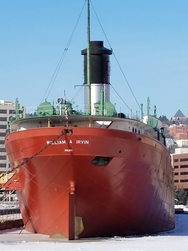
Duluth’s famous retired ore carrier, the William A. Irvin, and privately-owned tourist, charter and recreational vessels will have to find new, temporary homes for this fall’s proposed cleanup of the Minnesota Slip.
The Minnesota Pollution Control Agency (MPCA) is requesting
public comments on the environmental review of the cleanup through March 7.
The Minnesota Slip is contaminated from a century of marine-
and shipping-related activities that helped Duluth become a world class port.
However, for five weeks this fall, visitors will see construction equipment in
an otherwise empty slip during the proposed sediment cleanup project.
The nearly $2 million proposal will place clean material,
dredged from the Duluth/Superior harbor, on top the existing contaminated
sediments. This newly created “cap” will benefit the creatures that dwell in
the sediment and water, including the fish community, while effectively
isolating the contaminants from possible release to the harbor, the St. Louis
River and Lake Superior.
Currently, the slip’s contaminated sediments are 7 to 12 feet
thick with an estimated volume of 37,000 cubic yards. Contaminants include
polyaromatic hydrocarbons, lead, polychlorinated biphenyls, mercury, cadmium,
chromium, copper, nickel, and zinc.
For the project to move forward, state and federal permits
and authorizations will be required. Funding is secured as a 35/65 match
between state bonding dollars and the U.S. Environmental Protection Agency’s
Great Lake’s Legacy Act.
State agencies use an Environmental Assessment Worksheet to
help decide whether a project requires a more extensive Environmental Impact
Statement. The worksheet covers site location details, nearby resources and
other elements, including wells, soil types, water use, air and odor emissions, and traffic.
The worksheet for this project is available online or by
calling Patrice Jensen at 651-757-2465. Written comments may be sent to her at patrice.jensen@state.mn.us, or
mailed to her attention at the MPCA, 520 Lafayette Road N., St. Paul, MN 55155.
All comments must be received by 4:30 p.m. on March 7.
|
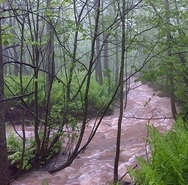
Often overshadowed by the more polluted St. Louis River,
lakes and other rivers in this watershed have their own water quality issues.
The MPCA recently released two reports on
water conditions in the St. Louis
River watershed, part of the Lake Superior Basin. The reports are open for
comment through March 22.
The two reports are the Total
Maximum Daily Loads (TMDL) study and the Watershed
Restoration and Protection Strategies (WRAPS) report. The two are companion
documents that quantify pollutant levels, identify pollution sources, and
propose ways to return water quality to an acceptable level.
Monitoring and analysis showed water quality is fair-to-good
in the watershed’s entire stream network and many of its 375 lakes. In
particular, lake water quality is very good in the watershed’s headwaters and
Whiteface River area in northern St. Louis and Lake counties.
Conditions affecting the watershed’s stream water quality
for aquatic life and recreation such as fish and swimming include:
- Sediment — soil and other matter — that makes the water cloudy and negatively impacts aquatic life
- Changes to stream flow that can lead to erosion and other problems
- Culverts that prevent fish and aquatic insect travel between stream sections
- Excess bacteria in some streams that can be unhealthy for
human contact
The reports recommend strategies for restoring Dinham Lake
and reducing West Two Rivers Reservoir’s nutrient levels, which can lead to excessive
algae in the lakes.
Other strategies include streambank stabilization, managing
stormwater, protecting headwater streams, and working with local cattle farmers
to improve pasture and manure management.
Phosphorus and sediment also currently impair aquatic life
in West Two River and Stony Creek. The cold-water fishery in Wyman Creek,
outside Hoyt Lakes, is also severely impaired due to high water temperatures.
Comments should be submitted in writing by March 22 to Mike
Kennedy, MPCA, 525 Lake Avenue South, Suite 400, Duluth, MN 55802, or by email
to mike.kennedy@state.mn.us. Questions
about the reports can be directed to Kennedy at 218-302-6629 or 800-657-3864.
Written comments must include a statement of your interest
in the report, a statement of the action you wish the MPCA to take, including
specific references to sections of the draft report you believe should be
changed, and specific reasons for your position.
Many partners that helped develop the drafts include the St.
Louis County, North and South St. Louis Soil and Water Conservation Districts,
and many local interested citizens.
|

Lake Superior’s North Shore between Duluth’s
Lester River and Beaver Bay is one of the state’s premier scenic and
recreational attractions. Unfortunately, increasing development, altered
drainage, forests and vegetation have contributed to seven impaired streams.
Two MPCA draft water quality reports, open for public comment through March 28
address these problems and propose several restoration and protection
strategies.
The reports open for public comment are the Total
Maximum Daily Loads (TMDL) study and the Watershed
Restoration and Protection Strategies (WRAPS) report. The two are companion
documents that quantify pollutant levels, identify pollution sources, and
propose ways to return water quality to an acceptable level.
The WRAPS Report summarizes information, tools
and stakeholder input that can be used by local governments, landowners and
others to decide on the best strategies and most effective places for those
strategies to protect and restore water quality.
Known as the Lake Superior – South watershed,
most of this area’s streams have good water quality. Problem areas tend to be
in the streams’ lower sections as they approach Lake Superior. Conditions
affecting the watershed’s water quality include highly erosive clay soils that
are typical of former lake sediments deposited about 11,000 years ago, and
stormwater runoff from impervious surfaces that contribute E.coli bacteria.
The reports recommend strategies to stabilize
streams, minimize lawns and impervious surfaces, plant trees, and establish
conservation easements.
The draft reports are available on the MPCA’s Lake Superior - South Watershed
webpage or at MPCA’s Duluth office, 525 Lake Avenue South, 55802.
Comments should be submitted in writing by March 28 to Brian Fredrickson, MPCA,
525 Lake Avenue South, Suite 400, Duluth, MN 55802, or by email to brian.fredrickson@state.mn.us. No comments
will be accepted by telephone. However, if you need further assistance or
clarification, please call Fredrickson at 218-302-6604.
Written comments must include a statement of
your interest in the report, a statement of the action you wish the MPCA to
take, including specific references to sections of the draft report you believe
should be changed, and specific reasons for your position.
|
Water quality in
the Lower
Minnesota River Watershed has persistent problems with excess phosphorus,
sediment, bacteria, and other contaminants, according to a recent MPCA report.
The watershed
covers 1,835 square miles of south-central Minnesota and includes 87 miles of
the Minnesota River, from just north of St. Peter, to its confluence with the
Mississippi River. The watershed comprises the Minnesota Valley National
Wildlife Refuge, 133 lakes larger than 10 acres, 2,482 miles of tributaries to
the Minnesota River, and the cities of Bloomington, Prior Lake, Winthrop,
Waconia, New Prague, and Le Sueur.
As part of its
regular water-monitoring cycle, the MPCA assessed water quality at more than
200 sites and found violations of state water quality standards throughout the
watershed. Elevated levels of phosphorus are fueling nuisance algae blooms,
which can deter recreation and create public health hazards. Sediment is
clouding the water in lakes and streams and can harm habitat for fish and other
aquatic life. The bacteria contamination detected could pose human health
risks.
Of the bodies of water assessed, 84% of
streams and 57% of lakes do not protect fish, bugs, and other aquatic life.
Fifty-five percent of lakes failed to meet water quality standards for
recreation. In lakes tested for mercury in fish, 74% exceeded standards.
Despite the
problems, the MPCA’s report also noted some good news. Four lakes in the
watershed — Crystal, McMahon, Mitchell, and Bryant — are now meeting water
quality standards that they failed to meet previously. The improvements are the
result of successful restoration efforts by local organizations.
Land use is a
major factor affecting water quality, and in this watershed it runs the gamut
from almost exclusively row-crop agriculture in the west, to residential
suburbs and urban industry in the northeast. More than 90% of the wetlands present
prior to European settlement have been drained to accommodate cropland. The
lack of wetlands prevents water retention on the landscape and leads to
increased storm-related runoff and discharges that can destabilize stream banks
and increase sediment into the water. Similarly, in urban and suburban
environments, impervious surfaces send huge volumes of water into storm drains
and nearby bodies of water.
Local and state
entities have made major efforts toward restoring and protecting the Lower
Minnesota Watershed’s water quality. But dramatic improvements on the landscape
are still needed to meet water quality standards in the watershed’s lakes,
rivers, and streams.
The next step in
the MPCA’s watershed management process will be to identify “stressors” — the
conditions contributing to water quality problems in the watershed. For more
information, read the full Lower Minnesota
River Watershed Monitoring and Assessment Report.
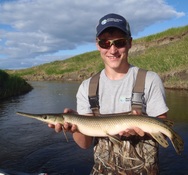
Photo above right: Rickie Guderian, part of MPCA’s summer
monitoring crew, holds a shortnose gar caught in the Lower Minnesota River
Watershed. MPCA monitoring staff examine fish, bugs, and other aquatic life to
help gauge water quality.
|
The
MPCA and Minnesota Department of Natural Resources will be trustees of an $850
million grant from 3M that settles the lawsuit the State of Minnesota filed
against the company in December 2010 over water
contamination by perfluorochemicals, or PFCs, in several east Twin Cities
suburbs.
“Our
primary concern has always been making sure affected east metro residents have clean
drinking water, and this settlement makes sure that happens,” said MPCA
Commissioner John Linc Stine. “We’ll continue to work closely with residents
and communities in the east metropolitan area to ensure a clean, safe drinking
water supply for generations to come.”
A portion of the 3M grant will be dedicated to improving the
east metro’s aquatic resources and wildlife habitat. “We are pleased with the
natural resources restoration and protection portion of the settlement and look
forward to working with the impacted communities as we determine how best to
invest these funds to restore and improve the area’s water resources, fishing
and wildlife habitat,” said DNR Commissioner Tom Landwehr.
For case details, see the “Background
of the 3M Lawsuit” page on the Minnesota Attorney General’s website.
-
Rain Garden Workshop in Northfield, March 8 from 7-8 p.m. and March 15 from 6:30-8:30 p.m. Register through Northfield Community Education (www.northfieldschools.org and click on the "Community Service Registration" or call 507-664-3649).
-
U of M Ecological Restoration Online Courses, March 19-April 29.
- DNR workshop “The Science of Healthy Waters: The Ditching Dilemma,” March 19-21 in Blue Earth, Minn.
-
State of the Water Conference, Freshwater Society, Breezy Point Resort, Brainerd, April 12-14.
-
Clean Water Workshops, hosted by the Izaak Walton League, March 24 in Rochester and March 25 in Winona.
|



