Feedlot program factoid
The Feedlot program factoid is a new feature to appear on occasion in the Feedlot Update newsletter.
How many counties are delegated by the MPCA to administer the 7020 feedlot rule, except for NPDES-permitted facilities?
The answer appears in one of the articles below, and following the Calendar.
|
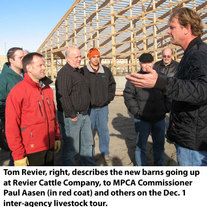
An inter-agency tour
Dec. 1 offered close-up views of a 6,000-cow dairy and 6,000-head cattle barn
under construction. The Pollution Control Agency organized the tour to advance outreach and communication with the
livestock industry and with related state agencies.
“We want to see operations
first-hand. We want to get a chance to make that connection, person-to-person
so we can understand each other better,” said MPCA Commissioner Paul Aasen. The group visited East Dublin Dairy, near Kerkhoven;
Revier Cattle Company and Christensen Farms, near Olivia. A week later, a similar group toured Skyview Dairy near Hutchinson.
Participants on the Dec. 1 tour included:
Pollution Control
Agency: Commissioner Aasen, Deputy Commissioner John Linc Stine, Assistant
Commissioners Michelle Beeman and Rebecca Flood, Regional Manager Gaylen Reetz,
and Communications Director Dave Verhasselt.
Dept. of
Agriculture: Assistant Commissioner Matt Wohlmann.
Board of Water and
Soil Resources: Director John Jaschke.
Board of Animal
Health: State Veterinarian Bill Hartmann; Carl Denkinger, ag specialist; Dale
Lauer, Willmar poultry testing lab.
|
|
 |
The Feedlot Program has completed a big milestone in the
transition of County Feedlot Officers to the state database, as six of the
seven statewide trainings on the Inspection Module have been completed. Counties administering the state delegated feedlot program now have the
advantage of entering feedlot registration information and feedlot inspection
results into the state database. This is the second round of face-to-face
trainings on the MPCA's DELTA database in just under a year - which aim to inform and to standardize
data entry across the program. The recent trainings covered the use of a
standardized inspection checklist, data entry points and exporting
reports. After Jan. 1, 2012, all 55 delegated counties and 83 users,
will be updating the database with feedlot location information and inspection
data, all of which is linked to the MPCA’s What’s
In My Neighborhood website.
DELTA inspection module training wraps up Dec. 14
The final training on the Inspection Module for County Feedlot Officers will be held at
the MPCA St. Paul office on Dec. 14, followed by a DELTA
refresher via WebEx on Jan. 25. Please watch for emails
with additional information regarding WebEx meetings.
The Feedlot Program Training and Communication Team will be hosting
bimonthly WebEx meetings for County Feedlot Officers in 2012. The
meetings will last approximately one hour on topics suggested by county and
MPCA staff in the feedlot program. Discussion topics must be submitted to
Courtney.ahlers@state.mn.us at
least one week prior to the meeting and must be related to the feedlot
program. Guest speakers and outside parties may be invited depending on the
suggested topics. More information will be released via email to CFOs
and at the Jan. 25 DELTA WebEx training.
|
Wayne Cords is the new MPCA East Feedlot Unit supervisor, which has staff located in Mankato,
Rochester and St. Paul. He served in the United States Navy as an Aviation Electrician
working on F/A-18 airplanes and three years as an avionics work center
supervisor. Following his experience in the Navy, Wayne worked in Waseca County
as the County Feedlot Officer, Agricultural Inspector and Zoning Technician for
eight years. His duties in the county included enforcement of local and state
feedlot rules and regulations, enforcement of the Department of Agriculture
noxious weed and seed rules, and implementation and enforcement of the local
zoning ordinance. Wayne has also served as a Board Supervisor on the Waseca
County Soil and Water Conservation District (SWCD) since 2000, including seven
years as the Chairman of the Board. Since September 2007 Wayne has worked for
the MPCA’s Feedlot Program writing feedlot permits, leading compliance &
enforcement actions, providing oversight of county feedlot programs, and
serving as a team leader for the Feedlot Program’s Data Team and the Feedlot Program’s
Land Application Team.
More staff news
|
|
 |
Sheri Reuss leaves feedlot program
After nine years as office and administrative specialist in the Willmar MPCA office, Sheri Reuss has moved to a new post with the Detroit Lakes office. Sheri played a key role in permit-processing and operating the DELTA database. Her data management skills will now be focused on the agency's electronic filing system. NPDES permit applications and questions about DELTA should be directed to Cathy Eidem in the Rochester office, cathy.eidem@state.mn.us, 507-206-2631; or Carrie Heise in the Mankato office, carrie.heise@state.mn.us. A map showing the appropriate office for sending permit applications is shown on the last page of the application form.
|
|
 |
Josh Finnesgard leaves Goodhue for First District
Josh
Finnesgard is leaving the Goodhue CFO post for a new job at First
District Association creamery in Litchfield. First District is nearing completion of a major
expansion. Josh reportedly will be working as a sales rep.
Shane Olson leaves Kittson SWCD for Digi-Key
In
Kittson County, Shane Olson recently departed from the SWCD office and
feedlot program, to a job with Digi-Key in Thief River Falls. The SWCD
office hopes to fill the vacancy by February. Office manager Darren
Carlson says the position would include feedlots, WACA, county ag.
inspection, trees, and cost-share programs.
Troy Dankemeyer resigns from Wabasha SWCD
Troy
Dankemeyer, Wabasha CFO, resigned Dec. 7 from the SWCD. Until a
replacement is named, feedlot duties go to Matt Kruger, who is the
feedlot technician for SWCD Area 7.
|
|
 |
The 2011 Minnesota
Legislature enacted a law change governing the issuance of National Pollutant
Discharge Elimination System (NPDES) permits for large feedlots. Previously,
the law required NPDES/SDS permits for feedlots with 1,000 animal units or
more, or that meet the federal definition of a Large Concentrated Animal
Feeding Operation (CAFO). The revised state law (MN Stat. 116.07, Subd. 7c) now
defers to the federal rule (40 CFR), which requires an NPDES permit only for
CAFOs that discharge or propose to discharge. Non-permitted CAFOs will be held
to a zero discharge standard. However, a facility still may retain its
NPDES/SDS permit. However, Minnesota Rule 7020 (.0405, Subp. 1A)
retains the requirement to obtain a State Disposal System permit for feedlots
or manure storage areas capable of holding 1,000 animal units or more. An
update of the rule is necessary to clarify which sites are required to have
permit coverage. For more information, see the factsheet, "State Disposal System permit for large feedlots" on the MPCA feedlot webpage.
State Register notice launches rule-making process
The Request for Comments (RFC) for the Animal Feedlot
Rule Amendments relating to the proposed SDS permit is scheduled to be published in the State Register on Monday Dec.
19. The comments period will end on
Jan. 20, 2012. The RFC is the first official step in starting the rule
making process, and does not refer to the actual rule amendments, which will be
developed in the coming year. Another public comment period on the draft
amendments will occur then.
Manure can be a valuable resource, or a
pollutant. During winter land applications, preventing manure from
becoming a pollutant can be especially challenging. The risk of pollution
increases with applications near waters. Those who are land applying manure this
winter are reminded that minimum setbacks are required by state law, and
that for NPDES permit holders liquid applications are prohibited except for
“emergency applications."
A
minimum 300-foot setback from surface waters applies to all manure
spread onto frozen or snow-covered soils. Manure may not be applied
within 300 feet of a lake, stream, ditch, tile intake, or wetland. A
300-foot setback can also be used to meet requirements for wells, mines,
quarries and sinkholes. Minimum rates per acre and other permit conditions may also apply if the facility has a feedlot permit.
Also, avoiding winter applications, especially during February, March or April when the risk of melting and runoff is the highest, can help reduce the risk
of pollution. If you need more specific information on winter
requirements please refer to the feedlot permit for the facility or your
regional feedlot office.
The dates and some speakers have been confirmed for the 2012 Commercial Animal Waste Technician training.
- Jan 18 - Minneapolis (Minnesota Pork Congress)
-
Jan 25 - Melrose
-
Feb 16 - Hutchinson (Minnesota Custom Applicators Association Conference)
-
Mar. 1 - Rochester
-
Mar. 16 - Owatonna
- TBD - Pipestone
Regulatory Update by
MPCA personnel coordinated by Courtney Ahlers; Nutrient Management and Water Quality by Grant Pearson (or other NRCS Nutrient
Management Specialist); Economics of Manure Application by Bill Lazarus (UMN), Road Study Results by TBD coordinated by Rick Martens, Drainage Management and Water Quality by Brad Carlson (UMN), Adapting Manure Management Strategies in Response to Climate Change by Jose
Hernandez (UMN), Pumping Manure Safety and Pit Foaming Update by Dr. Larry Jacobson (UMN).
For more information, contact: Dr. Jose Hernandez, Extension Educator -
Nutrient Management, University of Minnesota, (612) 625-4731.
The comment period ended Dec. 9 for a proposed rule to establish general regulations for improving the traceability of
U.S. livestock moving interstate when animal disease events take place. The topic was the subject of a panel discussion Dec. 2 at the Minnesota State Cattlemen's Association convention. "Under the proposed rule, unless specifically exempted, livestock moved
interstate would have to be officially identified and accompanied by an
interstate certificate of veterinary inspection or other documentation, such as
owner-shipper statements or brand certificates. The proposed rule encourages the
use of low-cost technology and specifies approved forms of official
identification for each species, such as metal eartags for cattle," according to the USDA animal disease traceability webpage. The MSCA panel included: J.D. Alexander, National Cattlemen's Beef Association president-elect; Billy Bushelle, Bagley Livestock Exchange manager; Neil Hammerschmidt, USDA Animal Plant Health Inspection Service traceability project manager; and Dr. Bill Hartmann, state Board of Animal Health director.
Jeff Johnson, USDA farm loan specialist located in the Willmar FSA office, is retiring after 34 years of government service. For future issues with conservation loans, Inventory farm easement management or NEPA
compliance items that deal with FSA Farm Loan Programs, the appropriate contacts
would be Stuart Shelstad, State Farm Loan Chief at 651-602-7715, Doug Kunde,
State Farm Loan Specialist, 507-537-1401 x107 or Krista Manor, State Farm Loan
Specialist, 651-602-7713. "I fully intend to remain engaged
in some form of environmental or real estate endeavors so the chance remains
that we may well meet again along the trail or creek or slough or
feedlot," Jeff says.
USDA’s Natural Resources Conservation Service (NRCS) announced that the
ranking period cut-off date for the Conservation Stewardship Program (CSP) is
Jan. 13, 2012. Producers interested in CSP should submit applications to
their local NRCS office by the deadline so that their applications can be
considered during the first ranking period of 2012. A CSP self-screening checklist is available on the CSP webpage.
MPCA news release, 12/12/11
West Central Tribune, 12/711
MPCA news release, 11/21/11
MPCA news release, 11/21/11
Factoid answer
55 delegated counties - Big Stone, Blue Earth, Brown, Carver, Clay,
Cottonwood, Dakota, Dodge, Douglas, Faribault, Fillmore, Freeborn, Goodhue,
Houston, Jackson, Kandiyohi, Kittson, Lac qui Parle, Lake of the Woods,
LeSueur, Lincoln, Lyon, Marshall, Martin, McLeod, Meeker, Morrison, Mower,
Murray, Nicollet, Nobles, Norman, Pennington, Pipestone, Polk, Pope, Red Lake,
Renville, Rice, Rock, Scott, Sibley, Stearns, Steele, Stevens, Swift, Todd,
Traverse, Wabasha, Wadena, Waseca, Watonwan, Winona, Wright, Yellow Medicine.
The MPCA Feedlot
Update welcomes news submissions from partners about, projects, people, and
upcoming events. Email submissions to forrest.peterson@state.mn.us.
Please note that the MPCA has switched to a new service, called GovDelivery, to
deliver the Feedlot Update. To ensure delivery of these messages, please add mpca@public.govdelivery.com
to your address book or safe sender list.
|




