Registration opened Thursday for Gov. Mark Dayton’s Water
Summit, which will take place on Saturday, Feb. 27 in downtown St. Paul.
The summit will focus public attention on the serious challenges facing Minnesota’s
water supplies – in both rural and urban areas of the state – and continue
statewide dialogue around steps that must be taken to address those challenges.
The summit will bring together water quality experts, farmers, legislators,
regulators, the business community, members of the public, local leaders, and a
wide variety of other stakeholders.
Registration for the summit is open
to all Minnesotans and free of charge. The event will be held at InterContinental
Saint Paul Riverfront starting at 8:30 a.m. Feb. 27.
To ensure that all Minnesotans’
voices are heard on this important, statewide issue, stakeholders and other
interested members of the public are encouraged to take this online survey,
launched in conjunction with the Governor’s Water Summit, regardless of whether
they plan to attend the summit in February. The information and input gathered
from this survey will help inform the Administration and Legislature on
Minnesota’s water quality challenges and possible solutions.
Also
Thursday, Dayton announced a
$220 million proposal to address the state’s aging water infrastructure.
|
The Minnesota Pollution Control Agency (MPCA) will soon be seeking
applications for projects that will reduce nonpoint source pollution in
Minnesota’s lakes, rivers, and streams. Funding for selected projects will be
provided by the Federal Clean Water Act Section 319 (Section 319) grant
funds. Once open, the MPCA will accept applications for about one month.
The MPCA anticipates about $2.5 million will be available
this year, contingent upon Congressional appropriation.
Only
Total Maximum Daily Load (TMDL) and Watershed Restoration and
Protection
Strategies (WRAPS) implementation projects will be funded. Eligible
applicants must have a TMDL implementation plan or WRAPS approved by the
MPCA by Feb. 29, 2016. No nonpoint source development, education or
applied research projects (DER) projects will be
funded this year.
Other changes this year include no maximum limit on funding
requests and the local cash or in-kind match has been reduced to 40 percent.
Grant
funds are limited and MPCA urges proposers to request only those funds needed
to complete a project by Aug. 31, 2020.
The
complete Request for Grant Application, applications form, and other
information will be available on the MPCA website.
The Legislative-Citizen
Commission on Minnesota Resources is accepting proposals through March 31 for grants from the
Environment and Natural Resources Trust Fund, which is funded with Minnesota
Lottery and investment proceeds. The commission expects that $50 million will
be available for projects that start in July 2017.
The commission is responsible for making funding recommendations
to the 2017 Minnesota Legislature. (The 2016 Legislature will vote on
recommendations for proposals received last year.)

Projects are being sought in the following areas:
- Foundational natural resource data
and information
- Water resources
- Environmental education
- Air quality, climate change, and
renewable energy
- Methods to protect or restore land,
water, and habitat
- Land acquisition, habitat, and
recreation
Note that electronic submission of proposals
is required. Commission staff are
available to assist and review draft proposals if submitted by March 11. Early
submission of drafts is recommended to receive the most detailed guidance.
The intent of this funding program is to provide access to
everyone for innovative ideas for environmental or natural resource projects
that provide multiple ecological and other public benefits to Minnesota. Projects
must be consistent with the commission’s Six‐Year Strategic Plan for the trust fund and the adopted funding
priorities described in the RFP.
The full Request for Proposals is available on the commission’s website.
|
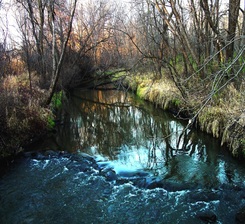
The MPCA, Coon Creek
Watershed District, and local groups are recommending a number of actions to
restore and protect water bodies in the Coon
Creek watershed. The watershed is located in Anoka County and includes the
cities of Andover, Blaine, Columbus, Coon Rapids, Fridley, Ham Lake, and Spring
Lake Park. The Coon Creek Watershed
Restoration and Protection Strategy (WRAPS) report and Total
Maximum Daily Load report are available for public comment through Jan. 28.
Several streams in the
Coon Creek Watershed are impaired for aquatic life and high levels of E. coli
bacteria. Stream bank erosion and stormwater runoff are having a negative
effect on the watershed’s water quality. Urban development and agricultural
activities in the watershed have resulted in runoff that carries excess
phosphorus, sediment, and bacteria into bodies of water. These pollutants
degrade water quality and are harmful to fish and other aquatic life. The TMDL
report quantifies the pollutant levels, identifies the sources of the
pollution, and proposes ways to bring water quality back to an acceptable
level.
The WRAPS report
identifies impaired water bodies and those in need of protection, and
identifies the actions needed to achieve and maintain water quality. For
example, installing buffers of plants along shoreland, stabilizing stream
banks, and implementing stormwater-control projects will help improve water
quality in the watershed.
These reports are part
of the state’s watershed approach, a holistic way of gauging the health of
streams and lakes, and developing strategies to restore or protect their water
quality.
The MPCA encourages
those interested in the Coon Creek Watershed to review and provide feedback on
the reports. Comments on the reports should be submitted in writing by Jan. 28
to Rachel Olmanson, MPCA, 520 Lafayette Road N., Saint Paul, MN 55155-4194, or by
email to rachel.olmanson@state.mn.us. Olmanson is available to answer questions at
651-757-2473.
Written comments must
specify which report you are commenting on, include a statement of your
interest in the report, and the action you wish the MPCA to take, including
specific references to sections of the draft report you believe should be
changed. You must state the specific reasons for your position.
|
The U.S. Environmental Protection Agency
recently approved the TMDL
report for the Vermillion
River watershed. The MPCA also approved the WRAPS
document for this watershed that covers 335
square miles in central Dakota County and extreme southeast Scott County in
the Twin Cities metro area. This watershed is part of the
larger Mississippi River – Lake Pepin watershed.
In-depth
monitoring and analysis have identified high levels of bacteria, sediment, and
phosphorus in many of the lakes and streams in the watershed. Increased urban
development, agricultural activities, and ditching and stream alterations are
having a negative effect on water quality.
In
addition, increased amounts of warm water from urban runoff and a lack of shade
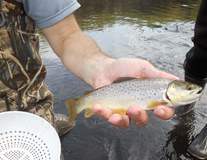
are stressing coldwater aquatic species, including brown trout. The report
reports identify impaired water bodies and those in need of protection, and outlines
actions to achieve and maintain water quality. For example, to reduce warm
water and protect coldwater species, trees and other native vegetation should
be planted along the stream to shade it.
Many groups are participating in restoration and protection
efforts, including the Vermillion River Watershed Joint Powers Board, the
Dakota County Soil and Water Conservation District, local governments, and
several state agencies.
|
Erosion control annual conference Jan. 26-28
The
Minnesota Erosion Control Association
will hold its annual conference and trade show Jan. 26-28 at DoubleTree Park
Place in Minneapolis. In addition to several sessions, Michelle Beeman, deputy
MPCA commissioner, will be the keynote speaker Jan. 27; Seth Brown of Maryland, founder of Storm and Stream
Solutions, will speak Jan. 27; Chad Pregracke of Illinois, founder and president
of Living Lands and Waters, will speak Jan. 28; and William Hunt, North
Carolina University professor and Extension specialist, will speak Jan. 28.
Registration
is available online;
fees vary with membership and days of attendance.
Road salt symposium
Feb. 4 in Chaska
The Freshwater Society, MPCA
and several other groups will host the 15th Annual Road Salt Symposium Feb. 4
from 8 a.m.- 3 p.m. at the Minnesota Landscape Arboretum in Chaska. This
symposium will focus on tools and practices that reduce salt use while still
maintaining safe roads. Cities, counties and other entities can learn how to
use less salt and save money, keep their public and customers safe, educate their
citizens, and do their part to protect Minnesota waters.
For more information and
to register ($135 fee or $85 for students and seniors), go to the Freshwater Society website.
Cannon
River group hosting film festival Feb. 5, Feb. 21
The Cannon
River Watershed Partnership in southern Minnesota will host its second Wild and
Scenic Film Festival Feb. 5 at 7 p.m. at the Sheldon Theatre in Red Wing and Feb.
21 at 2 p.m. at the Weitz Center for Creativity at Carleton College in
Northfield. Tickets are $10 for students, seniors and CRWP members and $15 for
the general public. The event includes seven short films about resources in
Minnesota, the southwest United States, the Arctic and overseas.
Watershed
groups to host corn research update for farmers Feb. 11
The Heron Lake Watershed District (HLWD) and
Redwood-Cottonwood Rivers Control Area (RCRCA) will host “Findings and Recommendations for Corn Belt
Farmers” on Thursday, Feb. 11 from 1-3 p.m. Participants will
meet at the University of Minnesota Southwest Research and Outreach Center,
23669 130th Street, Lamberton, MN 56152. The event will highlight findings and
recommendations from the Sustainable Corn project.
Farmers will learn the results of a five-year, U.S. Department of
Agriculture- National Institute of Food and Agriculture (USDA-NIFA) research project, focused on farm management
practices and their potential for making corn production more resilient. The
practices provide resiliency in times of drought, reduce soil and nutrient
losses under saturated soil conditions, decrease farm field nitrogen losses,
retain carbon in the soil, and ensure crop and soil productivity.
If unable to make it to Lamberton, farmers
and others interested may join by webinar at the USDA sustainable corn website.
Forums Feb. 26 andMarch 11: Protecting Mississippi from climate change
Seven
mayors from cities on the Mississippi River attended the 2015 Paris Climate
Conference to speak to the importance of a clean and healthy Mississippi River
in communities' resilience to climate change and the importance of halting
climate disruption to protect the river. Among them were St. Paul Mayor Chris
Coleman and St. Cloud Mayor Dave Kleis, who will speak at the next Mississippi
River Forums on how the agreements arrived at the conference will affect their
work to protect the river.
The
forums will be held Friday, Feb. 26
from 8.-9:30 a.m. in St. Paul and Friday, March 11 from 8--9:30 a.m. at St.
Cloud. Visit the National
Park Service website for RSVP, location, and webex details.
|




