|
The Clean Water Partnership (CWP) program is now accepting
applications from local governmental units interested in loan funding to lead a
nonpoint source pollution control project for protection or restoration of
Minnesota’s water bodies. A total of $11 million is available in funding. Application can be made at any time. Currently
there is no end date for application.
The Clean Water Partnership Loan Program Request for
Proposals (RFP) can be found on the MPCA
website. The application and related
information will be accepted through an email address listed in the RFP. The CWP grant program previously used the State
Wide Integrated Financial Tools (SWIFT) system as a publishing tool for grants.
It will not use SWIFT for the
continuous funding round.
The 2015 Legislature did not fund Clean Water Partnership
grants. As a result, MPCA will not offer CWP grant funding rounds in 2016 or
2017. Current CWP projects will continue until their agreement end dates, the
last of which will be June 30, 2018.
 The Conservation Partners Legacy Grant Program (CPL) has funding available
for the Expedited
Conservation Projects (ECP) grant cycle. $600,000 remains for Fiscal Year 2016
and applications will be accepted through mid-May, or until funds run
out.
This grant program funds conservation projects that restore, enhance, or
protect forests, wetlands, prairies, or habitat for fish, game, and wildlife in
Minnesota. The expedited grant cycle provides a simplified application and
review process for smaller, standard habitat projects. These grant requests may
range from $5,000 to $50,000 and require a 10-percent match of non-state funds.
Applicants must be either a nonprofit organization or a government entity.
Partnerships are encouraged.
To be eligible for these funds, projects must be on public lands or
waters open to all seasons of hunting and fishing. The next application
deadline is Nov. 18 at 4 p.m.
Questions? Please email lscplgrants.dnr@state.mn.us.
|
The University of
Minnesota’s Southeast
Regional Sustainable Development Partnership is taking applications for support of collaborative
research-based projects the improve surface or groundwater quality in southeast
Minnesota.
Individuals, groups and
local units of government from a 16- county region in southeast Minnesota are
eligible to apply. The partnership is interested in innovative ideas that will help
to ensure southeast Minnesota is an area where clean water, diverse natural
systems and healthy soils coexist with productive farms, industry and vibrant
communities.
Project ideas should fit
into one of the following priority areas:
- Promote collaborative strategies
within local units of government that address the needs of growing communities
from a natural resources perspective.
- Promote research, understanding and
use of Best Management Practices (BMPs) for farming, urban and shoreline
(rivers and lakes) land use.
- Prevent pollution of groundwater.
The partnership will
support approved projects in the $2,000 to $20,000 range. Funds go toward
University resources such as research faculty, extension staff, and student interns for community-based, applied research projects. Project timelines can be from a
few months to multiple years. To apply,
download and complete a copy of the RSDP Idea Brief by clicking on the Light
Bulb icon at at www.rsdp.umn.edu.
Applications are due Dec.
15, 2015 with notification of award decisions by Feb. 15. For more information contact Beth Kallestad, Natural Resource Work Group Program
Coordinator, at 507-301-9900 or bethcrokallestad@gmail.com
 The
Legislative-Citizen Commission on Minnesota Resources whittled its recommended
2016 proposal list to 88 at its Oct. 20
meeting. The proposals total $45.4 million from the Environment and Natural
Resources Trust Fund derived from lottery and investment proceeds.
The commission originally received 186 proposals totaling $130.9
million and heard presentations on 97 proposals totaling $70.4 million. About $46.3 million is expected
to be available for projects to begin July 1, 2016.
The
commission will meet in December to finalize its funding recommendations
package for submittal to the 2016 Minnesota Legislature for review and
approval. Visit the commission’s proposal
and funding process
webpage for additional information.
|
The
Minnesota Department of Agriculture (MDA) received $1 million of Clean Water
Funds to support the Forever
Green Agricultural Initiative at the University of Minnesota for fiscal
year 2016. The program selected 11 projects which focus on incorporating
perennial and winter annual crops into existing agricultural practices through
a request for proposal process administered by the University. The MDA will
oversee the distribution of funds and coordinate reporting on progress results
and outcomes.
The
following research projects were selected for funding:
- Advanced Management Practices for
Enhancing Profitability of Intermediate Wheatgrass
- Advancing Hazelnut Micro-Propagation
- Agronomics Development of Winter Annual
Oilseeds in a Field Corn Production System
- Developing Genomic Resources for Helianthus
Divaracatus to Facilitate the Development of Perennial Sunflower for Food
Production and Wildlife Services
- Effect of Cover Crops on Water Use and
Nitrogen Leaching in Corn and Soybean Cropping Systems
- Effect of Refinement and Dough
Conditioners on the Quality of Intermediate Wheatgrass for Food Applications
- Field Pennycress Breeding Project
Support
- Integrating Winter Annual Cover Crops
into Corn and Soybean Rotations in Minnesota
- Intermediate Wheatgrass Breeding
Support using Phenotypic and Genotypic-based Selection Methods
- Population Dynamics of Soybean Cyst
Nematode in Winter Annual Oilseeds
- Sustaining Hazelnut Breeding and
Agronomic Research at the University of Minnesota
According to the university’s website, “Most
of our current crops are 'summer-annuals' that are grown during the summer. By
selectively adding winter-annual and perennial crops to our agricultural
landscapes to create new crop production systems, we can enhance the prosperity
of Minnesota agriculture, support rural communities, and provide major benefits
to all Minnesotans.”
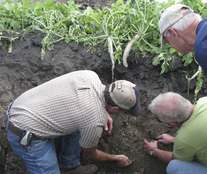
Photo above: Radish cover crop in Minnesota.
|
|
The Minnesota Department of Agriculture (MDA) is requesting
comments through Jan. 26 on topics relating to the state’s proposed Nitrogen
Fertilizer Rule designed to protect groundwater. This rule will address
agronomic crops that require significant amounts of nitrogen fertilizer. These
crops include corn, small grains, edible beans, sugarbeets, and irrigated
potatoes grown in the crop rotation.
The purpose of this request for comments is to solicit
stakeholder feedback on a variety of proposed topics related to the rule. The
proposed Nitrogen Fertilizer Rule will require the regulatory provisions
discussed in the state’s blueprint for preventing or minimizing the impact of
nitrogen fertilizer on groundwater, called the Nitrogen
Fertilizer Management Plan (NFMP).
The rule will consist of two parts:
- The first will apply to areas of the state overlying
vulnerable groundwater areas where nitrogen fertilizer applications in the fall
or to frozen soils will have restrictions.
- The second will apply to areas where measured nitrate levels
in groundwater are elevated and the state has determined that nitrogen
fertilizer Best Management Practices (BMPs) are not being adopted. Restrictions
will vary for different regions and soil types, and will be based on the
nitrogen BMPs developed by the University of Minnesota and adopted by the MDA.
Visit the MDA’s Nitrogen
Fertilizer Rule website for more information, or contact Larry Gunderson at
larry.gunderson@state.mn.us or
Katie Wolf at katie.wolf@state.mn.us.
|
Facing
escalating costs to denitrify its drinking water, taken from the Raccoon River,
the Des
Moines Water Works is suing three upstream counties over nitrate levels in
the river.
The utility
provides drinking water for 500,000 urban and rural customers in central Iowa. To
meet federal standards, it had to denitrify its water for a record 148 days in
one year, according to Bill Stowe, CEO and General Manager of the utility.
That’s up from the previous record of 108 days.
Stowe
recently spoke in St. Paul and Mankato as part of a lecture
series held by the Freshwater Society.
The utility
is suing three Iowa counties and their drainage districts. alleging they discharge
nitrate pollutants into the river, and fail to obtain a National Pollutant
Discharge Elimination System (NPDES) permit in violation of the Clean
Water Act. The complaint seeks to declare the drainage districts as “point
sources,” meaning they are subject to regulation and required to have a permit under
federal and Iowa law.
Though more
than 30 counties make up the drainage area for the Raccoon River, Des Moines
Water Works named the three counties of Buena Vista, Sac and Calhoun in the
lawsuit because water monitoring shows high nitrate concentrations in drainage
tile in those counties where the only source is agriculture. There are no other
sources such as wastewater treatment plants and golf courses, Stowe said.
The utility
chose to sue because it is spending more than $1 million a year to denitrify
its drinking water to safe consumption levels. If nitrate trends in the Raccoon
River continue to climb, then the utility will need to build a new
denitrification facility, estimated to cost between $76 million and $183
million.
Stowe said he
understands the need to drain water for agriculture, but it’s being done with
no regard to the quantity and quality of water being moved downstream.
According to Iowa State University researchers, corn and soybean fields are the
primary cause of nitrate levels in Iowa waterways.
“No other business besides ag can run a pipe
without regulation to a water of the state,” Stowe said.
With a
permit, the drainage districts would need to meet pollutant limits for their
discharges. Stowe cited conservation practices like nitrogen stabilizers and
saturated buffers that could reduce nitrate levels in streams.
“We don’t
want to bankrupt agriculture. We want to put the cost of taking out the nitrate
off our customers and back on the people benefiting from it,” he said. “This
not an issue that’s going to go away on voluntarism.”
According to
news reports, Iowa farm leaders say solutions like cover crops and bioreactors that
reduce nitrogen leaching take time to get in place. Also, the law firm
representing the counties argues that the drainage districts have no power to
direct how landowners use or manage their properties, nor control over what
goes through the drainage tiles.
The lawsuit
is scheduled to be heard in federal court in Sioux City in August 2016.
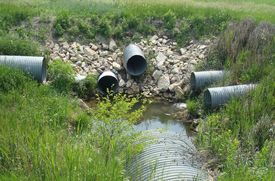
Photo above:
Agricultural drainage systems in Sac County, Iowa, from Stowe’s presentation.
|
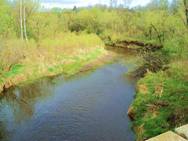
The MPCA and local partner
groups have developed a plan to restore and protect water quality in the Goose
Creek watershed. Goose Creek watershed, located north of the Twin Cities
metropolitan area, includes portions of Chisago and Pine counties. The Goose
Creek Watershed Restoration and Protection Strategy (WRAPS) report and Goose
Creek Watershed Total Maximum Daily Load (TMDL) report are available for
public review through Dec. 4.
Water quality monitoring and
analysis has shown that high levels of bacteria and phosphorus are present in
many water bodies within the Goose Creek watershed. The TMDL report quantifies
the pollutant levels, identifies the sources of the pollution, and proposes
ways to bring water quality back to an acceptable level.
The WRAPS report identifies
impaired water bodies and those in need of protection, and recommends steps
needed to achieve and maintain water quality. For example, to reduce the amount
of nutrients such as phosphorus in the watershed, stream buffers must be
re-established along the lakes, streams, and ditches to reduce runoff, and the
amount of phosphorus runoff from agricultural and rural lands must be reduced.
Many groups are participating
in restoration and protection efforts, including the Chisago County Soil Water
Conservation District, Pine County Soil and Water Conservation District,
Chisago County, local governments, lake associations, and several state
agencies. Individuals are always encouraged to get involved.
The MPCA encourages those
interested in the Goose Creek Watershed to review and provide feedback on the
reports. Comments on the reports should be submitted in writing by Dec. 4, to Christopher Klucas, 520
Lafayette Road North, St. Paul, MN 55155-4194 (651-757-2498).
Written comments must specify
which report you are commenting on, and should include a statement of your
interest in the report and the action you wish the MPCA to take, including
specific references to sections of the draft report you believe should be
changed. You must state the specific reasons for your position.
|
“The Intersection of Water Quality and
Agriculture,” a one-day special session, will be
Nov. 18 from 8 a.m.-5 p.m. in Minneapolis and online as a live streaming event.
This session will explore the
intersection of water quality and agriculture in Minnesota, and address how
projects relate to the larger watershed and considerations of downstream
impacts. Speakers will cover both a national and state/local perspective
with specific comments on what has worked in their partnership experiences, lessons
learned, and next steps. Climate changes that are impacting land and water
resources, and management decisions, will also be discussed.
This session is part of the annual
meeting for the American Society of Agronomy, Crop Science Society of America,
and Soil Science Society of America.
More
information and registration is available on the meeting
website.
The fall Watershed Professional Network meeting will be Thursday,
Nov. 19, 9:30 a.m-3 p.m., at the New
Ulm Pizza Ranch. This network focuses on water quality efforts in the Minnesota,
Crow and Lower Mississippi river basins. Topics for the November meeting
include ag and water quality research, one watershed-one plan perspectives, Minnesota
River Congress, and updates from watershed groups.
The Minnesota
Association of Soil and Water Conservation Districts (MASWCD) Annual Meeting
and Trade Show will take place on Dec. 6-8 at Double Tree by Hilton Hotel in
Bloomington, Minn.
With the recent passage
of the state's buffer legislation, the annual meeting will include the latest
guidance on the development of the DNR buffer protections maps for public
waters and public drainage systems subject to the requirements.
Additional sessions
will highlight: district shared services, comprehensive watershed management,
groundwater management, pollinator habitat and native plants, district
outreach, and more. The annual meeting includes a trade show featuring
conservation programs, products and technologies.
More information and
registration are available on the annual
meeting webpage.
The
Minnesota Association of Watershed
Districts will meet Dec. 3-5 at the Arrowwood Conference Center in
Alexandria. Michael Simpson, of Antioch
University New England and the Center for Climate Preparedness and Community
Resilience, will be the keynote speaker Dec. 4, presenting on “Preparing
communities for an Uncertain Future in Light of a Changing Landscape and
Climate.” Breakout sessions will include Minnesota’s buffer initiative;
stormwater management at Lowertown Ballpark, home of the St. Paul Saints minor
league baseball team; One Watershed One Plan; and more. Details available on
the association
website.
|