|
August 2015
The Basin Alliance for the Lower
Mississippi in Minnesota (BALMM) will meet Wednesday, Aug. 19, from
9 a.m. to noon at the People’s Energy
Cooperative, 1775 Lake Shady Ave. South
in Oronoco, Minn.
Agenda
as follows:
-
9 a.m. - Results of recent surveys and interviews in the Cannon River Watershed, Amit Pradhananga, Research Associate, Department of Forest Resources, University of Minnesota
-
10 a.m. BREAK
-
10:30 a.m. - Status update on the new Buffer Law, Tom Gile, Board Conservationist, BWSR – Rochester
- Noon - Adjourn
How do farmers and landowners make decisions about
conservation practice adoption? Amit Pradhananga, research associate with the
Department of Forest Resources at the University of Minnesota, worked on a study that provides a comprehensive decision-making
framework that identifies drivers and constraints associated with voluntary
conservation practice adoption. At the Aug. 19 BALMM meeting, he will discuss results of the study, which was
conducted among farmers and landowners in the Cannon
River watershed.
Tom Gile, conservationist with the Minnesota Board of Water and SoilResources in Rochester, will give a status update of the recently passed “Buffer Law.” What exactly does the language say? What are the plans for its implementation? Tom will give the latest news at the BALMM meeting Aug. 19.
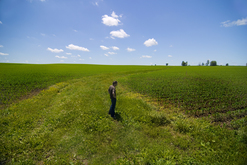
Background
The ditch buffer legislation passed in the
legislative special session will be in Minnesota Statutes 103F.48, and will
appear in the upcoming 2015 Statutes publication. The DNR website provides
background reports and information on implementing
the ditch buffer initiative.
Provisions of the law
(summarized in the Star Tribune June 13):
-
The Department of Natural Resources will map all public waters and ditches that will be subject to buffers by next July, and will be given $650,000 from the Clean Water Fund to do so.
- Fifty-foot buffers must be installed on public waters by November 2017 and 16.5-foot buffers on public ditches by November 2018. Gov. Mark Dayton had wanted the buffers by 2016.
- Many small streams, headwaters and ditches aren’t “public.” Dayton’s original proposal would have required that some of them, too, have 50-foot buffers. Now it will be up to the state’s 90 county soil and water conservation districts to identify those that need buffers.
- Over the first two years, the districts will share $22 million from the Legacy Amendment’s Clean Water Fund for technical assistance costs. That’s an average of about $242,000 for each district. After the first two years, funding comes from the state’s general fund.
- The state Board of Water and Soil Resources (BWSR) can withhold funds to soil and water conservation districts that fail to implement the law. The agency has been allocated $5 million from the Clean Water Fund to help with implementation.
- Counties, watershed districts or BWSR will enforce the law, and fines up to $500 can be issued; multiple fines could be issued. “You can’t just pay to not have a buffer,” said John Jaschke, BWSR executive director. (Under Dayton’s original proposal, the DNR would have enforced the law.)
- No new money is in the bill to pay landowners to take cropland out of production and plant buffers,
but there is $33 million from the Clean Water Fund and the Outdoor Heritage
Fund available for easements and other financial assistance to help landowners
meet or exceed buffer requirements. The federal Conservation Reserve Program
(CRP) and state Reinvest in Minnesota (RIM) program can provide annual or
easement payments.
|
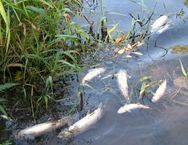
The Minnesota
Department of Agriculture, Department of Natural Resources and Pollution
Control Agency continue to investigate a fish kill that occurred the week of
July 27 on the South Branch Whitewater River east of Rochester:
Staff members
are looking into what caused thousands of fish to die over a 3-mile stretch of
the river after heavy rains in the area July 27-28. Citizens reported large
numbers of dead fish on July 30. Because of the elapsed time, any pollutants
from possible runoff were not apparent by
the time water samples were taken, and the fish
carcasses were too decomposed for necropsies.
Lab personnel
from the Department of Ag analyzed water samples for 138 compounds including
insecticides, herbicides and fungicides, and found no unusually high
concentrations that should cause a fish kill
of this magnitude. Runoff from agricultural fields can impact water quality,
but often multiple factors – such as water temperature, contaminants, low
oxygen – combine to stress or kill aquatic creatures.
At this
point, investigators have been unable to determine a specific or single cause
of the fish kill. The three agencies will continue to look into the incident.
Several media
covered the recent fish kill:
|
The MPCA was not awarded grant funds for the Clean Water Partnership
(CWP) from the 2015 Legislature. As a result, there will be no CWP grant
funding rounds in 2016 or 2017. Current CWP projects will continue until their
agreement end dates, the last of which will be June 30, 2018.
Although there will be no grant funding, there is almost $11 million
available for CWP loans in the next biennium. In order to take advantage of
this opportunity, as well as the Governor’s Buffer Initiative, the CWP loan
program is developing an open funding process for loan-only applications that
allows project sponsors to apply and receive loan funding at any time during
the year. Details of the process are still being finalized, but are expected to
be available soon.
If you have any questions please contact Pete Fastner
of the MPCA Watershed Section at 651-757-2349, peter.fastner@state.mn.us
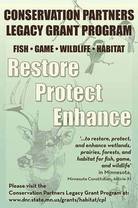
The
Minnesota Dept. of Natural Resources (DNR) is accepting applications for its
Conservation Partners Legacy grant program. This program funds conservation
projects that restore, enhance, or protect forests, wetlands, prairies, or
habitat for fish, game, and wildlife in Minnesota. Grant requests may range
from $5,000 to $400,000 with a maximum total project cost of $575,000.
Nonprofit organizations and government entities are eligible to apply, and a
10-percent match of non-state funds is required. Funding for this program comes
from the Outdoor Heritage Fund.
For
the Traditional and Metro grant cycles, $6.8 million is available. These
projects must be on public lands or waters or on lands protected by a permanent
conservation easement. Apply by Sept. 14.
For
the Expedited Conservation Projects
(ECP) grant cycle, $1 million is
available. These grants, up to $50,000, are for eligible activities on public lands
or waters open to all seasons of hunting and fishing. This cycle is open
continuously for applications until May 18, 2016, or until all funds are awarded. Apply by Sept. 16 for the first
round of funding.
Visit these webpages for details:
Questions?
Please email lscplgrants.dnr@state.mn.us
for more information.
|

The Lessard-Sams
Outdoor Heritage Council received 44 proposals totaling more than
$285 million in response to its call for funding proposals. This total far
exceeds the $100 million the council estimates will be available for total
funding for fiscal year 2017. The council will review the proposals and make
recommendations for funding to the 2016 Legislature for approval.
The
proposals range from $663,000, which the Audubon Society would use to control reed
canary grass and plant trees for enhancing the floodplain forest of the
Mississippi River in southeast Minnesota, to $25 million, which the Minnesota
Board of Water and Soil Resources would use to fund phase 7 of the Reinvest in
Minnesota wetlands program.
In
southeast Minnesota, the proposals include:
-
$9.5 million to The Nature Conservancy for Phase 4 of the Southeast Minnesota Protection and Restoration to protect 2,150 acres and enhance 1,575 acres of declining habitat for important wildlife species in Fillmore, Goodhue, Houston, Olmsted, Wabasha and Winona counties.
- $1.06 million to the Root River Restoration and Preservation to restore fish habitat in the river.
- $1.05 million to the Trust for Public Land for Phase 6 of the Cannon River Watershed Habitat Complex to
protect and restore 160 acres of wetlands, prairie, forests and shoreline to
reverse habitat loss, improve watershed function and provide access.
See the full list of proposals on the council webpage.
The
Outdoor Heritage Fund is one of four funds created by the Clean Water, Land and
Legacy Amendment, and receives one-third of the money raised by the tax
increase.
|
The MPCA is amending its Water
Quality Variance rules and planning to publish notice of the proposed rules in
summer 2015.
A Water
Quality Variance is a temporary change in a state's water quality standard for
a specific pollutant and its relevant criteria, allowing a particular
discharger to deviate from meeting a water quality-based effluent limit. As the
agency delegated to implement the Clean Water Act, the MPCA may grant variances
through the National Pollution Discharge Elimination System/State Disposal
System (NPDES/SDS) permit program. Because of this delegation, MPCA must assess
a variance using the same conditions and criteria that the U.S. Environmental
Protection Agency (EPA) uses.
Minnesota’s
water quality rules have variance provisions in three different rule chapters.
The procedures for granting a variance are different in each chapter. The
chapter 7052 rules are based on federal rules and apply to the Lake Superior
Basin while the chapter 7050 and 7053 rules apply to the rest of the state and
differ from federal requirements. These differences are confusing to regulated
parties, and make it difficult for the MPCA to maintain consistency in the
variance process and comply with federal requirements. The rule changes are to
address these differences and provide consistent application of the state’s
variance rules and federal requirements.
If
interested in receiving electronic notices about these rules, the agency
encourages you to subscribe to Water Quality Variance Rule email updates.
Information on these rules is available on the MPCA’s Water Quality Variance Rulemaking webpage.
|




