|
The Minneapolis Park and Recreation Board (MPRB) expects that Minneapolis trees and lakes will feel the effects of a forecast for sun and temperatures in the 80s or even 90 and above, through late next week.
If you can, please water street trees near your residence; and know that algae growth is likely on many city lakes. Read on for more information.
Helping thirsty street trees
Hot, dry weather can stress trees. This is especially true for trees under five years old, which includes many new or recently planted trees on city boulevards (the land between the sidewalk and the street).
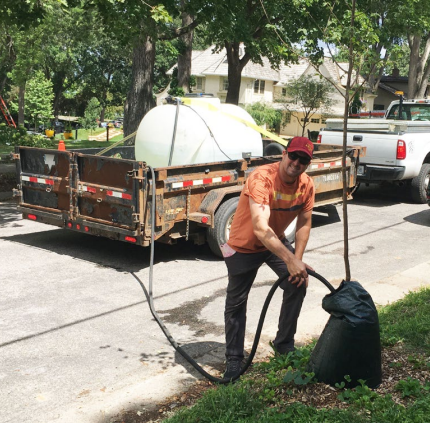
MPRB plants thousands of trees every spring, and asks Minneapolis residents to remember that trees need water any time local rainfall is less than an inch in a week - from spring through summer and fall.
With an already dry spring, season staff have begun overtime shifts to provide extra water for newly planted trees.
How you can help: see information below on three options for watering street trees
|
Hot, sunny weather rapidly warms the city's lakes and promotes rapid growth of algae. MPRB has already received reports of filamentous algae at several lakes.
This type of algae forms greenish mats on the water surface and can be nuisance - but it also provides cover for aquatic insects, snails, and other animals that are valuable fish food.
Filamentous algae is sometimes confused with blue-green algae, which is a type of
cyanobacteria. Both float on the surface of lakes and ponds, but there is an easy way to
tell them apart: Try using a stick to lift the algae out of the water. Filamentous algae has a stringy
consistency and clumps together when lifted.
MPRB begins monitoring water quality at beaches, including potential toxins, when life guard season begins: typically over Memorial Day weekend.
Fish die-offs
Fast warming water causes stress for fish and leaves them more susceptible to illness. Certain disease-causing bacteria are always present in fish populations but seem to affect fish more often in spring, when they are already stressed from spawning.
When a fish-die off occurs, it is usually a small percentage of the total population that is affected. Panfish are most often affected, but occasionally northern pike can be susceptible. No fish kills have been observed this season in the Minneapolis lakes.
Options for watering street trees
Watch this video or keep reading
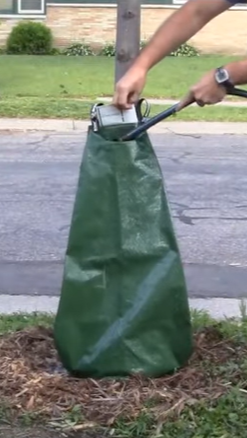
Option 1 - tree watering bag (usually new trees)
Fill the bag once a week.
When it's one-quarter full, pull up on the bag handles to straighten it.
Bags hold 20 gallons of water and take about five minutes to fill.
|
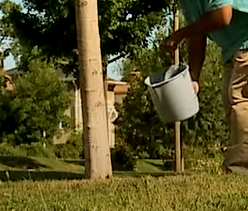
Option 2 - five-gallon bucket
Slowly pour water from the filled bucket around the base of a tree.
Do this four times for 20 gallons once a week.
|
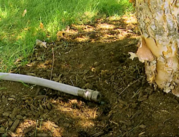
Option 3 - garden hose
Turn the hose on to a slow trickle.
Place it at least six inches from the tree trunk.
Let it run for an hour each week.
|
-
Water in the evening to minimize evaporation; trees also tend to take in more water during the night. Watering one tree weekly costs only about $3 for 23 weeks: the entire summer/fall season.
-
Track your tree watering by doing it on your weekly trash pick-up day.
Learn more
minneapolisparks.org/trees
minneapolisparks.org/lake_water_resources
|