|
NEWSLETTER / NOVEMBER 2025
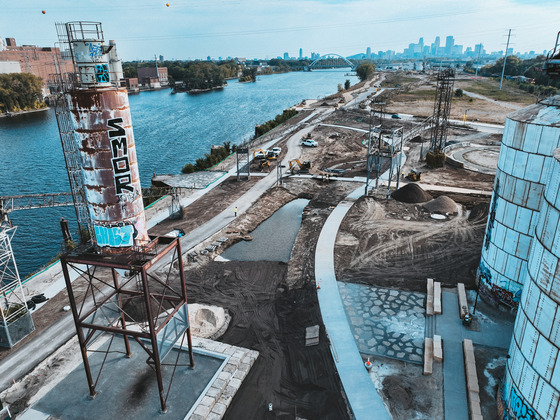 November 17 was National Stormwater Day, a reminder that stormwater doesn’t just disappear. It moves across streets and sidewalks, picking up whatever it touches: salt, leaves, trash, tire dust, the works. All that stuff has to go somewhere, and “somewhere” is usually our rivers and lakes… unless we build better systems, which is exactly what is happening at Upper Harbor Terminal.
We’re celebrating big progress on the 24-acre district-scale stormwater system taking shape there. This fall marked a major step forward, with the substantial completion of both the Minneapolis Park and Recreation Board’s new park and the underground components of the Southern Regional Treatment & Storage System. Once it’s up and running, it will capture and treat runoff from 75 acres of North Minneapolis before it can reach the Mississippi River.
And it’s not just about cleaner water. The treated stormwater will be filtered and pumped throughout the site for irrigation and sent into a brand-new ephemeral stream, a seasonal waterway built to support macroinvertebrates (tiny but mighty aquatic critters that help entire ecosystems thrive). Together, these features create a connected landscape of habitat, public spaces, and visible stormwater elements that invite people to experience the river in new ways. It’s a rare chance to rethink stormwater at a neighborhood scale and a step toward restoring our relationship with the Mississippi River and supporting its resilience as a living, shared home. That’s a National Stormwater Day worth celebrating.
 Well, Twin Cities… the winter snow has officially arrived, and with it comes that annual moment when many of us instinctively reach for the nearest bag of salt. But before we all go full “salt everything, everywhere, all at once,” here’s a winter science reminder worth keeping in your back pocket:
Salt doesn’t disappear. It doesn’t melt. It doesn’t biodegrade. Once chloride washes into our lakes, rivers, and groundwater, it stays there forever. A little truly does go a long way… and stays a long time.
Just one teaspoon of salt is enough to permanently pollute five gallons of water. And in the Twin Cities, 78 percent of the salt we use ends up in our local . That’s a big deal for our rivers, ecosystems, and fish, who absolutely do not need any surprise brine in their habitat.
The good news is we all have the power to make a huge difference with a just few small winter habits. Here’s how to salt smart this season:
-
Shovel early and often. If you clear snow before it gets compacted, you may not need salt at all.
-
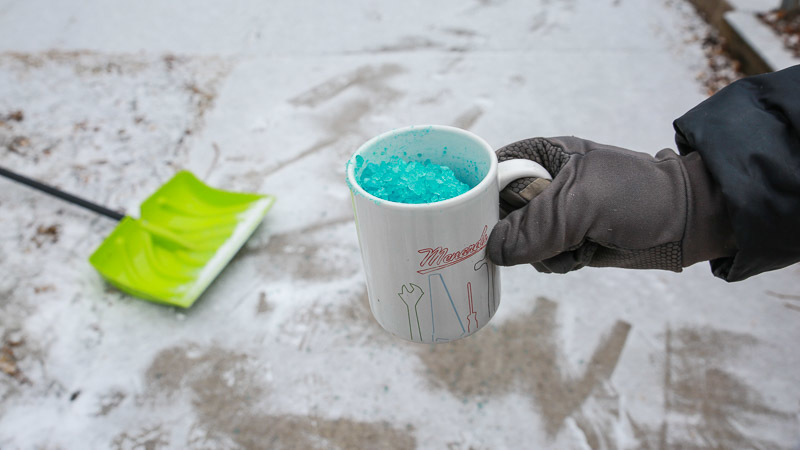
Use only what you need. A coffee mug of salt (about 1 pound) is enough for roughly 10 sidewalk squares.
-
Skip salt when it’s below 15°F. Tradition salt (sodium chloride) simply doesn’t work at very cold temperatures. Other products made of magnesium chloride, calcium chloride or urea have different melting temperatures, but the bottom line is that if it’s too cold, none of them will work.
-
Use sand or grit for traction on extremely cold days when salt won’t melt anything.
-
Sweep up extra salt and grit after ice melts. That keeps it out of storm drains and out of the Mississippi.
Each of these actions helps keep chloride pollution out of our water, protects infrastructure, and saves money, all while making winter safer for everyone.
As the snow keeps coming (and we know it will), thank you for being a part of a smarter, cleaner, more river-friendly winter season. Our waterways, and all the creatures that call them home, are quietly cheering you on.
Minnesota Water Stewards Now Recruiting for 2026 Cohort
Minnesota Water Stewards is a program that trains, certifies, and supports community leaders who want to make a real difference in revitalizing our local waterways. Stewards learn how to prevent water pollution and educate community members to conserve and protect our waterways. The program is offered by Freshwater and provides both education and hands-on experience, giving participants the tools they need to lead with confidence.
If you’re interested in becoming a Steward, start by attending a virtual information session and submitting an application by December 15, 2025. This is a great opportunity for anyone looking to deepen their environmental knowledge, build community connections, and take action for healthier lakes and rivers. Visit their website to learn more and apply.
The Mississippi Watershed Management Organization invites eligible applicants to apply for Action, Planning and Community Grants by Friday, December 12, 2025 for projects in the MWMO.
-
Action Grants are a type of Stewardship Fund Grant designedfor projects that are significant in scope and cost. Proposed projects should demonstrate that thorough planning for the proposed project has already taken place. Grants of up to $50,000 are available for implementation of proposed plans.
-
Planning Grants are a type of Stewardship Fund Grant designedto assist organizations to plan and prepare documentation for a project that will be implemented in the near future. Planning Grants help fund the planning process for detailed projects that help improve water quality through construction, education, outreach, or other creative ways. Grants of up to $20,000 are available for creating plans.
-
Community Grants are designedto help initiate new projects through direct community engagement and encouraging water and habitat stewardship. Grants of up to $5,000 are available for short-term or small-scale water quality projects.
The MWMO is particularly interested in supporting engagement or physical projects that will reach underserved populations (communities not previously involved in MWMO projects or communities representing marginalized and diverse cultural backgrounds) and projects located in environmentally sensitive areas as defined by the MWMO Watershed Management Plan or the MWMO Board of Commissioners. Projects with existing plans created through a previous MWMO Planning Grant are strongly encouraged to apply.
Matching funds may be required. Visit our website for full details and eligibility requirements.
Stewardship Fund Grants — Friday, December 12, 2025, by 4:30 p.m.
Photo of the Month
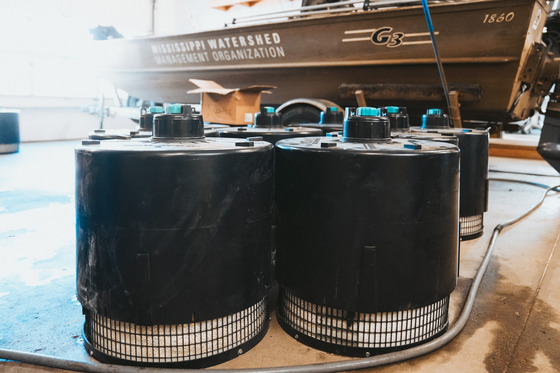 These stormwater filter cartridges were recently installed at Upper Harbor Terminal. When it rains, they use a siphon-powered system to pull runoff through their filter media and capture sediment and pollutants before the water reaches the Mississippi River. And because they’re extra clever, they actually scrub themselves clean between storms so they’re ready for the next one. This very neat little piece of engineering will also give our monitoring team better data as we track the site’s performance over time.
|