|
NEWSLETTER / OCTOBER 2025
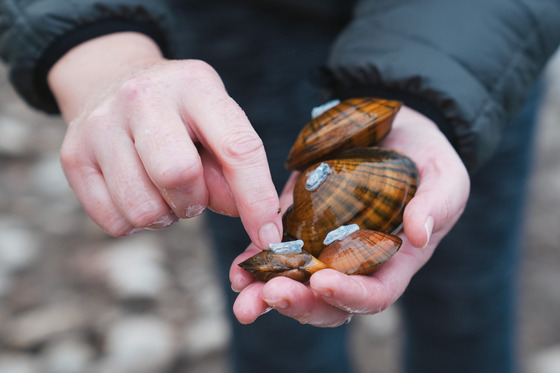 What happens when you “release” mussels? You don’t picture a gentle game of aquatic dodgeball, but that’s exactly what it looked like; a careful toss about 15 feet into the Mississippi River.
Earlier this month, MWMO and Minneapolis Park & Recreation Board (MPRB) staff joined the Minnesota DNR to help reintroduce 30 plain pocketbook mussels to the newly restored Hall’s Island. These native mussels are like tiny living water filters, quietly cleaning the river and revealing how healthy their habitat really is. Each mussel has a microchip tag (like your cat, but wetter), and researchers will check back next year to see how they’re doing and whether the site is ready for more.
This isn’t just restoration, it’s a long game of habitat maintenance and patience. Mussels take up to ten years to grow into self-sustaining populations, but if these “guinea pigs” thrive, the river will tell us it’s on the right track.
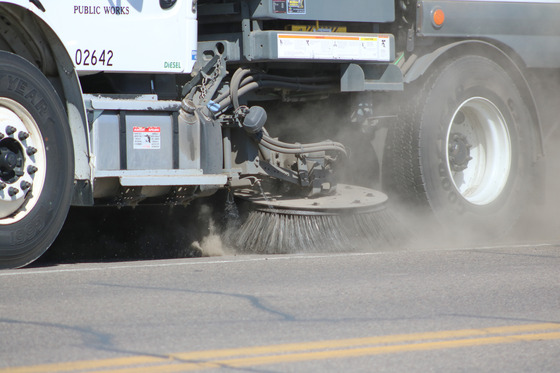 It’s street sweeping season across the Twin Cities, that magical time when trucks with spinning brushes appear like giant Roombas for your neighborhood. (Maybe you already noticed; hopefully, you didn’t get a parking ticket.😉)
Street sweeping might not sound glamorous, but it’s one of the simplest, most effective ways cities protect water quality. Every sweep helps keep dirt, salt, trash, and leaves out of the storm drains and out of our rivers, lakes, and streams. It also helps prevent clogs that can cause localized flooding when storms roll in.
Most cities sweep one to three times a year. Minneapolis does it twice; once in the spring to clean up leftover sand and salt from winter road maintenance, and once in fall to scoop up the leaf confetti Mother Nature drops everywhere.
Here’s how you can help the sweepers do their thing:
-
Move your car on sweep day! Experts say this is one of the most effective ways to improve street sweeping. When sweepers can’t reach the curb, leaves and polluted sediment get left behind, and that material often ends up washing into storm drains and waterways.
-
Don’t rake your leaves into the street. It makes street sweepers’ job harder and sends leaf litter straight into the drains, where it can clog things up and add excess nutrients to the water. Instead, check out our fall yard care guide for simple ways to manage leaves.
-
Adopt a storm drain. Even the best sweepers can’t get everything. Visit adopt-a-drain.org to join the more than 12,000 volunteers helping keep our local waterways clean one grate at a time.
Street sweeping isn’t just tidying up; it’s water quality maintenance in motion. Every pass of those brushes helps keep our river a little clearer and our neighborhoods a little safer.
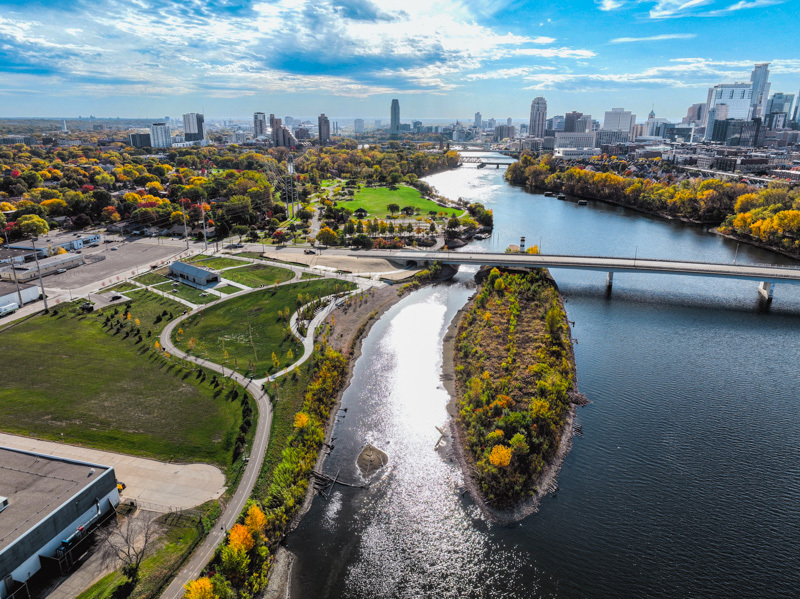 The new Graco Park along the Mississippi River is a showcase of smart, sustainable design.
-
70% of the site is restored native habitat, complete with 250 trees, native prairie plants, and a pollinator lawn.
-
A geothermal heated snowmelt system keeps sidewalks clear in winter while cutting down on salt use (and protecting the river in the process).
-
A series of stormwater basins, known as a “treatment train,” filters runoff before it ever reaches the Mississippi.
Over the next few years, MWMO will work with the Minneapolis Park & Recreation Board will study how well that geothermal system performs. The lessons learned here could help guide future climate-smart projects across the watershed.
Welcoming Shameka Gherau

The MWMO is pleased to welcome Shameka Gherau (she/her) as our new Administrative and Facility Operations Manager.
She’s the person making sure everything behind the scenes runs like a well-oiled (and sustainably powered) machine. From keeping the building secure and efficient to fine-tuning the systems that help our staff do their best work, Shameka brings expertise, organization, and a calm determination to the team. Think of her as the quiet force ensuring the lights stay on, the gears keep turning, and the spreadsheets behave.
Outside the office, you can usually find her lost in a good book or experimenting in the kitchen, proving that great management and great cooking both start with the right ingredients.
|
Meet Our New Communications Manager, Akadia Johnson

If you’ve read an MWMO newsletter or followed our stories over the past year, you’ve already encountered the work of Akadia Johnson (they/them) and their knack for making complex environmental topics feel clear, relevant, and human.
Now officially serving as Communications Manager, Akadia leads MWMO’s efforts to share the science and stories behind our work to protect and improve water quality in the Mississippi River watershed. With experience spanning government, nonprofits, and editorial storytelling, they bring a rare mix of technical precision and creative vision to help bridge the gap between research and real life, data and understanding. Their goal is simple but powerful: to inform, inspire, and connect people to the water that sustains us all.
Outside of work, Akadia stays just as active. They’re a passionate community-builder who’s always finding new ways to connect people through shared creativity. Whether they’re learning new languages, diving into books that explore new ideas and perspectives, training both discipline and artistry through figure skating, organizing local events, or creating video content simply for the joy of storytelling, Akadia dedicates and develops their skills both on and off the clock.
|
Watershed Systems Coordinator
The MWMO is seeking a Watershed Systems Coordinator to help protect and improve water quality in the Mississippi River watershed. This position plays a key role in planning, analyzing, and supporting projects that manage stormwater and enhance our local water resources.
If you have experience in hydrology, water resources, or stormwater planning and want to put those skills to work for healthier waterways, we’d love to hear from you.
📅 Application Deadline: November 16
MPCA Smart Salting Training
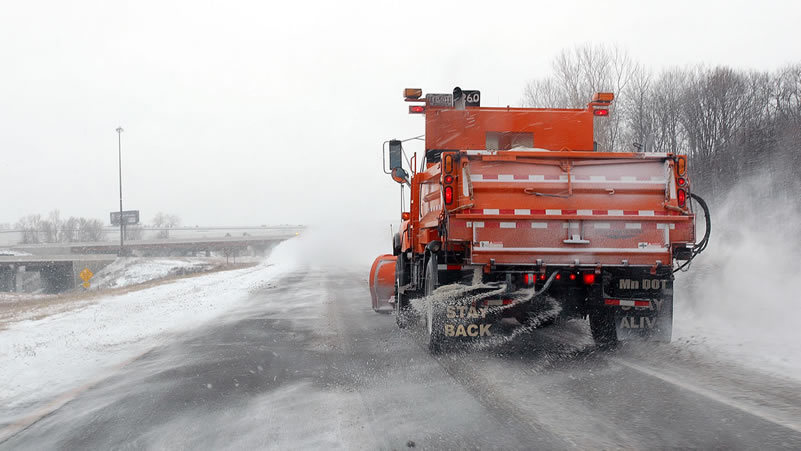 The Minnesota Pollution Control Agency’s Smart Salting Trainings offer ways winter maintenance pros can save money and time and reduce salt while maintaining safety!
MPCA Smart Salting for Property Management Certification Training
📅 Wednesday, November 12 | 9:00 AM–1:30 PM
📍 Online
This training is designed for property managers, business owners, contractors, environmental professionals, MS4 staff, and others who oversee or influence winter maintenance. Participants will learn how to reduce salt-related costs and damage, improve efficiency, manage liability, and comply with new MS4 chloride requirements — all while protecting Minnesota’s waters.
The interactive, real-time online format includes live instruction, chat, polls, and discussion using the WebEx platform. Attendees must actively participate and pass the online test to receive certification (valid for three years) and be listed on the MPCA Smart Salting webpage. Certificates are issued to Minnesota participants only.
Registration is required, and while multiple people may watch from the same device, each must register individually.
The Mississippi Watershed Management Organization invites eligible applicants to apply for Action, Planning and Community Grants by Friday, December 12, 2025 for projects in the MWMO.
-
Action Grants are a type of Stewardship Fund Grant designedfor projects that are significant in scope and cost. Proposed projects should demonstrate that thorough planning for the proposed project has already taken place. Grants of up to $50,000 are available for implementation of proposed plans.
-
Planning Grants are a type of Stewardship Fund Grant designedto assist organizations to plan and prepare documentation for a project that will be implemented in the near future. Planning Grants help fund the planning process for detailed projects that help improve water quality through construction, education, outreach, or other creative ways. Grants of up to $20,000 are available for creating plans.
-
Community Grants are designedto help initiate new projects through direct community engagement and encouraging water and habitat stewardship. Grants of up to $5,000 are available for short-term or small-scale water quality projects.
The MWMO is particularly interested in supporting engagement or physical projects that will reach underserved populations (communities not previously involved in MWMO projects or communities representing marginalized and diverse cultural backgrounds) and projects located in environmentally sensitive areas as defined by the MWMO Watershed Management Plan or the MWMO Board of Commissioners. Projects with existing plans created through a previous MWMO Planning Grant are strongly encouraged to apply.
Matching funds may be required. Visit our website for full details and eligibility requirements.
Stewardship Fund Grants — Friday, December 12, 2025, by 4:30 p.m.
Photo of the Month
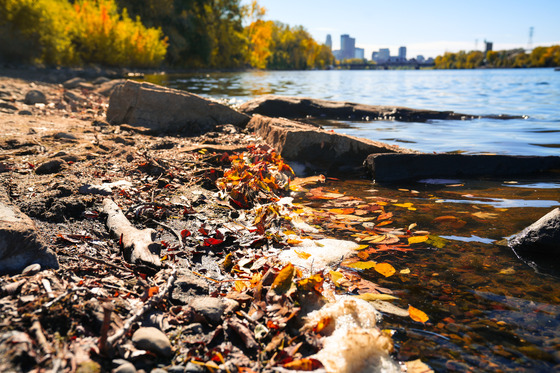 That fluffy foam along the shoreline isn’t necessarily pollution, but it’s not nothing, either. When leaves and other organic matter break down in the river, they release natural oils and proteins that can create foam as water mixes and aerates. A little is normal this time of year, especially during fall leaf drop.
But when there’s too much organic material washing in from leaves, grass clippings, or other yard waste, it adds extra nutrients to the river and can fuel algae growth downstream. So while the foam makes for a pretty fall photo, it’s also a reminder to keep leaves and debris out of storm drains to help protect water quality.
|