|
Welcome to the first quarterly newsletter from the Met Council's Data Practices Office (DPO) in the Office of General Counsel. Going forward, we will send regular updates to share DPO news, tips, highlights, and data request statistics.
We are sending this quarterly email to the Met Council’s data practices liaisons as well as leaders across the organization, so you can pass along information to your employees as needed. Thank you for reviewing these quick announcements so you can help address data practices requests and issues wherever they come up in the organization.
To start us off, we had a busy first quarter with lots of news:
Data Practices Specialist Nisha West has worked closely with the app development team in Information Services for months to implement enhancements to our online data request form and request management system – collectively, the data request portal.
These enhancements are in the testing stage. If all goes smoothly, liaisons can expect to start using the enhanced portal this summer.
Many of the changes are behind-the-scenes improvements, but we want to highlight a few key updates:
- DPO will have the ability to copy internal stakeholders when assigning new data requests.
- DPO will be able to assign requests that cross divisions to more than one liaison.
- Liaisons will have an updated dashboard view to help manage open requests.
- Classification fields will tag documents as internal (may contain not public data) or external (contains only releasable data). Requester submissions also have a tag.
- Updated document storage structure will clearly separate working documents from final shared documents.
- Liaisons will receive reminder emails of assignments still open at the three-week mark.
Those are a few of the many improvements in the works. Nisha is preparing guidance to support liaisons as we make this transition, so keep an eye on your inboxes and calendars in the coming weeks.
Since launching the data request portal in February 2023, DPO receives an average of 50 requests each month. To ensure that we can manage requests in a timely manner and continue to develop our other data practices work, DPO plans to hire another data practices specialist. Funding for this new position was approved in late March, and we hope to post the position soon.
The new specialist will be dedicated to Metro Transit, reflecting the reality that about 40% of Met Council data requests seek Transit data. They will work closely with Transit leadership, liaisons, and data owners to fulfill requests and build internal communications.
Nisha West will continue to expertly manage requests for data from other Met Council divisions along with large, search-based requests. She also will deepen her focus on building strong processes and systems to support our data practices work.
The Data Practices team, from left, Head of Data Practices Kathryn Olson and Data Practices Specialist Nisha West
DPO is partnering with our colleagues in Enterprise Content Management and Learning and Organization Development (LOD) to create new and updated data practices training for staff.
Last fall, we introduced an updated Intro to Records Management and Data Practices training module for new employees. This spring, LOD is finalizing the intermediate training module. This brand-new module explores data practices in more detail. It focuses on data classifications, working with not public data, and the Met Council’s responsibilities under the Data Practices Act.
Our target audience includes data practices liaisons, managers, and anyone who frequently works with government data.
Our request to you
We encourage all of you to take the module when it goes live. We also hope you will share it with employees who work with Met Council data and documents.
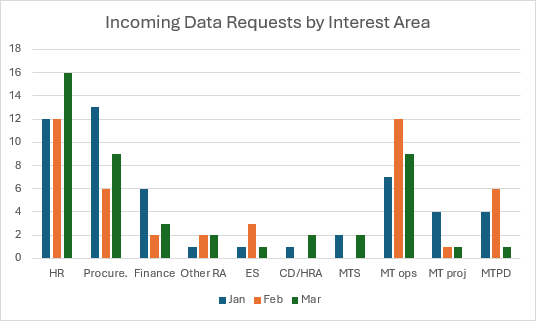
DPO received about 180 data requests seeking data from across the Met Council in the first quarter of 2024. Thank you to all our program-area data practices liaisons who helped us fulfill these requests.
Here is a breakdown of incoming data requests by interest area in January, February, and March:
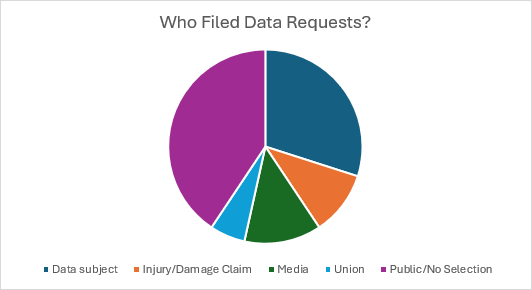
Data requesters also reported information about themselves:
|