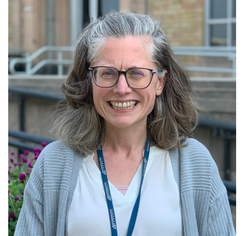
Sara Smith, Director, Operations Support Services
As I think about our division’s shared vision, I see how critical connections across our departments are to ensuring that “clean water for future generations” becomes a reality. Most of the problems and projects we work on impact numerous jobs, departments, and locations. They require insights from a broad range of staff. Yet, we often feel siloed or separated from each other.
We are organized into departments to group roles in ways that best serve our internal and external customers and to provide a management structure. We can’t let this structure create artificial separations. Connecting our work needs to be intentional and sustained.
Cross-departmental work may seem like an obvious part of the job in Operations Support Services, since we support both treatment and interceptor services. We could not effectively do our job without thinking beyond those departments and asking for input and collaboration with other business areas.
Recently, the need for an improved operator recruitment and training program was suggested by staff. New technology and changes to industry standards highlighted the need to update our training practices. Workforce changes have presented challenges to recruiting qualified hires. Since these jobs touch many areas in ES, we knew early input was needed from departments beyond treatment and interceptor services. We reached past our normal work boundaries to Workforce and Equity, and Training and Program Support to join the treatment and interceptor service group on the project. We also identified the need to involve the Office of Equity and Equal Opportunity as well as union representatives. As individuals, we would not be able to identify the specific goals and needs of each area, but together we can create a successful program.
When working on any project, we need to think about connecting. This means pausing and asking yourself and others, “who else should be involved or might be impacted?” When working day to day, we need to speak up and share our insights to help make these connections. ES is focused on inclusion as a core tenant of our culture. We are all parts of a whole, and no one group can have all the information necessary to make the most effective decision.
|
Josh Hamre, senior safety specialist, Environmental Health and Safety
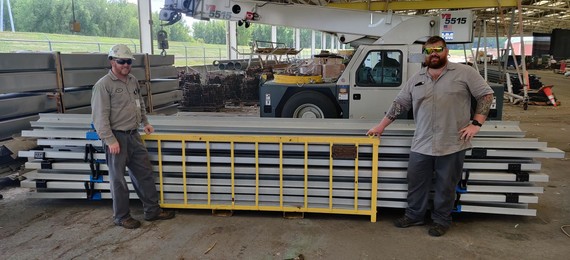
Machinist mechanics Nick Bernardy and Tony Bous with their improved basket hoist.
Traditionally, safety has been measured by the number of incidents within a given timeframe. We then try to determine what happened and why, and work to prevent it from happening in the future. The focus is usually on "what went wrong," which is valuable, but focusing safety on "what went right" can lead to new ideas and innovations division-wide.
Specialized machinists at the Metro Plant, sometimes called the "Tank Crew," have demonstrated this new view of safety. Staff recognized potential hazards in their work and created innovative solutions to prevent potentially dangerous conditions. Some examples of the Tank Crew's innovations:
- Developed a new process for removing and replacing sludge tank chain and flights, allowing machinists to work at waist height instead of on their knees.
- Fabricated a bracket to use with an electronic hoist instead of raising buckets with a rope. These are now in use at other plants as well.
- Installed a ladder that could hook onto part of the tank, allowing them safer passage, especially in the winter.
Created safer basket hoists to move large objects in and out of the large tanks.
These creative solutions to the complex and often changing work were created by the crew, for the crew, and are now being captured and shared by Environmental Health and Safety (EHS). Embracing this new view of safety, staff in EHS are encouraging employees to note "what went right," in a situation, as those ideas can lead to important safety improvements for ES.
Contact Josh Hamre, senior safety specialist, at joshua.hamre@metc.state.mn.us, with questions.
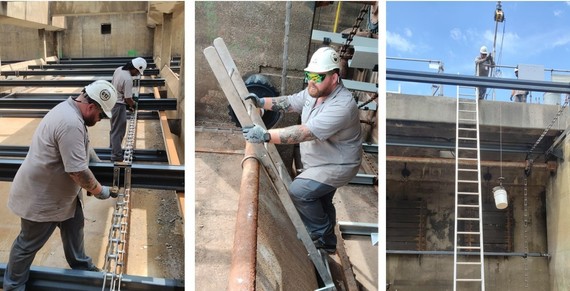
Tony Bous, Neale Carter, and Nick Bernardy demonstrating their team's safety innovations.
Luke Holifield, senior engineer, Plant Engineering
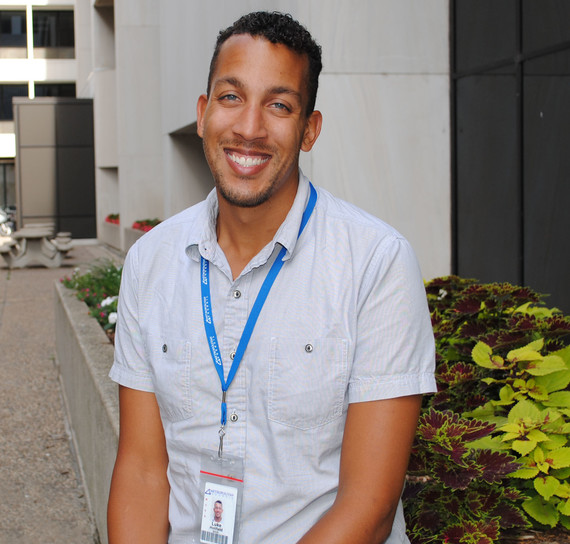
Tell us about your work
I am working on projects for the Blue Lake Plant in Shakopee to upgrade the facility's capacity for future population growth. I love how much there is to learn. There's so much that goes into wastewater treatment and so there will never be a time when I'm not discovering something new.
When you hear our new vision statement, "clean water for future generations," what comes to mind?
I feel hopeful. Water is such an important resource, and to be a part of that vision is humbling. With the projects at Blue Lake, I will be working to ensure that we treat the water there to the highest standards, releasing only the cleanest water into the Minnesota river. As our knowledge of pollutants grow, wastewater treatment is at the forefront of making sure we keep our water sources pristine for all to use.
What do you enjoy doing outside of work?
My biggest hobbies/interests are travelling. When I travel, I love to hike, camp, swim, or other outdoor activities. During the pandemic I made it a priority to take trips closer to home and travel around Minnesota to get to know all the beautiful outdoor spaces it has to offer.
Submit a co-worker to be in the spotlight. Email Lindsey Geyer at lindsey.geyer@metc.state.mn.us.
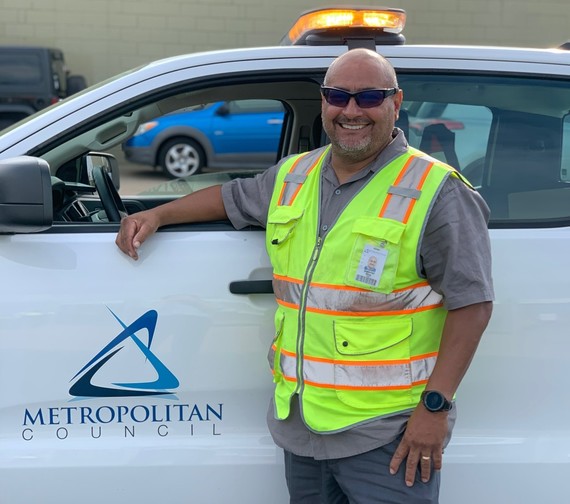
Gabe Rios, interceptor service worker 2, Regional Maintenance Facility
September 15 - October 15 is Hispanic Heritage Month. It's celebrated annually to acknowledge the history, culture, and contributions of Americans whose ancestry can be traced to over 20 countries in Latin America including Mexico, Central and South America, and the Caribbean.
Many ES staff identify as being of Hispanic heritage, including interceptor service worker Gabe Rios. Gabe identifies as Mexican American/Chicano/Tejano. He describes Chicano as a culture of political empowerment and Tejano as a culture specific to Texas, focused on music and food.
"Music in my culture is storytelling. From the Mariachi, Norteño, Banda, Tejano, or other styles, music is a joy to hear. We love to have fun. We want others to feel what we feel, taste what we taste."
Gabe has taken his love of music to a boarder audience, hosting a Tejano music radio show called Sabados Alegres on KFAI and co-founding Tejano Lippz Internet Radio Station. He founded the station to support and promote Tejano artists.
"The support I have felt within the Tejano community is truly humbling, and I am blessed to be in the middle of this circle that is much bigger than me."
When Gabe is not at the radio station, he is expressing his heritage through food, specifically making tamales during the holidays. It's a tradition his family started in Gabe's adulthood, but it's one he's planning to stick with.
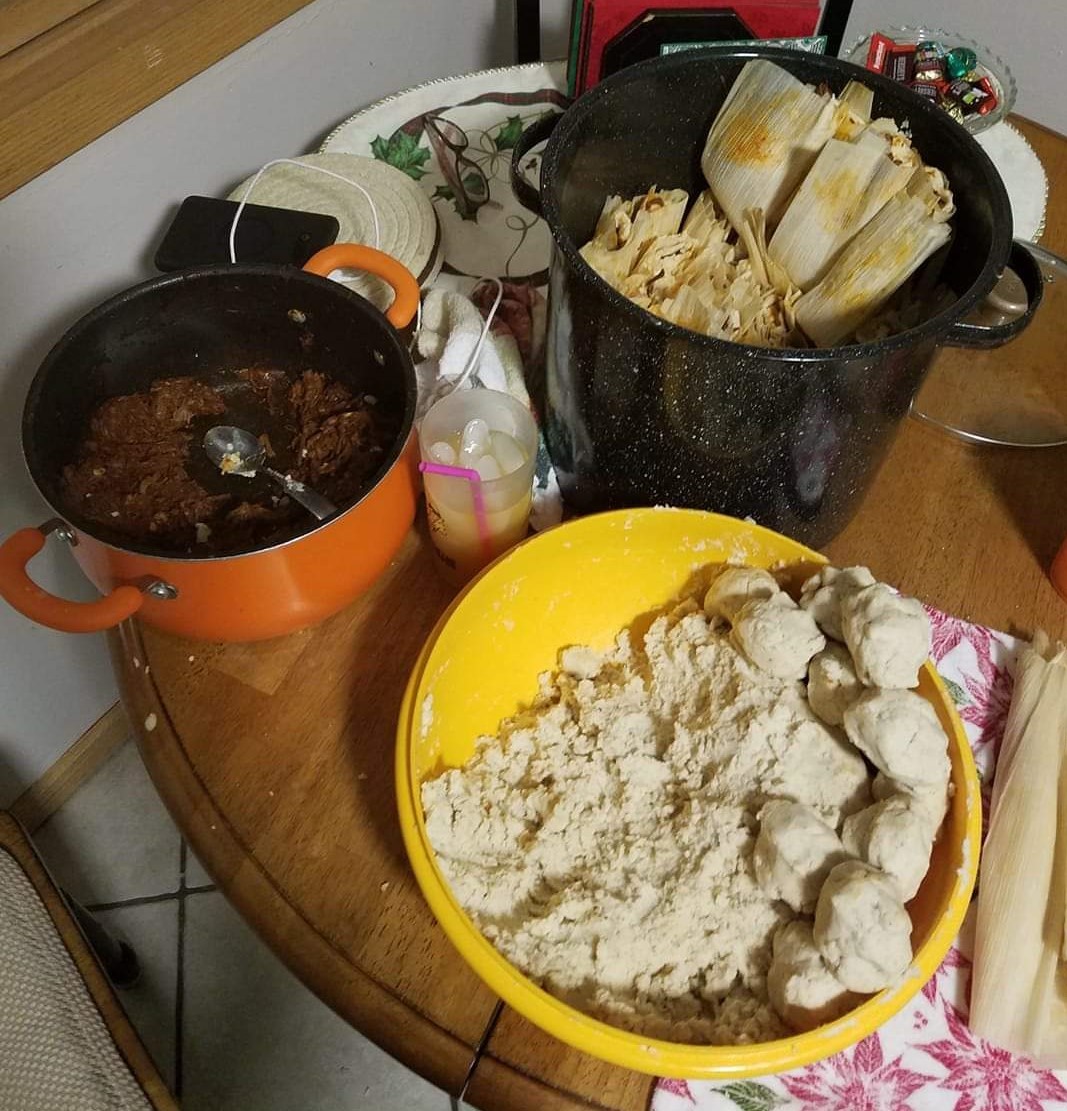
Gabe's homemade tamales
Learn more about Hispanic or Latino/a/e/X culture and support local businesses:
In celebration of Deaf Awareness Month (Sept.) and Disability Employment Awareness Month (Oct.), join the Metro Transit Equity and Inclusion Team for a Deaf/Blind Awareness Mini-Training. It includes a simulation that allows you to experience the emotions of riding a bus without sight or hearing, followed by a debrief discussion. The training is offered twice:
- Wednesday, 9/28, 10:00-11:00am
- Wednesday, 10/5, 1:00-2:00pm
Meet in the picnic tables in between Heywood Garage and Heywood Office Building.
Contact Dan Stoffer at Dan.Stoffer@metrotransit.org to reserve a spot, or arrive on-site the day of the event.
Collectively, each of our actions can create a positive work environment for all. In big and small ways, we interact frequently with our friends and co-workers whether in person, or by phone, email, or chat. Over the past few years, pandemic isolation increased stress levels and separated us from people outside our normal "bubble." As we work to reset other areas of our life, let's also work to reset our workplace.
Stress can lead to actions like anger and criticism. If you have been experiencing stress in your life, free counseling is available through our employee assistance program, Sand Creek. A positive workplace is also founded on respect for our coworkers and their differences. When speaking to someone you may not agree with, be sure to listen to understand and learn. If you catch yourself acting negatively, pause and consider how you can constructively address the negative feeling you are responding to. If you have witnessed or experienced disrespectful workplace conduct, please report the incident to a manager.
It is up to us to know our Respectful Workplace Procedure and contribute to an effective workplace.
Relevant Council policies:
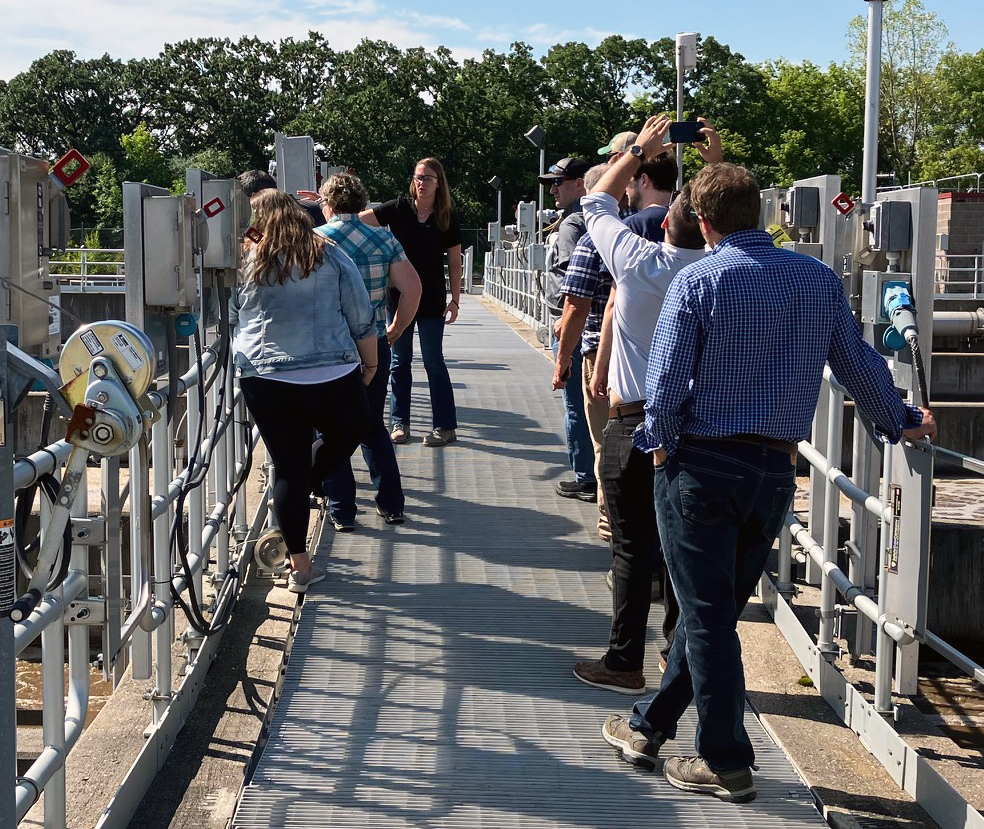
Metro area educators on a tour of Eagles Point Wastewater Treatment Plant
Environmental Services works to connect with our metro area community through external outreach. We do this to raise awareness and invite engagement. Some recent and upcoming outreach events include:
Teacher Externship – August 3
- Held at Eagles Point Wastewater Treatment Plant.
- Science, technology, engineering, and math (STEM) educators from across the metro area attended the event.
- ES staff including Jack Barland, Cassie Champion, Erick Herberg, Colton Janes, Andrea Kaufman, Jen Kostrzewski, and Leslee Storlie produced and facilitated the event.
Metro Children's Water Festival – September 28
- About 1,300 fourth grade students attend the festival virtually or in-person at the Minnesota State Fair Grounds.
- Staff have created three learning stations for attendees including, "FLUSH Obstacle Race! Wastewater to Clean Water," "Bugs and Water Quality," and "Water Transport."
- ES Staff participating in the event include Jack Barland, Cassie Champion, Ali Elhassan, Lindsey Geyer, Scott Haire, Dan Henely, Brian Johnson, Jana Larson, Lanya Ross, Henry McCarthy, Deb McKinley, and Tyler Winter.
Take our survey for a chance to win a T-shirt!
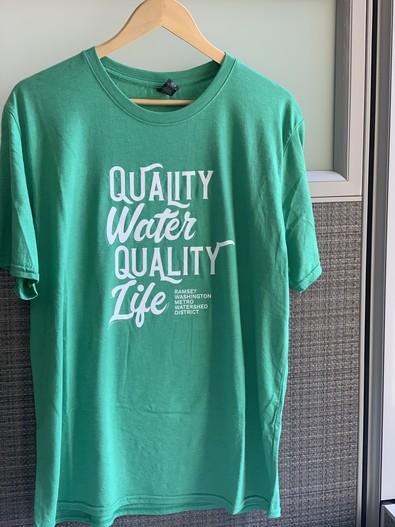
We are looking for staff input on outreach efforts to help develop and improve our outreach efforts. Please take two minutes to complete this survey by Friday, Sept. 30 and you will be entered to win one of six "Quality Water Quality Life" T-shirts from our partners at the Ramsey Washington Metro Watershed District.
For questions, contact Jana Larson, senior outreach coordinator at jana.larson@metc.state.mn.us
Win this this "Quality Water Quality Life" T-shirt by taking our survey.
Two sewer system incidents prompted evacuations at the University of Minnesota's Minneapolis campus and in surrounding neighborhoods this summer. They provided stark reminders of the importance of our work in regulating and monitoring our regional sewer system.
On June 30, a fire and explosion occurred in the sewer system on campus. On August 2, a large oily slug was observed in the sewers near the university along with hazardous lower explosive limit readings. On August 9, a discharge was observed and later traced back to a permitted industry. That company agreed to stop its discharge. It entered into a stipulation agreement with requirements that need to be met before it can resume discharging. The company was also issued a Notice of Violation and assessed cost recovery. They are cooperating with Industrial Waste and Pollution Prevention on implementing improvements to their processes, procedures, and monitoring.
These incidents required a large coordinated interagency response, as well as a large internal Met Council response. Staff involved in response efforts include:
- Interceptor Services staff: Executed the response plan, provided line tracing, and assist in ongoing monitoring.
- Metro Plant staff: Engaged in readiness planning for potential flammable substances in influent and monitored influent.
-
Ned Smith: Served in incident command and coordinated the interagency response.
- Industrial Waste and Pollution Prevention staff: Were early responders to the incidents, led interagency collaboration, and are actively working on the investigation.
- Communications staff in ES and Regional Administration: Created the Governor's Office Briefing and served as public information officer for incident command system.
Thank you to all employees involved in the response. We have completed all planned industry inspections at this time. We continue to monitor to ensure safe conditions for staff and the public.
|
Congratulations to the following staff on their Keystone award wins!
Team Keystones
High-performing teamwork addressed the Brooklyn Park/Osseo sewer collapse
When a section of an ES interceptor collapsed in mid-May, this exceptional group of staff responded quickly to keep wastewater moving around the affected area and to coordinate the emergency repair. For this outstanding work, a Keystone Team award was presented to interceptor service workers Justin Anderson, Bryan Blum, Art Dengel, Dave Erickson, Michael Evens, Mike Fenlason, Eric Geertsema, Aaron Head, Nathan Kahler, Heath Kraft, Ryan Lee, Randall Mateo, Mike Quesnel, Seth Sovde, Jose Torres, and Jeff Zuchowski; contract administrators Sarah Hachey and Karl Rydeen; principal engineer Jeny Baroda; and ABUM Isaac Raser.
This team worked with numerous internal and external stakeholders and engaged in creative problem solving to install temporary pumps in the area while additional crews worked to start the excavation and repair. Because of their actions, they protected public health and safety and minimized disruption in the busy area.
Created the Priority Waters List
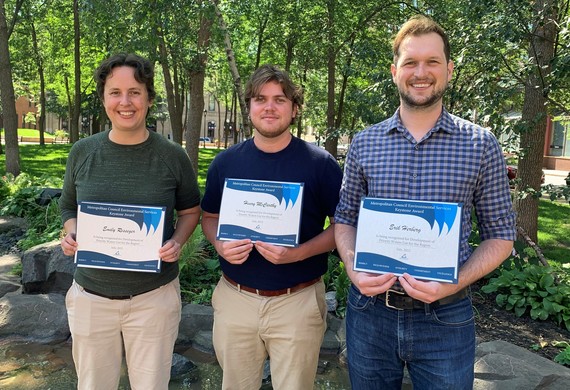
Water Resources Planning Keystone award winners Emily Resseger, environmental analyst, Henry McCarthy, environmental scientist, and Erik Herberg, senior environmental scientist
Water Resources Planning staff Erik Herberg, Henry McCarthy, and Emily Resseger were presented with a Keystone Team award for outstanding work in creating the Priority Waters List.
Recognizing the need to better prioritize project areas given their limited budget, this team analyzed the Twin Cities metro area waterbodies based on seven categories: recreation and tourism, healthy habitat, drinking water protection, tranquil connection, equity, industry and utility, and science and education
The team used GIS tools to organize all the layers of data, scored them, ranked them, and then compiled the list and all qualifying documents into a standardized process. The Priority Waters List will now be used to organize work projects, services, monitoring efforts, and to determine where best to support the community through grant programs.
Individual Keystones
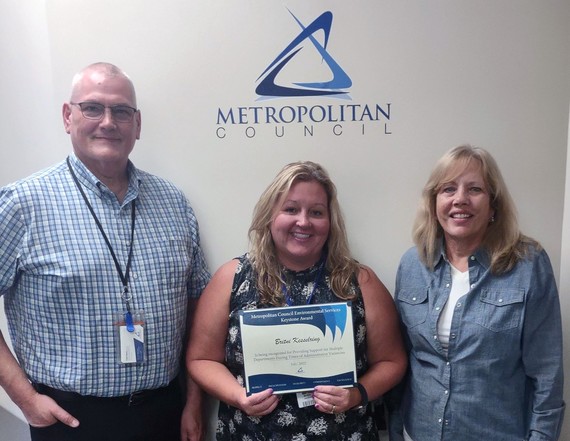
Assistant General Manager of Treatment Services Craig Edlund, Keystone award winner Britni Kesselring, and Karen Neis, Director of Administration and Communications
Britni Kesselring was presented with an individual Keystone award for her exceptional performance in a time of administrative turnover. Britni has shown commitment, flexibility, and a willingness to fill in to ensure seamless administrative support to multiple departments.
Britni has gone above and beyond her role as program technical specialist, taking on additional work as it arises, and has assisted in the onboarding of 30 new plant operators and the onboarding and training of several new administrative support staff.
For incredible attention to detail and exceptional performance, a Keystone award was presented to John Young, manager, Facilities and Fleet. John took on the intricate task of gathering all data required to submit our COVID-19 Federal Emergency Management Agency (FEMA) reimbursement request.
John combed through multiple databases, invoices, and systems to help identify and summarize all COVID-19-related expenses, like plexiglass barriers, pre-check signage, masks, and test kits. Due to John's work, ES will receive more than $600,000 in reimbursement funds.
 |
|
Plant operator Ryan Zajac's normal job duties are focused on the operation, monitoring, and control of the wastewater process. When Empire Plant was looking to start their Phase 1 Solids Improvement Project, Ryan stepped up.
Ryan served as Operation's representative for the project, performing project preparation work, participating in project meetings, reviewing plans and drawings, issuing permits, and working with internal and external groups to help coordinate and oversee the work. Ryan's commitment to improving the processes extended to modifying staff manuals and training operators on the new equipment. For his hard work and dedication to the project, Ryan has been presented with a Keystone award.
|
Congratulations to the following staff on their WATER to Keystone awards!
-
Dan Anderson, business unit coordinator, Liquids Business Unit
-
Colin Drake, plant operator, Liquids Business Unit
-
Kris Hess, formerly business analyst 3, Administration and Communication (currently project manager, Information Services)
-
Tiffany Leff, GIS specialist 2, Interceptor Operations
-
Juston Seyfert, senior metering and alarm system operator, Interceptor Services
-
Samuel Willie, machinist mechanic, Mechanical Planning and Maintenance
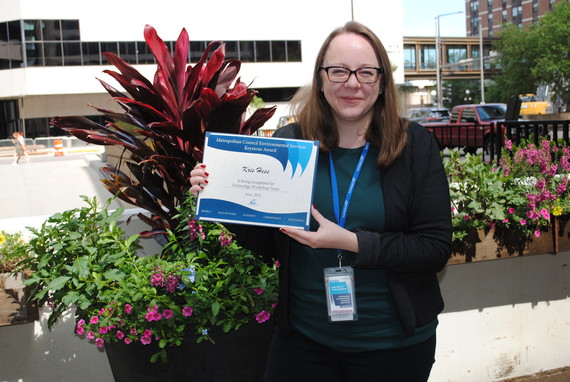
WATER to Keystone award winner Kris Hess
RECOGNIZE A COWORKER
Help share your coworkers' exceptional efforts through the MCES Employee Recognition Program. We have two options: WATER and Keystone. Each has different nomination criteria. Any ES staff can nominate someone for either award.
Go to the Recognition MetNet site.
Anniversaries
Congratulations to these employees celebrating milestone anniversaries!
15 YEARS
Brian Johnson, senior environmental scientist, Water Resources, Metro Plant
10 YEARS
Robert Anderson, plant operator, Solids Handling NEFCO, Blue Lake Plant
Deodato Dagudag, plant operator, Solids Business Unit, Metro Plant
Mark Doble, plant operator, Seneca Plant
Tracie Fischer, plant operator, Eagles Point Plant
James Hreha, plant operator, Blue Lake Plant
Abdul Khan, plant operator, Blue Lake Plant
Jennifer Kostrzewski, environmental analyst, Water Resources, Robert Street
Andrew Lamberson, plant operator, Solids Business Unit, Metro Plant
Steve Moore, plant operator, Seneca Plant
Raheem Shabazz, plant operator, Solids Business Unit
Murray Silverberg, plant operator, Solids Handling NEFCO, Blue Lake Plant
David Voss, maintenance operator, East Area Business Unit
Ryan Zajac, plant operator, Empire Plant, East Area Business Unit
5 YEARS
John Sipe, lab assistant, Analytical Lab Services, Metro Plant
Staffing changes
Reported by Human Resources since the August Update
NEW HIRES
Richard Anderson, painter, Mechanical Planning and Maintenance, Metro Plant
Natalie Bartell, lab analyst 1, Analytical lab Services, Metro Plant
Gregory Brown, plant operator, Treatment Services, Metro Plant
Daniel Dahlstrom, plant operator, Treatment Services, Metro Plant
Young Hour, plant operator, Treatment Services, Seneca Plant
Christy Hurley, program technical specialist, Operations Support Services, Metro Plant
Zachery Lofgren, plant operator, Treatment Services, Metro Plant
Judy Nielsen, plant operator, Treatment Services, Metro Plant
Sasu Ofori, plant operator, Treatment Services, Metro Plant
Nneka Onah, executive assistant, General Manager's Office, Robert Street
Stephen Ritt, plant operator, Treatment Services, Metro Plant
Rodd Waller, plant operator, Treatment Services, Metro Plant
DEPARTURES
Kimberly Borman-Krinhop, assistant manager, Performance Excellence and Analytics, Metro Plant
Robert Golden, assistant manager, Industrial waste and Pollution Prevention, Metro 94
Penelope Hunter, intern, Pretreatment and Finance, Robert Street
Tim O'Donnell, senior information coordinator, Administration and Communications, Robert Street
Maxwell Savage, intern, Performance Excellence and Analytics, Metro Plant
POSITION CHANGES
Eric Geertsema, interceptor service worker 2, Interceptor Services RMF (previously interceptor service worker 1, RMF)
Jetsen Krueger, plant operator, Metro Plant (previously interceptor service worker, RMF)
Daniel Szuberski, business unit coordinator, Empire Plant (previously plant operator, Empire)
Tom Waldera, assistant manager, Planning and Scheduling, Metro Plant (previously machinist mechanic, Metro Plant)
A few highlights of Councilwide announcements
-
Submit 2023 internship requests by September 16.
- The annual Councilwide employee recognition event will be held in-person on October 17 and is invitation-only.
Additional details and Councilwide announcements can be found in The Wire.
|