The Environmental Services monthly employee newsletter

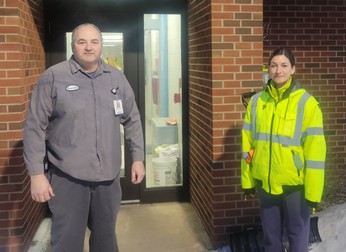
During a medical emergency, timing is everything – especially if the incident occurs outdoors when it's 10 degrees below zero. Last month, Empire Plant staff proved their readiness to respond after someone fell and broke a leg just 6 feet from the guard shack.
Security guard Arnie Solovjovs called for an ambulance and notified plant personnel about the situation. In response, two Empire employees (pictured at right) – Melissa Maxa, then a plant operator and now an environmental scientist, and Ray Donohoe, business unit coordinator – came to the scene immediately to assist the injured individual. Unable to move from the frozen ground, he needed to keep warm until the ambulance arrived.
Maxa did her best to keep him comfortable with warm blankets, and she and Donohoe waited with him until he was taken to the hospital. To help prevent further accidents, they added more sand and salt to the area where the incident occurred.
Maxa is a member of the Met Council's Medical Emergency Response Team (MERT). Every MERT member receives certified emergency medical responder training. This gives them the basic knowledge and skills to provide lifesaving interventions while awaiting additional emergency medical response.
"Our all-volunteer MERT program provides an additional layer of protection to all of our MCES employees," said Tim Morrell, acting manager, Environmental Health and Safety. "The MERT members take on additional training so they can assist in the event one of their coworkers needs help. It is commendable and appreciated by everyone in the division."
"A special thanks to Arnie, Melissa, and Ray for their quick response and calm demeanor during this difficult situation," said Colton Janes, East Business Unit manager. "And, a big thanks to all those folks who are MERT trained."
To learn more about the MERT program, including how to join, visit the MERT page on MetNet.
|
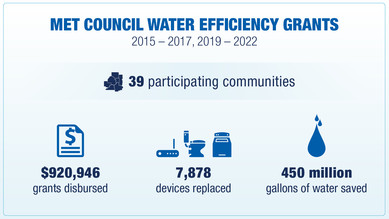
As the Twin Cities metropolitan area population grows, the demand for water increases as well. "Although our aquifers are being continually recharged through precipitation, they are still sensitive to water level decreases in some locations," said Brian Davis, principal engineer, Water Supply Planning. "It's important that we take steps to reduce demand on our aquifers to ensure a sustainable water supply."
One way MCES is working to preserve the local water supply is through our water efficiency grant program. Through this program, cities and townships can receive up to $50,000 to reduce costs for residents, commercial properties, and government facilities that upgrade to water-efficient toilets, washing machines, dishwashers, irrigation controllers, and more.
"This program is an excellent way for communities in the metro area to become more efficient with their water use," said Davis. "We've estimated that the program has saved up to 450 million gallons of water since its inception in 2015."
For communities that take advantage of the program, the benefits can be far reaching – including financial savings related to infrastructure projects. Davis uses the example of a growing city that projects it will need four new wells by 2040 to meet increasing water demand.
"If this city invests in replacing irrigation controllers and other improvements, they could decrease the number of wells needed in 2040 to two," said Davis. "The city could save around half a million dollars by eliminating the need for two of those future wells."
MCES has received national attention for our water efficiency grant program, winning a 2021 WaterSense Excellence Award from the U.S. Environmental Protection Agency in recognition of our dedication to helping consumers and businesses save money. Learn more about the program on our website.
|
The Metropolitan Area Water Supply Advisory Committee (MAWSAC) developed its latest Recommendations for Water Supply Planning in the Metro Area (PDF) in time to inform the 2022 legislative session. The report, published in early February, identified goals for four core water supply focus areas, including water quality, land use and water supply connections, understanding and managing groundwater and surface water interactions, and water supply infrastructure. Recommendations related to these focus areas were organized in a framework for action, including four general steps:
- Collaboration and capacity building
- System assessment
- Mitigation measure evaluation
- Plans
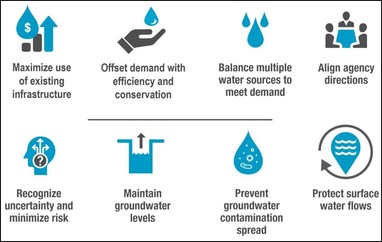
Eight conditions that define regional water sustainability were also highlighted in the report (see graphic at right).
"The report provides concrete, actionable recommendations," said Emily Steinweg, senior engineer, Water Supply Planning. "It will be used to better inform legislators and influencers to develop and implement policies that ensure a sustainable water supply for the region."
MAWSAC – facilitated by MCES staff – includes representatives of the 11-county metro area and several state agencies, and provides crucial advice and assistance to the Met Council related to our water supply planning efforts.
"Compared to other Met Council advisory committees, MAWSAC is pretty unique," said Lanya Ross, environmental analyst, Water Supply Planning. "In addition to community and utility perspectives from across the seven counties, we also have members from four upstream counties (Chisago, Isanti, Sherburne, and Wright) and all the state's water agencies. Our work – and the Met Council's – really benefits from their pooled expertise as we work on more and more complex water problems."
Ross emphasized the collaborative nature of the report development process, even with the shift to online meetings. "We had great commitment and leadership from our MAWSAC chair Wendy Wulff (Metropolitan Council member) and Technical Advisory Committee chair Mark Maloney (city of Shoreview)," she said.
"I'd also like to give a shout out to the report writing team," she continued. "Emily Steinweg, of course, and also Henry McCarthy, environmental scientist, along with Deb McKinley, manager, Programs and Administration." Other key support was provided by Water Supply Planning manager Ali Elhassan, as well as Jeanne Landkamer and Linda Jones from RA Communications.
Learn more about MAWSAC on our website.
|
Scientifically valid data helps drive our work in MCES, from identifying sources of pollution in local waterbodies to using wastewater testing to track the spread of COVID-19 in the metro area.
Our focus on collecting high-quality field data to inform our water quality management practices is highlighted in the new book Water Quality Modeling that Works by Dr. Wu-Seng (Winston) Lung. Lung is a water quality modeling expert who was hired as a consultant by MCES in the early 1990s. His book focuses on the use of field data in water quality analysis and is intended to help guide environmental engineers and scientists working in water quality management.
"If you read the preface, you'll see how much emphasis he puts on quality data – the type our river and lab crews deliver," said Cathy Larson, a now-retired Water Resources staff member and large-river modeling expert who worked with Lung on several water quality modeling studies.
"High-quality water data on our rivers, streams, and lakes is needed to guide our wastewater and water policy work," said Judy Sventek, manager, Water Resources. "Our partners also need this data to help them make informed decisions about how to protect and restore the water resources they are responsible for managing."

Lake Pepin study featured
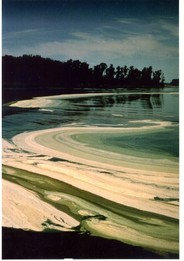
MCES launched one of the studies referenced in the book in response to severe algal blooms that appeared in Lake Pepin during a prolonged drought in summer 1988 (see photo at right, courtesy of the Minnesota Department of Natural Resources). The algal blooms caused unsightly surface scum, unpleasant odors, low oxygen levels, and localized fish kills. These were all symptoms of a complex underlying problem related to excessive nutrients, primarily phosphorus, in the system.
If excess phosphorus was degrading water quality in Lake Pepin and the Mississippi River, how much of a reduction would be needed, and from what sources? To answer these questions and others, MCES collected and analyzed hundreds of samples from both waterbodies. The data was used in complex computer models to get a better picture of the complex phosphorus dynamics under various flow conditions.
Some of the main sources of phosphorus came from point (specific) sources, such as wastewater treatment plants, nonpoint sources, such as agricultural runoff, as well as from internal sources stored in the sediment from years past. Results from this and other related studies led to widespread efforts by MCES and other public agencies to reduce phosphorus across the basin.
For example, stricter wastewater treatment plant permit limits resulted in reduced point source phosphorus contributions. "Metro Plant effluent phosphorus limits dropped from 4 mg/l in the 1990s down to 1 mg/l by the end of 2003," said Tim Pattock, senior environmental scientist, Water Resources. "And from 1992 to 2015, total phosphorus concentrations in the Mississippi River Lock and Dam No. 2 in Hastings have gone down 45%!"
Although the initial work happened decades ago, insights from these studies continue to inform water resource planning and drive water quality improvements throughout the region. "This pivotal work continues to drive and support our activities today," said Sventek. "We've made a lot of improvements in reducing phosphorus from point sources in response to these studies – but we still have a way to go in addressing nonpoint sources in order to best protect our water resources."
|
Black History Month is an annual celebration of achievements by African Americans and a time for recognizing their central role in U.S. history. Every February offers an opportunity to reflect on the role history plays in shaping the present and future.
This opportunity to actively engage with the past is why the ES Cultural Inclusion Team chose "Sankofa" as this year's Black History Month theme. A word from the Twi language of Ghana, Sankofa is loosely translated as "looking to the past to inform the future."
This year, celebrate Black History Month by learning, reflecting, and taking action:
-
Learn about Black History, the Civil Rights Movement, and the ongoing contributions that Black Americans continue to bring to American life and culture.
-
Reflect on the stories, information, and experiences that have shaped your understanding of the world around you, especially in relation to race and culture.
-
Act by supporting local Black-owned businesses and filtering your online shopping to find products from Black sellers. Seek out disadvantaged and underutilized businesses when hiring vendors using the Met Council's DBE and MCUB lists.
Visit the Black History Month page on MetNet to access a variety of resources, including websites, videos, and podcasts, as well as information about local Black-owned businesses such as restaurants, food trucks, and bookstores.
Join the new ES Cultural Inclusion Team
The ES Cultural Inclusion Team focuses on increasing cultural awareness and building an inclusive workplace and welcomes the input and support of all MCES employees. To help plan events, develop educational materials, and more, please contact Suidi Hashi at Suidi.Hashi@metc.state.mn.us.
Event: Introduction to environmental racism and environmental justice
Join your colleagues on Feb. 23 for a presentation by Dr. Fayola Jacobs, our Black History Month speaker. Jacobs will trace the history of the environmental justice (EJ) movement and discuss the ways an EJ framework is applicable to the issues of pollution, greening, transportation, and climate change.
Since January, more than 40 local and national news stories have talked about MCES's involvement in tracking the spread of COVID-19 through wastewater testing. This work is being led by Steve Balogh, principal research scientist in Research and Development (R&D), and George Sprouse, manager of Process Engineering, R&D, and Air Quality. Here is a sample of these stories.
A recap of recent Met Council announcements relevant to MCES
-
New templates for committee meeting materials coming soon: Design updates to the Met Council PowerPoint template and several Word templates for committee meetings will launch in March, as well as a new online asset library for easier access to templates. Committee recording secretaries and content creators will be invited to a training.
-
Teams recordings will be deleted after 60 days: Starting in April, if you haven't uploaded a video recording to Stream or manually changed the save setting and it is older than 60 days, you will no longer be able to access it.
-
Learn more about the 2020 Census results: Watch the recording of a recent webinar from the Research team in Community Development. Research staff are also available for more detailed consultation on census information with work units or individual employees.
-
Use Teams Approvals to streamline requests: To enhance your personal productivity, use Approvals for internal processes to help organize your requests and track responses from your team.
-
Transcription updates to virtual meetings: Microsoft Teams and Webex both rolled out new transcription features that make their meeting platforms more accessible.
-
Explore the expanded Title VI MetNet site: Title VI prohibits discrimination on the basis of race, color, and national origin in programs and activities receiving federal financial assistance. Several new pages and resources were added to the MetNet site to help everyone understand the federal Title VI requirements and how these guidelines apply to our work.
-
Human Resources updates: MentoringWorks applications extended through Feb. 28, summer internship applications open through Feb. 28 and info sessions this week, W-2 tax forms available, Trade Time For Fitness deadline March 1.
Full information on MetNet.
COVID-19 RESOURCES
Anniversaries
Congratulations to these employees celebrating milestone anniversaries!
30 YEARS
Mike Flaherty, principal engineer, Industrial Waste and Pollution Prevention, Metro 94
25 YEARS
Ricky Arora, manager, Performance Excellence and Analytics, Metro Plant
15 YEARS
Dan Anderson, business unit coordinator, Liquids Business Unit, Metro Plant
Scott Haire, senior environmental scientist, Water Resources, Metro Plant
Scott Smrekar, operations process manager, Solids Business Unit, Metro Plant
10 YEARS
Joseph Holbrook, machinist mechanic, Mechanical Planning and Maintenance, Seneca Plant
Mike Rolfe, principal contract administrator, Construction Services, Metro Plant Construction Field Office (CFO)
5 YEARS
Matthew Amundson, contract administrator, Construction Services, Metro Plant CFO
Ron Camp, assistant manager, Treatment Services Operations, Metro Plant
Cori Wallis, construction inspector, Construction Services, Blue Lake Plant CFO
Staffing changes
Reported by Human Resources since the January Update
NEW HIRES
Steven Brandner, plant operator, Metro Plant
T.J. Dollard, plant operator, Metro Plant
Joy Duckworth, plant operator, Metro Plant
Derek Fisher, plant operator, Metro Plant
David Guinn, plant operator, Metro Plant
Matt Kline, plant operator, Metro Plant
DEPARTURES
Craig Angrimson, business unit coordinator, Seneca Plant
Robert Nordquist, program supervisor, Industrial Waste and Pollution Prevention, Metro 94
Justin Ruff, interceptor service worker, Interceptor Services, Mounds View Lift Station
POSITION CHANGES
Brian Davis, principal engineer, Water Supply Planning, Robert Street (formerly senior engineer)
Doug Lebeis, plant operator, Metro Plant (formerly machinist mechanic in Mechanical Planning and Maintenance)
Melissa Maxa, environmental scientist, Environmental Health and Safety, Metro Plant (formerly plant operator at the Empire Plant)
Story idea? Contact Shannon Keough by email at Shannon.Keough@metc.state.mn.us.
|