The Environmental Services monthly employee newsletter
LEISA THOMPSON
MCES GENERAL MANAGER

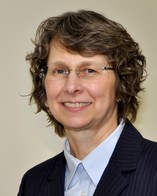
I think a great deal about how to build our workplace into one that focuses on innovation, inclusion, systems thinking, servant leadership, continuous improvement, and learning. That's an ambitious – and achievable – list of interconnected organizational approaches I want the division to adopt for how we carry out our work.
What these approaches might look like in action:
-
Innovation – We engage customers and community members in new ways. We adopt technologies that enhance our work and experiment with new ways, without creating risk for our treatment processes or infrastructure.
-
Inclusion – We engage diverse perspectives in discussion and planning. Individual differences are appreciated. Staff feel invited and safe to speak up and contribute to productive discussions.
-
Systems thinking – We plan and carry out work in ways that create the greatest benefit for the whole organization, not just one work area.
-
Servant leadership – Managers focus on developing individuals to perform their best and help them grow. Managers lead from behind and empower staff to achieve shared goals.
-
Continuous improvement – We use metrics to improve decision-making. We build a high-performance culture through ongoing efforts to improve products, services, processes, and workspaces.
-
Learning – We regularly share knowledge and seek opportunities to learn from others. Continuous learning is essential.
Through the Strategy Network – the cross-functional team that brings together perspectives from across all of the systems that support our work – I've been working with leaders to transform our workplace, centering on these approaches.
How long does transformation take? Nine to 14 days is how long it takes for a caterpillar to transform into a butterfly. Some say complete organizational transformation takes two to three years. Some say longer. Many say an organization can feel very different within 12 months. It's hard to predict how long our transformation will take. It's more complex than a caterpillar changing into a butterfly.
Each of us plays a role in creating new and better ways of doing our work together. Our division's transformation requires all of us to adopt these six approaches as workstyle habits. How long our transformation will take depends on our individual starting points: our understanding of what these approaches mean, how well they are embedded in our current habits, and how we support each other and hold each other accountable.
We do excellent work across the division. This transformation will make our workplace better for everyone and enhance our ability to support clean water, customer service, and the prosperity of our region. Cheers to our new habits in the new year!
Steps toward the future in Wastewater Planning and Capital Project Delivery
The four managers – Kyle Colvin, Wastewater Planning and Community Programs; Adam Gordon, Interceptor Engineering; Rene Heflin, Plant Engineering; and Jim Sailer, Construction Services – have done a commendable job of stepping up to oversee WP&CPD and support the department in continuing its excellent work.
I am working to bring in a temporary assistant general manager, who will start sometime in January, to support these managers with leading the department for the next six to nine months. The individual I am interested in seems like a good fit based on their interview with Craig Edlund, Sam Paske, and myself, with extensive experience in water infrastructure and water resource planning. I am working out the details of the arrangement and will share additional information later this month.
Main roles of the temporary assistant general manager:
- Support Adam, Jim, Kyle, and Rene and respond to their needs for advancing our wastewater planning and capital project delivery activities.
- Engage in our discussions about how we can build on the department's excellent work and support all of our workplace goals.
- Bring their experience from other organizations and collaborate with staff to identify what's working well for WP&CPD and the division and help us decide where to implement changes that best support all of our work.
I will be meeting with the WP&CPD department at the end of January to discuss these changes further. If you have any thoughts or questions related to the transition process, feel free to reach out to me.
|
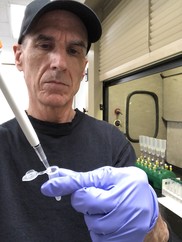
In March 2020, Steve Balogh (pictured at right), principal research scientist in Research and Development (R&D), started noticing reports in scientific literature and popular press about testing wastewater to track the spread of COVID-19.
"The reports indicated that wastewater could show the level and trends of disease prevalence in a community and help inform public health decision-making. The pandemic was an emergency, and wastewater surveillance seemed like something we should be doing to help," Balogh said.
He contacted Kenneth Beckman, director of the University of Minnesota Genomics Center (UMGC), to discuss a potential partnership. Beckman was interested but had no previous experience with wastewater analysis. If Balogh could determine how to extract remnants of the viral RNA (genetic material that may contain traces of the virus that causes COVID-19) from untreated wastewater, the UMGC would analyze it.
This was just the sort of challenge Balogh has embraced throughout his 34 years with R&D. He didn't know how to extract RNA from wastewater, either – but he and his team would figure it out.
A commitment to knowledge development and innovation
"This is what I was hired to do: use science to solve problems," said Balogh, reflecting on his career-long application of the scientific process. "In R&D, we read the scientific literature to find out what is known about the technical problems we face, and then apply that knowledge to find a solution."
Testing wastewater for COVID-19 was, and still is, a developing field of study. To learn how to extract RNA from wastewater, Balogh immersed himself in the rapidly expanding research, reviewing dozens of pre-releases of scientific manuscripts to learn about the process.
Balogh eventually developed a reproducible and robust extraction process, opening the door to a partnership with the UMGC. Ever since, the MCES team has been collecting daily wastewater samples, extracting the viral RNA, and delivering the frozen samples to the UMGC for identification and analysis.
Canary in a coal mine
The ongoing surveillance of wastewater has provided valuable data on virus concentrations and variant prevalence in the Metro Plant service area, which includes about 70% of the Twin Cities metro area. The data provides public health officials with an objective and comprehensive measure of the prevalence of COVID-19 and specific variants of concern in the community, and is not influenced by the level of community testing or the number of asymptomatic cases. In addition to providing this information to the Minnesota Department of Health, on Jan. 14 MCES began posting the data on our public website: COVID-19 Research - Metropolitan Council (metrocouncil.org).
Balogh emphasized that the wastewater testing is a team effort. George Sprouse, manager of Process Engineering, R&D, and Air Quality, has been a partner in this work from the start, and many other people continue to contribute, said Balogh. "From lab staff who collect the samples every day to my colleagues in R&D – the success of this project depends on the collaboration of many people throughout Environmental Services. And beyond MCES, our partners at UMGC have helped us formulate the scientific plan and continue to provide us with high-quality data. There are a lot of people involved."
Having recently secured additional research funding from the state via the American Rescue Plan, Balogh and his team are committed to continuing their work and doing their part to support and improve public health initiatives. "As scientists, we want to make the world a better place," said Balogh. "Wastewater treatment exists to protect public health and the environment. That's why we're here and why we do what we do."
|

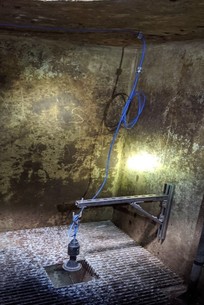
A cross-functional effort to replace 16 wastewater flow meters and 170 meter components was completed ahead of schedule late last year and should significantly reduce time spent on preventive maintenance, allowing staff to focus on other projects. (Pictured at right: New radar meter installation in an interceptor flume.)
Two hundred twenty flow meters are an integral part of MCES's interceptor system, which also includes 640 miles of sewers, 60 lift stations, and 24 rain gauges. "Our flow meters can detect the amount of wastewater flow in our system at any given time," said Chuck LaPierre, manager, Electrical Planning and Maintenance. "This data is used to determine billing rates for our customers, so accuracy is key."
Successful functioning of the system depends on a scheduled preventative maintenance program designed to identify and address detected deficiencies. (Read more about interceptor asset management in the November ES Update.)
A staff review of the existing flow meters revealed outdated equipment that needed frequent maintenance. In early 2020, Maintenance and Wastewater Planning and Capital Project Delivery joined in developing a project to:
- Replace 110 open channel level sensors with low-maintenance, highly accurate radar level sensors
- Replace 16 end-of-life magnetic flow meters
The team also coordinated the installation of high-water-sensing floats at 60 lift stations and meter vaults. This equipment sends an alarm to our Dispatch Center when potential flood conditions are detected nearby.
Staff forecasted the project to take 24 months but reached substantial completion in just 18 months (late 2021), and we have already seen measurable results. For example, corrective action "bad flow check" visits have decreased by 90% following the installation of the highly accurate radar sensors.
Staff time spent on preventative maintenance has also decreased significantly following project completion. Estimated staff hours that will be saved annually:
- Interceptor Services: 1,920 hours
- Maintenance: 740 hours
By reducing the average time spent repairing and restoring damaged equipment, these positive outcomes allow staff more time to focus on other projects.
LaPierre emphasized that the success of the project stemmed from the team's collaborative approach and completing all of the work "in house," without the need to hire and manage contractors. "This project demonstrated how collaboration between work areas allowed us to finish the work ahead of schedule and with a lower economic impact," said LaPierre. "The coordination between Wastewater Planning and Capital Project Delivery, Operations, the Process Computer Group, and our in-house trades staff created efficiencies in both time and cost."
|
With a focus on speaking to a younger, more diverse audience, MCES has launched a video project designed to highlight the careers available across our organization. "One of the goals of this project is to put a new spin on how we talk about our careers to youth," said Kristi Goble, program coordinator, Workforce and Equity. "We wanted to move away from the traditional, scripted career videos we normally see and create more engaging, personal videos that showcase the diversity we have in both who we hire and our many potential career paths."

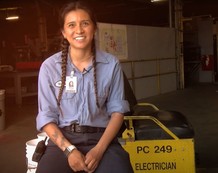
Workforce and Equity collaborated with the Communications department in Regional Administration to create the initial three videos. They feature Nancy Gonzalez (pictured at right), electrician apprentice, and Bryan Trost, electrician, from Electrical Planning and Maintenance, and Sadie Wolf, contract administrator, Construction Services. In addition to speaking about the challenges and rewards of their daily work, each featured participant expressed some level of surprise about their career path. "I honestly didn't know this existed," said Gonzalez, referring to the Metro Plant with its wide variety of career paths.
This is exactly the sort of knowledge gap these videos seek to address. "We want the public, and young people specifically, to know that our careers aren't only in wastewater treatment," said Goble. "The opportunities in Environmental Services are rich and varied, and we want to ensure our future workforce knows about them."
MCES uses these videos in career outreach efforts at high schools and colleges and will share them with partner agencies and community organizations. The videos will be shared via Council social media at strategic points throughout the year.
The video featuring Gonzalez is showcased on the Met Council's external job posting site (bottom of page). The other two videos can be viewed on YouTube:
The next round of videos will feature MCES machinists, engineers, and environmental scientists, as well as staff focused on safety, industrial waste, and lab work.
The featured participants in the first three videos said they were proud to be part of a larger effort to promote the important work happening every day across MCES. "I jumped at the opportunity to do this video because I wanted to represent the role of women in the environmental service industry," said Wolf. "Until we smash the illusion that women can't do this work, there will continue to be gender gaps. I want to pave the way for other women to take a chance on a career in a field that might traditionally be male dominated."
|
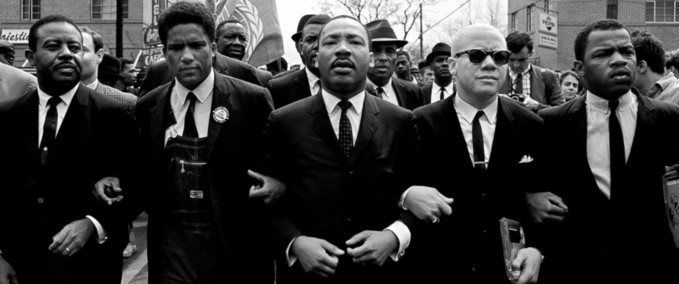 Dr. Martin Luther King, Jr. locks arms with his aides as he leads a march of several thousand people to the courthouse in Montgomery, Ala., March 17, 1965. From left: Rev. Ralph Abernathy, James Foreman, King, Jesse Douglas, Sr., and John Lewis.
As we work toward achieving true equity and inclusion in MCES, we should look back and learn from the legacy of Dr. Martin Luther King, Jr. For many, he is the leader who comes to mind when thinking about the civil rights movement of the 1950s and '60s.
Dr. King encouraged nonviolent resistance as the path to achieving equal rights for African Americans in the United States, as demonstrated through dozens of boycotts, sit-ins, marches, speeches, and more. His work, in collaboration with many other civil rights activists and leaders, led to the passing of the Civil Rights Act of 1964 and the Voting Rights Act of 1965.
On Jan. 14, employees gathered to remember Dr. King and explore how his legacy persists today. Participants watched an interview with the late Congressman John Lewis and discussed how we can all continue to work toward the justice and ideals championed by Dr. King. A recording of the event will be available soon on the Workforce and Equity Past Events page.
Next month, Workforce and Equity will continue to focus on the theme of "looking back to look forward." Watch your email for opportunities to learn, celebrate, and take action in honor of Black History Month.
A recap of recent Met Council announcements relevant to MCES
-
BIPOC Employee Resource Group kickoff meetings Jan. 18 and 19: This group will serve as a resource for those interested in supporting and networking with staff who identify as Black, Indigenous, and People of Color (BIPOC). Virtual kickoff meetings will be held at 5 p.m. on Jan. 18 and at noon on Jan. 19.
-
FSA and HRA reminders for the new year: If you elected to participate in health, daycare, or parking Flexible Spending Accounts (FSA) for 2022, you should have received a letter and new debit card from TASC, the Met Council's new FSA administrator. The Health Reimbursement Account (HRA) plan is still with HealthPartners, so if you are enrolled in both FSA and HRA you will have two separate cards and accounts.
-
Change in Enterprise Content Management (ECM) support: To align better with Information Services internal processes, requests for assistance from the ECM team should now be sent to the Service Desk at ServiceDesk@metc.state.mn.us.
-
Learn more about the 2020 Census results: The Research team in Community Development is hosting webinars on Feb. 1 and Feb. 2 for any Met Council staff interested in learning more about the 2020 Census results and how it can be applied to their work. Research staff are also available for more detailed consultation on census information with work units or individual employees.
-
Human Resources updates: MentoringWorks applications open through Feb. 4; enrollment open for 2022 LOD classes; HealthPartners health assessment now open.
Full information on MetNet.
COVID-19 RESOURCES
Anniversaries
Congratulations to these employees celebrating milestone anniversaries!
30 YEARS
Daniel Roeller, machinist mechanic, Mechanical Planning and Maintenance, Metro Plant
15 YEARS
Larry Brengman, assistant manager, Electrical Planning and Maintenance, Metro Plant
10 YEARS
Ron Grajczyk, principal contract administrator, Construction Services, Metro Plant Construction Field Office
5 YEARS
John Young, manager, Facilities and Fleet, Metro Plant
Staffing changes
Reported by Human Resources since the December Update
NEW HIRES
Michelle Larson, senior administrative specialist, East Business Unit, Empire Plant
DEPARTURES
Philipp Baumeister, intern, Sustainability, Metro Plant
Angie Craft, assistant business unit manager, East Business Unit, Empire Plant
Jerome Kramer, interceptor service worker 2, Interceptor Services, Regional Maintenance Facility
Ray Smith, senior program supervisor, Training and Program Supervisors, Metro Plant
POSITION CHANGES
Jane Henry, senior program supervisor, Training and Program Supervisors, Metro Plant (formerly program supervisor)
Story idea? Contact Shannon Keough by email at Shannon.Keough@metc.state.mn.us.
|