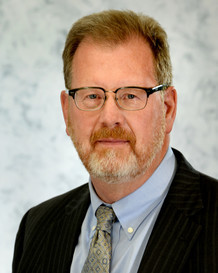
From General Manager Wes Kooistra
Earlier this week, the Metropolitan Council approved our 2021 operating budget and Capital Improvement Plan, which guides the maintenance of our fleet and facilities.
As you can imagine, these were not our usual budget plans.
Significant losses in fare and motor vehicle sales tax revenue were offset by emergency federal aid and the use of reserve funds. Without years of good stewardship and one-time federal funding, we would be telling a much different budget story.
As it is, we will be able to keep bus service levels where they are now – about 20% lower than before the pandemic. Early in 2021, we will begin running light rail weekday service on a schedule similar to Saturday service. There will continue to be 20 Northstar trips per week, down from the 72 trips per week that were provided before the pandemic.
While operating less service than we used to, we can look forward to the opening of the METRO Orange Line and the start of construction on the METRO D Line, new Bus Rapid Transit lines that will improve service in two of our busiest corridors.
Our capital budget also allows us to make targeted improvements to bus stops, transit centers and support facilities, and to keep our assets in a state of good repair. Fully funded investments like the new Minneapolis Bus Garage and the Green Line Extension will continue moving forward as well.
We are in a better position than many of our peers, especially larger transit agencies that are more reliant on fare revenue and are having to consider potentially drastic service and staffing changes.
As an industry, we are hopeful federal lawmakers will acknowledge transit’s essential role in our nation’s economic recovery and help us through this difficult chapter.
But one-time federal relief and reserve funds are not a long-term solution to budget challenges that existed even before the onset of this pandemic.
To improve our service, we need a dedicated and reliable funding stream. While recognizing our state and regional economies are in recovery mode, we will continue making the case for just that kind of investment.
As this pandemic has shown, transit is part of the region’s critical service infrastructure. Thousands of essential workers are relying on our buses and trains to access jobs, care for loved ones and tend to other essential needs. And while there are many lapsed riders who aren’t currently traveling to work, school or special events, we will actively work to bring them back once it is safe to do so.
A transit network that is defined by reliable and safe service has always contributed to a more equitable and sustainable region – goals that are more urgent than ever.
So while we must acknowledge that we are facing some real financial challenges, we can also take confidence in knowing we have many supporters who are committed to finding a way forward that does not rely on one-time funding.
As we prepare for the next chapter, I want to thank all those who helped develop our 2021 budget, especially Finance Director Ed Petrie and his team. And I want to thank you all for your work navigating the uncertain road ahead. It won’t be easy, but we will find a way.
Supporters asked to call for transit investment on December 15
The American Public Transportation Association is urging transit supporters to voice their support for transit on Tuesday, Dec. 15, by contacting elected representatives and using the hashtag #SavePublicTransit.
Learn more about APTA's call for emergency transit funding
|

All on-site essential employees are encouraged to take a COVID-19 test at least once before the end of the year, even if they are not showing symptoms.
Several free testing options are available to employees and their family members. In most cases, no appointments or insurance is required.
Remember: If you suspect mild symptoms or have been identified as a close contact, immediately contact your medical provider and alert your manager.
Testing options include:
Community Testing Sites: Free testing is available everyday at the Starlite Center in Brooklyn Park, the Minneapolis Convention Center, the MSP Airport and the Roy Wilkins Auditorium in St. Paul. Other locations are offering tests on a more limited schedule. Appointments are suggested. To make an appointment and see a full list of sites and hours visit mn.gov/covid19 or call 1-855-612-0677.
HealthPartners drive-up clinic: Employees who have a HealthPartners medical plan can schedule a video screening that will help determine whether they should go to a drive-up testing site or seek more immediate care. COVID-19 tests and treatment are fully covered for HealthPartners members. For more information, visit healthpartners.com/coronavirus or call 612-339-3663.
Well@Work Clinic: Asymptomatic employees may schedule a COVID-19 test at the Council’s Well@Work Clinic, located in the Heywood Office, 560 N. Sixth Ave., Minneapolis. To make an appointment, call 952-967-7468.
At-home test kit: COVID-19 test kits that can be self-administered are available to select on-site essential employees. Saliva samples will be sent to a lab and results will be available within 48 to 72 hours. The state is also offering free at-home saliva test kits. To learn more about getting a test kit through work, contact a manager or supervisor. Questions about in-home testing can also be directed to mn@vaulthealth.com or 800-800-5698.
New COVID-19 Employee Preparedness Plan released
Measures to maintain a safe working environment are outlined in a new COVID-19 Employee Preparednesss Plan. The plan addresses key steps Metro Transit is taking to protect employees, like limiting on-site staff, frequent cleaning and mask distribution. Another example put in place this week -- the installation of 94 hands-free sanitizer dispensers at support facilities.
Review Metro Transit's COVID-19 Employee Preparedness Plan
Review COVID-19 case data by worksite
Every Friday, the number of confirmed cases of COVID-19 reported to the Employee Resource Center in the previous week will be reported in Insights. Managers and supervisors are encouraged to post this information at work sites.
See the latest data on COVID-19 cases by worksite
Continue reading
Find more information about Metro Transit's COVID-19 response on MetNet
Learn more about COVID-19 vaccines
Minnesota Department of Health Situation Report
|
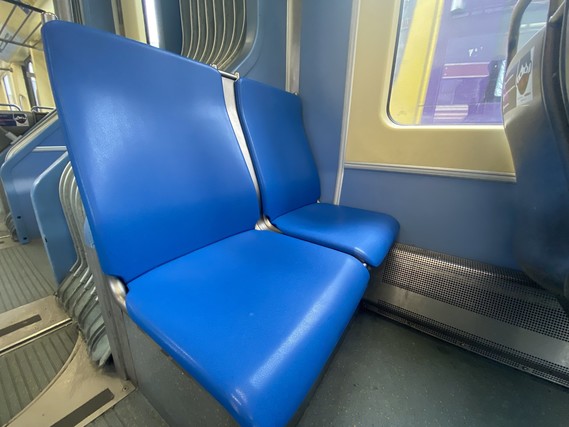
For the past 16 years, customers who have taken a seat on a light rail vehicle have rested on cloth seats. But the seats have proven difficult to keep clean and dry, particularly during winter months.
To prevent future soggy bottoms and defray ongoing maintenance costs, Metro Transit is replacing more than 13,000 cloth seat backs and bottoms with new, custom-designed plastic seats.
After testing plastic seats on a handful of train cars last year, all 91 light rail vehicles are being retrofitted over the coming months. New light rail vehicles that will be used on the Green Line Extension will also feature plastic seats.
“Our customers have been asking us to do this for a while, so we’re excited to take this step and improve their riding experience,” said Ryan McTeague, director of light rail vehicle maintenance.
Maintenance staff are also looking forward to the change. To clean existing cloth seats, staff must sometimes remove seat bottoms and backs, steam them and allow them to dry. In some cases, cloth seats need to be refurbished or discarded.
The transition to plastic seats comes as maintenance staff put extra time and energy into cleaning and disinfecting light rail vehicles, part of Metro Transit’s response to the COVID-19 pandemic. All light rail vehicles are fully disinfected before entering service each day.
“We are doing everything we can to provide a comfortable and safe riding experience, and these plastic seats will be a big part of that moving forward,” McTeague said.
Customers are invited to offer feedback on the new seats by contacting Customer Relations.
Lives: St. Paul
Job: Operator, South Garage
Years of Service: 7
How did you come to work at Metro Transit and what do you do?
After working jobs at the Mall of America as a young man, I decided I needed something more reliable and got a Commercial Driver's License (CDL). Twenty-six years later, I continue to drive buses. I started with school buses and worked for a few different companies in the region but always had an eye on Metro Transit. It took me four tries to become a bus operator here. The process is very stringent but worth it --the pay and benefits here are great.
What is your favorite part about working for Metro Transit?
I enjoy working a split shift and extraboard. It's very similar to working for a school district with morning and afternoon shifts with a break between. As an extraboard operator, my routes change often, so I'm able to see different parts of the city and interact with different people. What I like most about the customers here is that I can reason with them a little better than children on a school bus.
What are your favorite activities when you’re not working or “Off the Clock”?
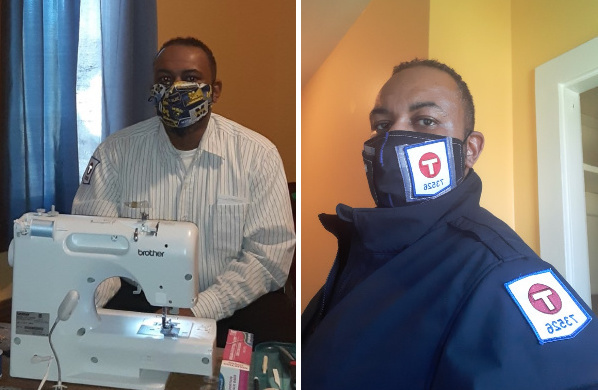
During the shut down in April, I was on COVID leave due to my pre-existing conditions. With nothing much to do, I figured I could do something to help people out with the mask mandate. Even though I hadn't touched a sewing machine since home economics in high school, I decided to start making masks. So from sunup to sundown, I studied and tested out different methods and materials until I found out what worked. Today, I have 42 mask variations and have made over 1,200 masks, including masks made out of operator uniforms with their employee number on the front.
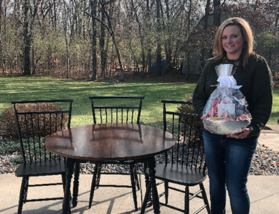
Lt. Erin Dietz recently discovered that she can use her stress-relieving hobby to help formerly homeless families. She finds and refinishes used furniture and donates them to families the Homeless Action Team (HAT) helped find permanent housing. To date, she's donated two dining table sets she refinished along with another set in good condition to three families.
To find homes for the dining sets in November, Dietz contacted Carol LaFleur, the Metro Transit Police Department’s associate community outreach coordinator and HAT member.
LaFleur worked with Capt. Brooke Blakey to identify families who recently moved into permanent housing and needed furniture. The team delivered the furniture to their new homes. “One family had no furniture other than the table we gave them,” Dietz said.
As word spread, people began donating gift cards. Dietz used some of the money to create Thanksgiving food baskets to accompany each set of tables and chairs.
“Carol and I then thought about making holiday food baskets for other families in need. Carol coordinated a Facebook page for donations for the baskets. We received enough gift card donations to make 22 baskets. I was able to make these baskets in my spare time and fill them with fixings for holiday side dishes and a gift card for other grocery items needed,” Dietz said.
The 22 baskets will be distributed in advance of the December holidays to families known to HAT. The team continues working with people after they move into permanent housing.
She also added gift cards in small amounts to “blessing bags” of snacks, toiletries, and other little necessities that officers give people who seek shelter on trains and buses.
|
|
Nicollet Garage operator Tarik Ouardi recently received a commendation for his support on this customer's big day.
The driver was very polite, greeted and welcomed me when I boarded. It's my first day of work and he wished me good luck as I was getting off.
Lindsey
|
|
 |
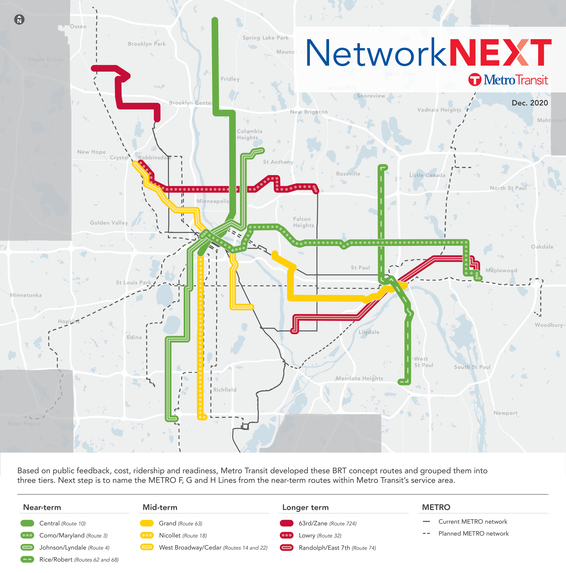 Metro Transit is looking for help identifying which corridors should be next in line for Bus Rapid Transit (BRT) service.
Through January 20, community members are being asked to rank their top three corridors from a list of four that have been identified as future BRT corridors. The corridors are currently served by Route 10 (Central Avenue), Route 3 (Como and Maryland avenues), Route 4 (Johnson and Lyndale avenues) and routes 62 and 68 (Rice and Robert streets).
Like existing BRT lines, the corridors would be improved with faster and more frequent service, all-door boarding and enhanced waiting areas featuring ticket machines, real-time displays and on-demand heat.
The future investments are being considered as part of Network Next, a 20-year plan for expanding and improving the bus network.
Two BRT lines, the METRO A and C lines, are in service and another three are in planning. The next one scheduled to open is the METRO D Line, which will improve service on the Route 5 corridor.
Congratulations to these employees who retired in November
JoAnn Blomgren, #3811, 18 years of service
Congratulations to these employees who celebrated their retirements anniversaries in November
40 years
Keith Stein, Maintenance Manager, South
James Graham, Foreperson-Facilities Maintenance
35 years
George Durant, Mechanic Technician, Ruter
25 years
Elizabeth Kelly, Transit Control Center Supervisor
20 years
Katherine Downs, Principal Financial Analyst
Deanna Ashmead, Operator, Heywood
Joseph Flascher, Operator, Nicollet
Jessica Rose, Operator, East Metro
Nicolas Hensgens, Rail Transportation Supervisor
Larry Wilson, Operator, Heywood
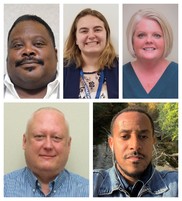
Welcome to these new employees
Clockwise from top left:
-
Alvin Riley, Data Analyst. Riley will be compiling and analyzing police data for MTPD. He most recently was a part-time bus operator.
-
Taylor Levine, Principal Administrative Specialist. Levine joins Lt. Joseph Dotseth’s administrative team.
- Andrea Hunt, Receptionist. Hunt will be working at MTPD's front desk serving the public.
-
Nasser Mussa, Associate Coordinator. Mussa will be working on Network Next, Riders Club and other projects.
-
Mika Raveala, Supervisory Control and Data Acquisition/Communications Technician. Raveala will focus on preventative maintenance in stations and tunnels including signs, emergency telephones, PA systems and cameras.
To share news about new hires, promotions, retirements or other milestones, please email insights@metrotransit.org.
|
-
AWT to celebrate achievements on December 14: Advancing Women in Transit (AWT) is hosting a virtual celebration on Monday, Dec. 14 from 12:30 p.m. to 1:30 p.m. The event celebrates women at Metro Transit who were promoted, participated in temporary roles through internships or the Leadership Academy or contributed in other ways. All are welcomed to join the virtual celebration on WebEx. For more information, contact Amina Wolf.
-
Learn more about an LGBTQ group for employees: A council-wide LGBTQ Employee Resource Group (ERG) has started taking shape. ERGs are employee groups which share a common characteristic or interest, such as gender, ethnicity or race, sexual orientation, generation, or other special interest. ERGs provide resource and support to members and to the organization. Attend the next meeting at 10 a.m. on Monday, Dec. 21, to catch up on the 2021 charter and workplan. New members are welcome year-round. Contact Sarah Berres to learn more.
-
South Garage operator David Burnett passed away: It is with great sadness and a heavy heart that Metro Transit informs staff of the passing of South Garage Operator David Burnett. Burnett passed away on Friday, Dec. 5. The family plans to announce a celebration of life post pandemic.
|