A thought for the day…
When we do the best we can, we never know what miracle is wrought in our life, or in the life of another.
– Helen Keller (1880–1968) American writer and social advocate
 IN THIS ISSUE
Notes from Mary Bogie
Deputy Regional Administrator & Chief Financial Officer

As the COVID-19 pandemic continues, many of us are naturally wondering what the future looks like for the Met Council budget, our staffing, and the services we provide. This is a challenging time for everyone, and while we don’t know exactly what will come, we do recognize that the impacts to our organization are going to be lasting.
At this point, it is too early to tell what lies ahead, but we are developing budget plans to address our funding and any adjustments we will need to make to our services and operations.
This crisis underscores more than ever the important work Met Council employees do for our region and our state. For now, the best thing we can all do is continue to work hard and provide the services on which our neighbors depend.
We heard last week that our state’s budget and economic outlook has significantly worsened since the COVID-19 pandemic began. Projected revenues, primarily income and sales taxes, fell dramatically ($3.6 billion), while claims for unemployment benefits continue at unprecedented pace.
Our Met Council budget has not been spared from the impacts of COVID-19. The downturn in the state forecast weighs heavily on our services and programs. Our Parks and Trails passthrough funding relies on sales taxes. Motor Vehicle Sales Taxes have declined significantly, and the virus impacts on our ridership and fare collection have upended our transit service as we know it. Our customers, too, are experiencing economic hardship that likely will impact our operations.
While our budget impacts are significant, we entered this situation in a healthy state with “rainy day” reserves available in our operating funds. Federal CARES Act funding for Transit ($226 million) and Housing ($1 million) help to fill gaps and give us time to develop plans for our future. While we are currently under a soft hiring freeze, I want to be clear, at this point, we have no plans to reduce our workforce through layoffs.
Our recovery will not be a quick flip of a switch; it will be a prolonged transition out of the pandemic and in to a new normal. As the Governor makes decisions to reopen, businesses will make decisions that fit for their workforce, and we will adapt our services to meet the needs for the region.
From the state, Minnesota has worked hard to build a $2.4 billion budget reserve to lessen impacts from this economic downturn. The Governor's thoughtful leadership and smart, transparent decision-making based on data and expert input has reassured Minnesotans that he is making the best possible decisions for the state.
The Met Council as well has prudent financial practices in place that will help us weather this storm. We will continue to adapt by using available data to model our future and keep you informed as we continue to address the various impacts from this crisis. Thank you for all you do to continue our critical work for the region.
|
New layout is a result of best practices research
Met Council staff who visited the website homepage last week got a surprise with the unveiling of a new look and layout presenting the agency.
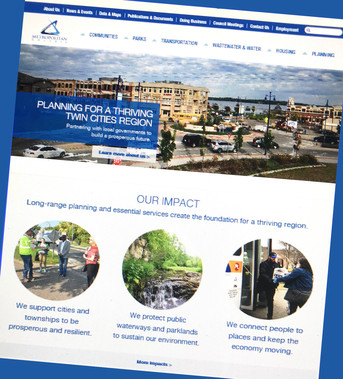
The new homepage is the result of work began last year and ramped up more seriously in January. It updates a homepage most recently redone in 2012 (“the old days,” digitally speaking).
A key goal of the new layout is to immediately “set the scene” and quickly define who we are and what we do, said Web and Social Media Editor Crystal Mulry, who initiated the project and helped guide its implementation.
There was a desire to streamline and focus the homepage on a few key messages that represent the whole agency in a few seconds, especially for first-time or infrequent visitors. Every word on the page was carefully considered and debated.
Check it out at MetroCouncil.org.
“We knew from research and input over many years that the landing page was not everything it could and should be,” she said.
“After we studied best practices and took a close look at several more effective sites, we developed our own solution about how we wanted to present the Met Council.”
Other key contributors to the work were Graphic Designer Shawn Jacobson, who created the design and layout; Applications Developer Jim Dudley, who handled technical development; Multimedia Manager Ed Lube, who was project manager; and Principal Communications Specialist Jeanne Landkamer, who wrote and edited the text. Several more Communications staff added critical input as reviewers during the development process. “It truly was a joint effort, and everyone’s input was critical,” Mulry said.
The big image that leads the homepage was made by photographer Jeff Syme in Forest Lake a few years ago. The photo will be refreshed over time, perhaps seasonally; other photos are in the queue.
Mulry said the top image and brief text provide essential cues about our core mission: "Planning for a thriving Twin Cities region.” A second deck of information describes “Our Impact: Long-range planning and essential services create the foundation of a thriving region.” Toward the bottom are links to news and upcoming Council meetings.
Later this year, staff will begin taking a closer look at webpages linked from the homepage, with an eye toward making the information and layout more user-friendly.
Staff who have an opinion to share about the new homepage can email Crystal.Mulry@metc.state.mn.us.
|
Posts on coronavirus response from Metro Mobility are huge
A lot of things have changed around the central office since the state lockdown began – having almost no staff on site and no on-site public meetings, to state the obvious.
But one thing that hasn’t changed is public interest in Met Council services and programs, as reflected in the statistics that measure social media activity and website visits.

Two posts are like lightning on Facebook, Twitter
Two stories covering innovative transportation services during the pandemic have garnered high interest on our social media accounts – both stories toting up 400-500% more interest on Facebook than usual for one of our news stories:
Other above-average posts included one about reduced traffic during the quarantine and multiple posts on “What Not to Flush” and keeping sewer pipes free from clogging – a strong showing for Environmental Services.
Web and Social Media Editor Crystal Mulry said the increased numbers confirm a strong ongoing public interest in the Met Council. “The numbers show that what we’re doing during the lockdown, and how we’re helping support the community at large, has a lot of interest and people are excited about helping share our good news,” she said.
The Met Council joined the Twittersphere in 2010 and has 10,000 followers; we joined Facebook in 2012 and have 6,300 followers.
Web traffic strong as ever
“Website traffic has been surprisingly high since the lockdown began, and much higher than I would have expected, all things considered,” said Multimedia Manager Ed Lube, who oversees the Met Council website and monitors digital statistics and trends.
Lube said there were more than 45,000 unique visitors to our website in April, consistent with increased visitor counts since 2019. While some of the visits reveal an increased interest in online committee meetings, that accounts for only a portion of the activity, Lube said.
As usual, online visitors fanned out to every area of the Met Council from transportation to housing to parks to Metro Mobility to research. “Every page is important to the person seeking information there,” Lube said, noting that the number of unique website visitors increased by about 40% early in 2019 and has remained strong.
As with Facebook and Twitter, two web stories drew the lion’s share of readers in April, both attracting 4-5 times the interest of other popular stories in April: Metro Mobility transporting healthcare workers and Metro Mobility delivering groceries and food supplies.
Not surprisingly, Met Council webpages devoted to employment, contract opportunities, and Metro Mobility were down 30-40% from earlier months.
“Our employment and Metro Mobility web pages, in particular, are reliably strong almost every month, and have been for years,” Lube said, noting that a soft hiring freeze at the Met Council and a greatly pared-back summer internship program, along with reduced Metro Mobility ridership, explains the lower numbers. On the flip side, Southwest LRT web pages remain as busy as ever, he added.
|

Interim Budget Projection reveals weakened state outlook
Last week Minnesota Management & Budget (MMB) released an interim budget projection for the current biennium (FY2020-21), which shows that Minnesota’s budget and economic outlook has worsened significantly since the COVID-19 pandemic began.
The May 2020 Interim Budget Projection is not a full state budget forecast like the November and February forecasts, but a more limited budget projection produced at the direction of Gov. Tim Walz to take into account current economic conditions and provide lawmakers timely information before the end of the 2020 regular legislative session.
A deficit of $2.43 billion is now projected for the FY20-21 biennium. That represents a nearly $4 billion negative change compared to the February forecast, which projected a $1.5 billion surplus.
Revenues are expected to be $3.61 billion lower, and spending is expected to be $391 million higher. The state’s existing budget reserve is $2.36 billion and will be available to mitigate some of the budgetary impacts of the crisis, though it is likely that lawmakers will need to adjust the budget several times throughout the course of the biennium.
MMB Commissioner Myron Frans and State Economist Laura Kalambokidis stressed that given the great deal of uncertainty about the path of the pandemic, the economic outlook will remain volatile for some time.
Final week of 2020 regular session is here
Just six days remain until the legislature reaches the constitutional adjournment deadline of May 18 for the 2020 regular session. Legislators have been following physical distancing guidelines as they work, so the final week of session will be busy with Zoom committee meetings and floor sessions where legislators vote in shifts and telephonically.
Key topics of discussion in the remaining days of the session will include the state's COVID-19 response, economic recovery, and a bonding bill to fund public projects.
Watch The Wire for a legislative summary later this month.
|
Environmental Services digs deep to keep it flowing
 Big sewer project near Minnehaha Falls ramps up
Six months after work began, the massive sewer rehabilitation project near Minnehaha Falls entered a new phase last week when the normal flow of sewage was diverted into temporary piping to take it around the section under repair. In the big photo, Royan Allison of Lemetti & Sons is dwarfed by the 11-foot-diameter sewer that normally conveys 15 million gallons of wastewater every day to the Metro Plant in Saint Paul. Also shown: A gigantic system of pumps and pipes (lower left) allows crews to control which one, two, or three of the 24-inch pipes are used to convey the flow. The temporary pipes (lower right) convey wastewater about a quarter-mile around the repair site. The work was deemed essential to update aging infrastructure and should be complete by July 2021.
Mask-makers to the rescue!
 LOCAL HEROES ALL
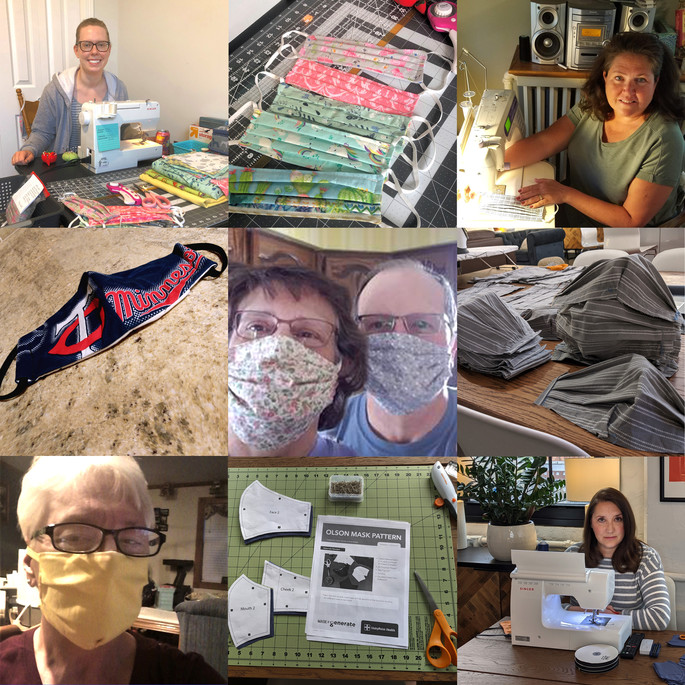
Top (left to right): Samantha Bean, Samantha's masks, and Sandi Dingle. Middle: Mask by Ying Lan; Deb and Mike Conley (middle) in masks by Sandi Dingle; and masks by Julie Melville. Bottom: Debbie Borgan, Julie's sewing table, and Julie Melville.
Met Council staff proved they have a lot of heart when a call for community “hero stories” during the quarantine brought forth a handful of employees who have created and donated more than 600 protective face masks for family, friends, police, hospitals, and others.
- “At a time when it’s easy to feel powerless, it’s great be able to help out,” said Business Analyst Samantha Bean, who lost count after making 50 masks for local firefighters, friends, and family.
- “It has been rewarding to know I can help in some way, and it is my way of staying grounded through this stay-at-home order,” said Senior Account Specialist Debbie Borgan, who has donated nearly 100 masks.
- “I believe we all need to take this seriously and do whatever we can to help each other get through this,” said Program Technical Specialist Sandi Dingle, who has donated 100 masks.
Similar sentiments were expressed by other employees who answered the call for personal face masks from Gov. Tim Walz, the CDC, local hospitals, and others in mid-March and after. See their stories below.
Central office staff contributions add to a similar effort at Metro Transit spearheaded by Melinda Love last month. (See a story in Insights, April 24, 2020.)
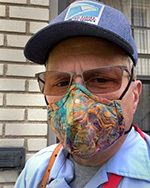
Most of the employees featured below already knew their way around a sewing machine, but not all did. Account Specialist Lynne Lindholm said her role was mostly tracing, cutting, and ironing patterns for a neighbor to sew – but her work combined toward 110 masks with the neighbor, which "feels great.” (That's Lynne's husband, John, a mail carrier, at right. See their story below.)
Graphic Designer Linda White sewed a bunch of masks – but said you don’t necessarily need to be a seamstress to participate. “There are also many ways to make masks without sewing them,” she said. “It seems that masks are becoming a new fashion statement these days.” How to make a no-sew face mask.
Still, if you want to sew, help is here. Applications Developer Ying Lan said she didn’t know how to make a mask before now but found a lot of help online, including patterns and even video instruction. “I like this pattern (below) because it is easy to put a filter in the middle of the mask, like a coffee filter or other materials that can help prevent viruses,” she said. “It’s not that difficult.”
North Memorial: Homemade healthcare mask pattern
North Memorial: Homemade mask instruction (video on Facebook)
Another popular and simple pattern
MASK MAKERS SHARE THEIR STORIES
SAMANTHA BEAN
BUSINESS ANALYST
ENVIRONMENTAL SERVICES
I started sewing masks when the CDC first released its recommendation that all Americans wear face coverings in public, and I’ve been donating a lot of them. I dropped off 25 masks at my local fire department during the Governor’s MinneSEWta mask drive. And the quilt shop near me is a drop-off location for Allina, so I’ve taken some there. I’ve given the rest to friends and family. Some of my masks are on their way to Germany!
At a time when it’s easy to feel powerless, it’s great be able to help out. And that I can contribute while also pursuing my hobby (crafting) is a bonus. I’ve really enjoyed making them. And It’s great to hear about colleagues who are also putting their sewing machines to work to help in the pandemic!
JULIE MELVILLE
DATABASE ADMINISTRATOR
INFORMATION SERVICES
I had bought a sewing machine last summer with the intent to rekindle a teenage hobby, but hadn’t picked it up until one of the owners on my condo’s Facebook page, who is the chief of police at a municipal police force, put out a message asking for hand-sewn masks for her officers. I’m not a prolific mask maker but I found some donated thread from another condo owner and an unused king size, 100% cotton sheet, and found I had the raw materials to make a mask for 20 officers on the force and still had 9 more.
Since then, I’ve also sewn masks for friends and neighbors who are immune-compromised, and/or caregivers; that totals around 15 more masks. I may sew more for a community shelter or other entity as I hear about the need. As a bonus, I’ve regained my former sewing skills! It’s been a great way for me to honor my mom, who was so patient teaching me all those years ago.
Read more testimonials on MetNet.
|
If you have ongoing questions about COVID-19, the state and Council response, and what the road ahead looks like today, there is a raft of resources at your fingertips.
For starters, keep your eye on MetNet for regular updates from Met Council leaders that pertain directly to the agency and all its employees. From MetNet you can jump directly to employee and manager pages of frequently asked questions, which are updated regularly as we have new information to share.
Keep an eye, too, on your inbox for regular all-staff emails from Regional Administrator Meredith Vadis. As a reminder, the formerly five-days-a-week email has now been pared to Monday-Wednesday-Friday for the time being.
The State of Minnesota also has robust COVID-19 pages and tools easily found on its websites. If you have questions about COVID-19, check out the new chat bot on the state’s COVID-19 response website. The virtual assistant, made by the Minnesota Department of IT Services (MNIT), can answer your questions about everything from the Governor's executive orders to Minnesota COVID-19 statistics. In addition to the new virtual assistant, the "If You Are Sick" section of the state's COVID-19 response website provides easy access to Minnesotans' closest testing site, offers general information related to the COVID-19 outbreak, and provides an interactive screening tool to help Minnesotans determine if they need a test for the virus.
For a national picture, your best place to start is the Centers for Disease Control and Prevention website.
Another great choice is the Met Council’s employee assistance provider, Sand Creek, whose website is full of helpful resources including articles, streaming webinars, links, and more. For more personal attention, don’t hesitate to call Sand Creek and speak with one of their counselors.
For additional health and wellness resources around mental health, physical health, relationships, finances, and more, check out the COVID-19 wellness resources page on MetNet from Fit For Life (where you can find a wonderful resources guide covering many topics) and their regularly updated events page for upcoming webinars and programming.
We’re in this together – and together we’ll get through it.
Chair Zelle matches wits with the Theater for Public Policy in a show entitled, 'Transit and sewers and zoning, oh my!' now available to watch on YouTube
"Love it or hate it, the Metropolitan Council touches the lives of everyone who lives or works in the seven-county metro." That's the opening line in a promo announcing an appearance by Chair Charlie Zelle at the Theater for Public Policy (TPP) last week – which is now available for viewing on YouTube. The TPP is a local improvisational troupe that works at the nexus of public policy and theater ... or "education disguised as entertainment."
In the one-hour show, aired live online last week, host Tane Danger interviewed Zelle over the internet about several real-life Met Council issues (transit, housing, parks, planning, the environment) followed by lengthy sketches starring TPP actors engaging with Zelle. Rest assured that the show is very interesting! And certainly unique. The TPP promo also proclaims, "We will ask Zelle about overseeing this massive organization and whether he thinks zoning is sexy." No spoiler alert here; you'll have to check it out.
Charlie Zelle and the Theater for Public Policy on YouTube (approx. 1 hour)
Accessible remote meeting guide now available from MNIT
Remote meetings are suddenly our most common way of connecting with one another. And since this will not change anytime soon, we should all make sure that remote meetings are as effective and accessible as possible to all staff and community members. Minnesota IT Services has created a Remote Meeting Guide for agencies like the Met Council to help ensure that our remote meetings are done in a way that use accessibility best practices. Additionally, there’s a free webinar available from the State’s Chief Information Accessibility Officer, Jay Wyant, that addresses accessible remote meetings as well as a guide on troubleshooting audio and visual issues.
Webinar, 'Social Media: How it affects your family'
Texts, emails, Facebook posts, Tweets ... these can all be convenient and, in some cases, entertaining, but they can also affect how a family interacts. Do your family members text during dinner? What is the tone of your electronic communication? Do you hear about things going on with your children on Facebook?
Social Media: How it affects your family
Wednesday, May 13
Noon to 1 p.m.
Join this session to explore the positive and negative influences of social media on family communications and develop some strategies to harness the power of social media, while eliminating the negative influences.
Register: https://register.gotowebinar.com/register/1243273175707586829
Watch for these future webinars:
Shifting Our Mindsets, May 19 & May 22
Moving From Victim to Thriver, May 27 & 29
Managing the Financial Impact of COVID-19, June 3 & June 5
 A Time Out of Mind
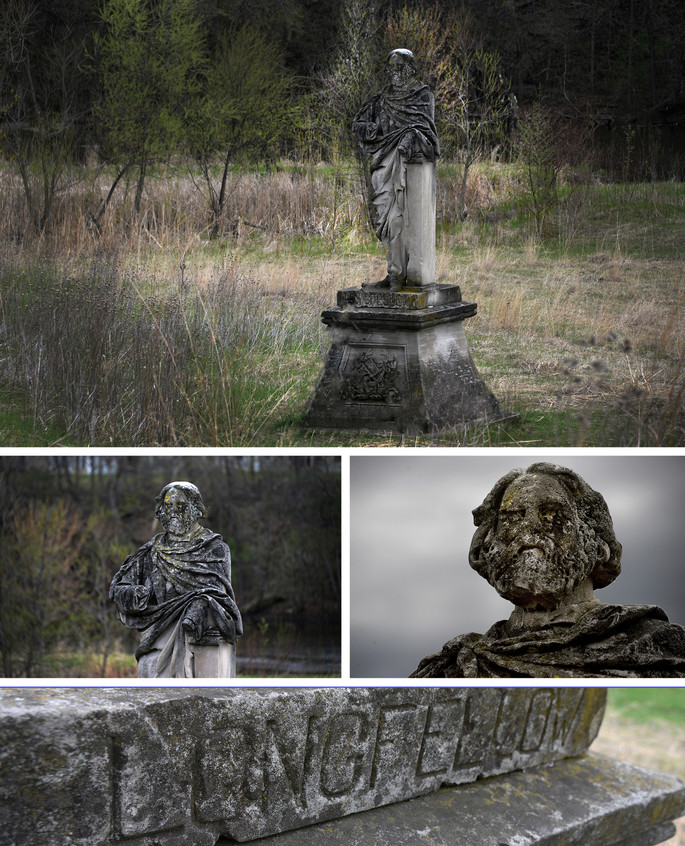
Hidden in plain sight in south Minneapolis is this almost lost and mostly forgotten tribute to legendary American poet Henry Wadsworth Longfellow, who wrote the "Song of Hiawatha” in 1855. The statue was the centerpiece of a popular park and zoo near Minnehaha Falls from 1906 to 1934, according to an informational kiosk nearby. No word there about restoration plans. The statue is just west of Hiawatha Avenue and south of Minnehaha Parkway, not far from the restored Longfellow House facing Minnehaha Falls, but is not visible from any roads. You can learn more about the backstory at Longfellow Zoological Gardens at MinneapolisParks.org (scroll down to the history tab).
The Wire is published every two weeks for employees of the Metropolitan Council. Everyone is invited to submit comments and story ideas. Contact the editor at thewire@metc.state.mn.us.
|