A thought for the day…
I've always believed that you can think positive just as well as you can think negative.
– James Baldwin (1924-1987) American Writer
 IN THIS ISSUE

Notes from Meredith Vadis
Regional Administrator
Last week, the COVID-19 pandemic overshadowed what promised to be the biggest Earth Day celebration in our nation’s history – the 50th year of a historic landmark in the movement to preserve the health and biodiversity of our one and only planet.
But I want to take this opportunity to appreciate every employee for the work you do to advance sustainability and stewardship in our region. Whether you manage payroll, drive a bus, keep our wastewater treatment plants running, help communities mitigate climate change, or inspect Section 8 housing units, you are all helping to realize the vision in Thrive MSP 2040.
One of the great things about working at the Council is the personal commitment our employees bring to our work – a commitment to clean water, good planning, clean air, and healthy families and communities – all things that contribute to the goals of the original Earth Day.
I’m remembering what one of our industrial waste technicians said once about his job: “I’m a sewer cop. I’m here to protect and serve the community.”
And one of our planners, on the importance of climate change mitigation: “Everything we do in Minnesota not only will make things better in the long run for us, but it will affect everybody else in the world as well.”
I could quote many more of you. Suffice it to say that it is fulfilling to be part an organization that is doing so much good work in our region. I encourage you to take pride in the work you do this Earth Day and every day.
And no doubt, this year’s Earth Day and spring season feel very different from what we’re used to. As Minnesotans reaching the end of a long winter, we eagerly look forward to heading outside and celebrating the warmer weather with family and friends, and getting back to our favorite warm-weather outdoor activities. But this year, we have to adjust and adapt to the conditions of our situation – while maintaining that connection to nature and each other.
As we continue to practice physical distancing and adhere to the stay-at-home order and other guidance from the state, make sure you are staying connected and enjoying the beauty that spring brings. Plant a garden in your yard, open the windows and fill your home with fresh air, safely visit a regional park and take a walk, or start practicing one of the sustainability-at-home tips we’ve outlined below. Strengthening your connection with nature and contributing to the sustainability of our planet, both at home and in our work at the Council, help restore the soul and build a brighter future for all of us.
|

Sure, these are trying times. So why not try some activities at home to support your mother Earth
While this year's Earth Day feels very different than past years, as we spend more time at home and in-person events are canceled, there are many ways we can still celebrate this holiday's 50th anniversary this month and practice sustainability in our daily lives.
Try out some of these Earth Day activities you can do at home, courtesy of Travel + Leisure:
-
Plant a garden or add some green to your space. If you have access to a backyard (or even a window box), now is the perfect time to plant flowers, vegetables, a tree, a small herb garden — the possibilities are endless. Local gardening centers are open in states throughout the country, with some even offering no-contact pickup. You can even have plants delivered straight to your doorstep if there isn’t a garden center near you.
-
Take a walk (while physical distancing) and discover native plants. If you’re able to do so, take a walk around your neighborhood and learn about the plants and animals that live in your area. You can use the Native Plant Finder website to search for plants in your zip code, or do a little research about the animals native to your region.
-
Learn about recyclables. Sure, you recycle plastic bottles and aluminum cans, but there are probably a lot more things that you could be recycling. Take this time to refresh your knowledge of local recycling rules, and find out where you can recycle materials like textiles and electronic waste.
-
Shop sustainable brands online. Make your next purchase easier on the environment by buying from a sustainable brand. Clothes made from recycled materials, package-free toiletries and household essentials, and more are available online.
-
Watch a nature documentary. Cure your cabin fever with a documentary that reminds you of the Earth's expansive beauty. Online streaming sites have a lot of great nature documentaries, so take a look around your subscription services and even YouTube.
-
Rethink food scraps. Approximately 30 to 40 percent of the U.S. food supply becomes waste, according to the USDA. Find resourceful ways to repurpose food items that would otherwise be thrown out (e.g., cocktails, infused spirits or syrups, making stock) or start composting in your backyard or collecting organics recycling in your kitchen. Check your city's website to see if they offer organics recycling pick-up or drop-off sites for residents.
-
Donate to charity. While you might not be able to participate in group Earth Day activities like beach cleanups or festivals, you can still make a difference from home. Whether you want to protect endangered species or promote clean energy, there’s a charity for you.
-
Take a virtual field trip. If you can’t get outside, bring the outdoors in with a virtual field trip: You can take a tour of a national park, explore the Great Barrier Reef, or even stroll through a botanic garden.
|
Craig Bantz began Monday, working remotely from Ohio
Starting a new job during the state lockdown presents new layers of challenges beyond the obvious. But Craig Bantz is well equipped for the job.

Bantz began his new job Monday as chief information officer from his home in Columbus, Ohio, and will rely on technology and telework until he can safely return to his roots in Minnesota.
“I’m very pleased to welcome Craig to the Council, and look forward to the day when I can introduce him personally to the executive team, his department colleagues, and the wider Council,” said Deputy Regional Administrator Mary Bogie, who will be Bantz’s boss. “Craig has a rich background in servant leadership and a wealth of experience well-suited to the Council’s varied needs.”
Bantz fills the vacancy left by former CIO Dave Hinrichs when he retired last November after 12 years leading Information Services.
Bogie thanked Acting CIO Sue Hauge for her leadership after Hinrichs left. “I want to thank Sue and everyone in IS for their continuing service and patience with organizational change,” Bogie said.
Bantz said he’s looking forward to the work ahead.
“The immense impact of the Metropolitan Council presents an outstanding opportunity to leverage transformative technology to enhance the daily lives of many citizens in new and exciting ways,” Bantz said. “I am honored and excited to be joining a dynamic team of outstanding leaders devoted to public service.”
CIO’s background in Minnesota
Bantz worked for the past five years as chief digital officer and, before that, chief information officer for Ohio University in Columbus, where he provided technology leadership to a system composed of approximately 35,000 students.
Craig’s roots in Minnesota run deep. Before joining Ohio University he was employed by the University of Minnesota for nearly 10 years in a number of IT leadership and broader administrative roles, ultimately serving as associate chief information officer for the Twin Cities campus. He is an alumnus of the University of Minnesota, where he received his undergraduate degree and Master of Science in the Management of Technology.
|
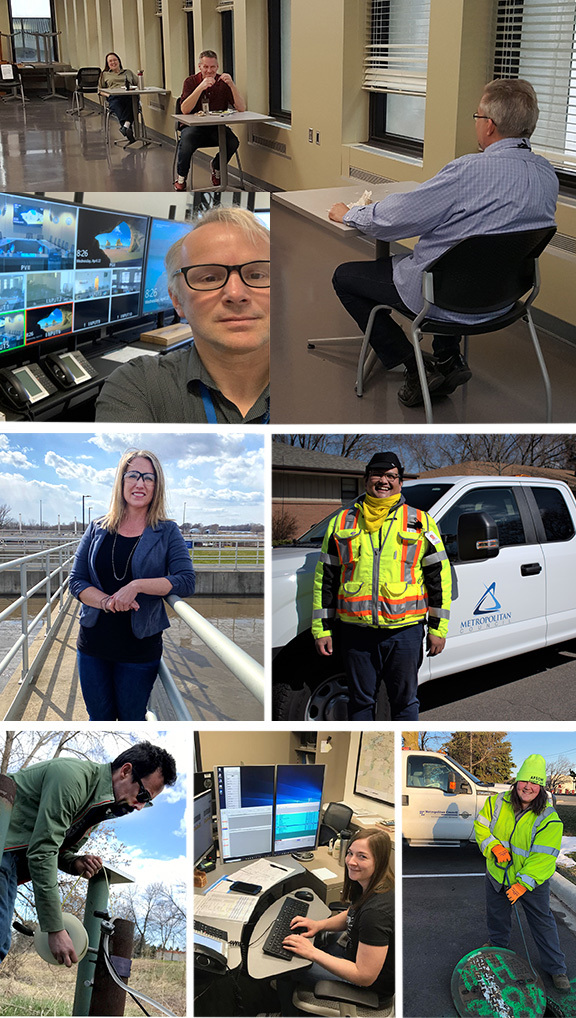 It's work as usual (mostly) for some staff. Clockwise from top: Margaret Marek, Greg Brainard and Steve Ylitalo enjoy lunch at Robert Street (that's Jason Tintes in the inset); Manny Lee out there doing fieldwork; Jax Lebeis pulling a servicehole cover; Ashley McQuiston at Regional Maintenance; Jack Barland grabbing water samples; Manager Angie Craft at the Empire Treatment Plant.
Like everyone else in the state, many Met Council staff are hunkered down at home and telecommuting to continue their responsibilities at work. That certainly includes almost every employee normally housed at Robert Street and Jackson Street, and many more. But not everyone.
For some staff, telecommuting is just not an option, or not everyday. For employees at Environmental Services treatment plants, Metro Transit bus and rail operators, and some others, their work is on-site and nowhere else. And yes, a few central office employees are still working at Robert Street.
Last issue, The Wire presented comments from Met Council staff now working at home. Here is a collection of comments from staff still mostly working at their normal locations.
One theme: It sure is weird out there. And eerily quiet.
JOSEPH HILL
CHIEF SECURITY GUARD
CENTRAL SERVICES
ROBERT STREET
What has changed?
The biggest change now is the absolute quiet and lack of activity. The building is virtually a “ghost town.” The doors are locked all day and only employees can come inside. During my shift from 6 a.m. to 2 p.m. perhaps five or six people come in to get their department mail or take care of other work obligations. It’s so quiet I’ve developed an imaginary friend, “Vladimir,” who is a Cuban jazz percussionist!
What’s the same?
The protocol for deliveries to the dock is the same now as before.
SANDI DINGLE
PROGRAM TECHNICAL SPECIALIST
COMMUNITY DEVELOPMENT
ROBERT STREET
What has changed?
Much has changed and nothing seems the same! Best of all: No traffic! I can get door-to-door in nine minutes, where normally the commute takes twice that. Also, parking is a breeze with a lot of open meters. But it is very surreal. I will maybe see a half-dozen pedestrians. Also, there are very few buses and the ones I do see are empty. My office faces a big bus stop on 6th Street and it’s normally filled with people all day, but now there are only one to two at most. I come in twice per week for about an hour to collect the mail for CD and MTS on the second floor. I’ve noticed we’re getting less and less mail each day. As far as the empty building, I will often only see 1-3 other people at most. I have mastered getting into the building, up to the second floor, and to my cube using only my elbow. It’s very strange! Second floor is dark and I’m working alone. It’s also beyond quiet. It feels like I must have accidentally showed up on a Saturday.
What’s the same?
There is one thing that feels the same: The unwavering support of upper management to keep us all employed and continue the great work we do for the region. I commend them for their support. I also commend Information Services for all their technical support. (Bottom line: While there are many advantages to working at home, I do miss many of my coworkers!)
JACQUELYN LEBEIS
INTERCEPTOR SERVICE WORKER
ES INTERCEPTOR SERVICES
REGIONAL MAINTENANCE FACILITY
What has changed?
Not a lot has changed for us out in the field. But we do have staggered start times now, so people start every half hour at our location from 5 a.m. to 8 a.m., and it’s only one person per truck versus two or three. There is not much traffic, so not driving in highway congestion is amazing!
What’s the same?
I have to say that good, bad, or COVID-19, a lot is the same on my team. The amazing and funny guys are still the same. My attitude is good, and we all appreciate the care that Bert Tracy has for his employees and his team. Although “distancing” doesn’t always work, especially when we’re putting things in maintenance holes or pulling them out, playing frogger. (“Frogger” is what we call waiting for a little break in traffic to be able to pop open a maintenance hole cover, look inside, get the info you need, close it, and paint it without getting squished. Minneapolis off Broadway is the worst!) Still, the team keeps their humor, personalities, and quirks, and when I get to work with them the world seems a little less lonely. They are the few faces I get to see because of social distancing. To have that means so much. It’s a daily dose of human interaction!
Read comments from more on-site employees on MetNet.
As part of the state’s effort to provide widespread, rapid COVID-19 testing, Gov. Walz last week unveiled a new website to help Minnesotans find a testing location within their community: mn.gov/covid19/for-minnesotans/if-sick. We're especially proud of this website, as it was built primarily by Met Council staff.
Many staff were involved, but the lion’s share of credit goes to Jim Dudley, Matt McGuire, Jim Gonsoski, Jonathan Hoekenga, and Tanya Mayer of Information Services. Also, Shawn Jacobson and Crystal Mulry of Communications.
This testing collaborative includes 127 clinics and health care facilities across the state. The new COVID-19 website provides easy access to Minnesotans’ closest testing site, offers general information related to the COVID-19 outbreak, and provides an interactive screening tool to help Minnesotans determine if they need a test. This interactive testing site allows the state to coordinate with local public health and tribal organizations that have strong connections to the communities they serve.
"While the Met Council is not a state agency, we are partnering very closely with the Governor, Minnesota Department of Health, and other state agencies to help our region and our state deal with this crisis," Regional Administrator Meredith Vadis wrote in her daily communique with staff last Friday.
"We are proud to be an integral part of these efforts, and we want to extend a big thank you to the talented team from Information Services (GIS and Enterprise Technical Services) and Communications for their hard and swift work to build and publish this website," she said. "It took a lot of ingenuity to get this website launched, and it is an incredible demonstration of how the Met Council as an organization is adapting its work to meet the needs of our communities."
 Late shift for crews building transit station on I-35W at Lake Street
A new transit station at I-35W and Lake Street moved closer to reality last week as crews poured a new bridge deck. At the freeway level, the new station will be served by the METRO Orange Line and I-35W express routes. The Orange Line is a new Bus Rapid Transit line that will provide frequent, all-day service between downtown Minneapolis and Burnsville. Service is expected to begin in late 2021. Learn more about the METRO Orange Line.

'A great milestone' to measure progress
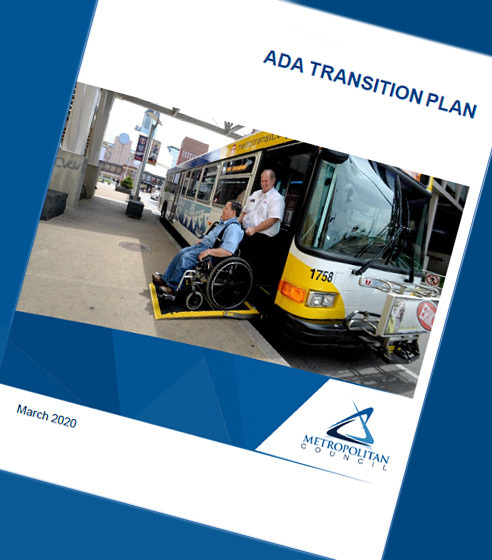
After spending 2019 conducting a self-evaluation of over 400 Met Council locations, including all Metro Transit and Environmental Services facilities, the Council’s “Americans with Disabilities Act (ADA) Transition Plan” was adopted by the Council in April. You can find it on the ADA and Accessibility webpage (see link below).
“The document details the findings of the self-evaluation and actions that both Metro Transit and Environmental Services will take to address the evaluation findings,” said Guthrie Byard, ADA and Title VI Administrator. “It is a great milestone for the Council to ensure that its programs, services, and facilities are in compliance with the ADA.”
An ongoing assessment of Council facilities, including all its bus stops, will continue, Byard said. He added that the document will be updated annually to report the progress made and the status of additional projects addressing the findings.
Read the ADA Transition Plan on the ADA and Accessibility webpage.
For more information, contact Guthrie Byard, ADA and Title VI Administrator.
|
Floor sessions resume after month-long break

The state legislature returned on April 14 after a four-week recess during which the House and Senate operated on an on-call basis.
The legislature took very limited action during the recess, meeting only to pass measures agreed upon by caucus leaders and the Governor. On their first day back on the floor, the House and Senate passed a policy bill touching on a number of different areas in response to the COVID-19 pandemic.
Related to the Council, the bill (HF4556):
- Requires the Council to submit a report to the legislature on its use of any emergency powers during the peacetime public health emergency.
- Extends the deadline for the comprehensive transit finance report required under Minn. Stat. 473.4485 from Oct. 15, 2020, to Feb. 15, 2021.
- Provides language authorizing the Council to use funds allocated by the federal government to respond to the impacts of the COVID-19 crisis and requires a report on use of those funds by Feb. 15, 2021.
Legislative committees meet remotely
The House Ways & Means Committee and Senate Finance Committee have held remote committee hearings on the state budget outlook.
The state’s two-year budget was enacted in 2019 so this is not a budget year for the state legislature, but legislators have expressed concern about budget projections given the economic uncertainty stemming from the pandemic.
Minnesota Management & Budget (MMB) testified about a budget projection that is scheduled to be released the week of May 4 and will provide updated data for the current biennium. MMB Commissioner Myron Frans noted that the May projection will not be a new State Budget Forecast, and that a high level of uncertainty will remain due to the effects of the pandemic and lagging revenue data.
The legislature must adjourn by May 18.
|
Many old files can be weeded out, but be careful
The COVID-19 pandemic and stay-at-home order upending just about everything have presented significant challenges to employees across the Met Council.
And while there is plenty to do, you may still find gaps in your workday – “windows of time” – that offer a new opportunity to think outside the box and tackle long-buried projects that were set aside or lost during your old workday routine.
One project employees working from home should consider is cleaning up old electronic files saved to Council-owned assets, platforms, and network drives.
But how do you do that, and where to start?
Fortunately, the National Institute of Standards and Technology offers guidance on best practices for data and system management, said Brian Campbell, manager of data and records protection in the Met Council’s Enterprise Content Management (ECM) department.
“Best practices include routinely cleaning up data wherever it is stored to ensure that documents being kept are for business purposes consistent with data retention policies,” he said. “A second goal is ensuring that stored documents are restricted to those with the appropriate authorization.”
In addition, as good fiscal stewards of the Met Council, Campbell said we should only save essential documents because network and OneDrive space cost money to maintain.
A lot of places to purge
Given the number of systems the Met Council uses to conduct its business, employee files can exist in several places:
- Emails and email attachments
- Local drives (directly on Council-owned laptops and devices)
- Shared drives (the H: and N: drives, for example)
- OneDrive
- SharePoint
- ApplicationXtender (AX)
- Databases
Campbell suggested that when you find an open window of time during the day, however small, you begin to review the documents you’ve saved and assess if they can be deleted. But be careful.
“Some documents must be kept and cannot be destroyed,” Campbell said. “For example documents that have not met their minimum retention under the data retention schedule, are on legal hold, are subject to a data practice request, still serve a business need, or are subject to audit. Before you start slashing, please review appropriate criteria on our ECM Retention Page below.”
Duplicates, drafts of finalized documents, articles, reference materials, and documents that have reached the end of their retention schedule (and do not meet a retention category above) can be deleted, he said.
Each department manager should coordinate with their entire team to ensure that all information that meets a business need remains intact.
When possible, Campbell recommended that files stored on local or shared drives be moved to OneDrive, SharePoint, or AX because they have better search functionality than shared drives, which leads to faster retrieval.
Privacy concerns
In addition to reviewing documents for retention length, employees should evaluate the documents for content.
Any documents containing Personally Identifiable Information (PII), Protected Health Information (PHI), private data, confidential legal information, etc., must be stored in a secure location and accessible only to those who need that information. To learn where certain file types should be stored, please contact Campbell.
Retention schedule information can be found on ECM’s Retention Page.
If you have questions about retention schedules or need further guidance, contact Brian Campbell.
Read key tips about records retention.
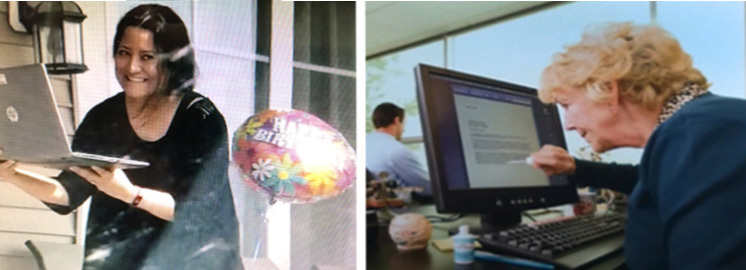 Maya Rutherford (left) reacts to an online birthday song from colleagues. At right, the cover on a birthday card delivered to Kathi Primoli. Inside the card, it said, “Just white-out a few years and have a happy birthday.”
Even from home, Human Resources staff celebrate colleagues’ birthdays
The pandemic has shut down most things. But birthdays continue, and so do birthday celebrations.
“We had two birthdays on my team recently, and I just could not let them go by without doing something,” said HR Staffing Manager Nancy Jennings. “We still need to connect and enjoy those moments together even while distancing and staying safe.”
In the first case, Jennings created a virtual staff meeting on April 10. But just before the meeting began, she showed up at Maya Rutherford’s door with cupcakes, balloons, and a card. When the meeting began, laptops open, Jennings’ team virtually serenaded Rutherford on her porch, to everyone’s delight. “It was quite a surprise for Maya and really a lot of fun,” Jennings said.
A week later the group tweaked the stunt for Kathi Primoli. Shortly before a virtual meeting was going to start, Lynnette Anderson secretly dropped off a cake on Primoli’s porch. When the meeting began, Primoli was alerted to retrieve the cake, followed by an online sing-a-long.
“These were happy moments for our team,” Jennings said. “It felt good to connect in this way, and I think everyone had a good time.”
Met Council releases greenhouse gas inventory
In celebration of Earth Day, the Met Council released an early version of a new online tool that will deliver to local governments high-quality data about greenhouse gas emissions from six key sectors.
A local scenario planning tool is also being developed. Learn more and access the inventory.
|
|
 |
Mask makers and other pandemic heroes: We want to hear from you
Several Met Council staff have stepped up to the challenge of making homemade masks for local healthcare workers and others on the front line of the effort to control the pandemic, and we want to hear their stories! Several employee mask makers were featured in Metro Transit Insights recently, and word has spread about another cluster of sewers in the Information Services department. We want to credit them for their generosity! (And not only mask makers, but all staff who have gone out of their way for the cause, however it is expressed.)
Please submit your friends' and colleagues' names (or your own) for some well-deserved credit in a future Wire story. Just email TheWire@metc.state.mn.us.
Hearty congratulations to the following employees who in May celebrate major milestones in their service to the Council. This recognition includes only Robert Street employees and Regional Administration employees working off-site. For recognition of Metro Transit and other Environmental Services employees, see Insights and ES Update, respectively. The information is published when it is made available by Human Resources.
Years of Service
20 Years
Beverly Brown, Talent Acquisition Specialist, Human Resources (Heywood)
15 Years
Hope Falkenstein, Business Systems Analyst, Finance
10 Years
Jonathan Hoekenga, GIS Systems Administrator, Information Services
5 Years
Carolyn Harris, Project Manager, Information Services
Erik Herberg, Senior Environmental Scientist, Environmental Services
Margaret Marek, Senior Administrative Assistant, Central Services
Elaine Ogilvie, Supervisor/EO Consultant, Office of Equal Opportunity
Maya Rutherford, Manager, Human Resources
New Staff
Craig Bantz, April 27, Chief Information Officer, Information Services
Departures
Jennifer Keogh, April 18, Manager, Metro HRA
 Colorado Bound, by Natalie McGuire
When the open road calls, it's a good idea to answer it (according to the book of common knowledge, lol). "I love how the road leads you to the mountains," said Purchasing Clerk Natalie McGuire. "For me, that is my 'zen place.'" McGuire makes her way to the west and greater southwest every year or two for art fairs, photography, and to visit friends and family. She made this photo heading north near the border of New Mexico and Colorado. "With a little zen practice, you can alter your current reality and let this photo make you feel the road under your wheels and the wind blowing in your hair," she said.
The Wire is published every two weeks for employees of the Metropolitan Council. Everyone is invited to submit comments and story ideas. Contact the editor at thewire@metc.state.mn.us
|