Station design open houses set for November
Public open houses are set for November in each corridor city for Blue Line Extension LRT Project staff to share light rail station design concepts and gather feedback.
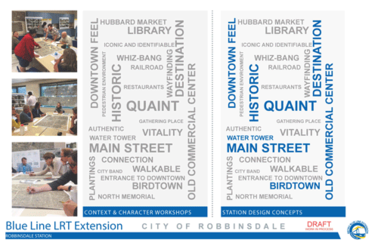 Staff worked over the summer with their counterparts at the five corridor cities, Hennepin County, Minnesota Department of Transportation and the Minneapolis Park and Recreation Board to collect information about each station site’s context and character. Their conversations and the station sites informed the draft design concepts to be previewed at the open houses. The designs also reflect public feedback through years of other meetings on station area planning, West Broadway Avenue design and municipal consent plans.
Above: Participants in a Robbinsdale planning workshop identified elements of station identity that are important to their community.
Below: Rendering of platform variation opportunities.
|
 Stations will get individuality through design treatments on four areas
Four areas on each of the 11 stations are available for design treatments to provide some individuality while maintaining common features for all stations to ensure they’re easy for passengers to use and for Metro Transit staff to maintain and repair. The four areas are the station roof, glass panels (using different arrangements of Metro Transit’s standard-size panels to create variety), the column paint color and the concrete platform surface treatment. Staff will seek the public’s feedback on design concepts to help refine plans.
Interpretive elements to note history of areas around stations
Five stations will have panels or other interpretive elements that note nearby historic properties, as required by the federal process. The Osseo Branch Line/Great Northern Railway Historic District (BNSF corridor) contains the future 63rd Avenue, Bass Lake Road and Robbinsdale stations, as well as the Golden Valley Road and Plymouth Avenue stations. The latter two stations are also in the Grand Rounds Historic District in Theodore Wirth Park which borders both sides of the LRT route.
Designs to reach 60 percent level of detail by March 2017
Staff will advance station designs to a 60 percent level of detail by March 2017 when plans for each station will be ready for review by the public and staff at the cities, county and park board. The 60 percent design plans will include details such as passenger access to the station platforms, the site dimensions and locations of lights, security cameras and ticket vending machines. Color and material finishes will be identified for some station elements.
The stations will share common elements such as security cameras, emergency phones, lighting, heaters, roofs to provide some protection from normal weather, tactile warning strips on the platform edges, ticket vending machines and card validators.
Staff expect to finalize all designs in late 2017. This includes advancing work on roadway design, the stations and operations and maintenance facility.
|
 Photo at left shows Prospect Park Station on the METRO Green Line.
1. Shelter Roof: Protects passengers from the elements
2. Lighting: Illuminates the platform and access areas
3. Railings: ADA-compliant; protect ramps and access areas
4. Prohibited behavior sign: Rules for using the platform and riding the train
5. Center-platform design: A single platform serves both eastbound and westbound trains; access from both ends
6. Rider alert sign: Information on train shutdowns and alternative routing
|
 |
|
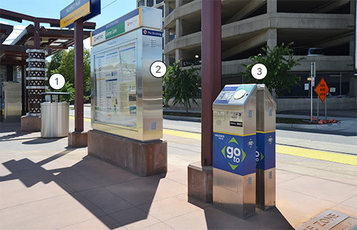
1. Waste receptacle
2. Information kiosk: Route map, station information and schedule
3. Card validators: For GoTo fare cards and UPass
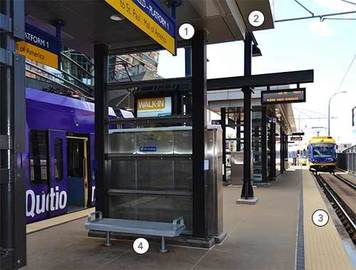
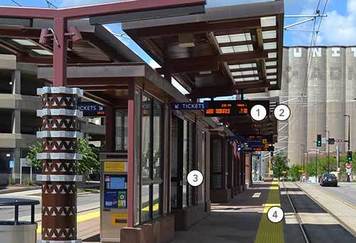
Light rail transit station photos show Prospect Park Station (METRO Green Line) at left; Target Field Station in Minneapolis (METRO Green and Blue Lines) at left below.
|
 |
|
1. Station name
2. Shelter roof: Protects passengers from the elements
3. Platform tactile edge: Creates a necessary buffer between edge of platform and rail; ADA compliant
4. Benches
|
 |
|
1. Real time departure information: Updated real-time information for the next two trains
2. Security cameras: Monitored 24/7 for safety
3. Emergency telephone: Direct contact to Rail Control Center
4. Platform tactile edge: Creates a necessary buffer between edge of platform and rail; ADA compliant
|
Public Open Houses: Station Design
The public is invited to review station design concepts for the METRO Blue Line Extension Light Rail Transit (LRT) project and learn about the station design process.
Minneapolis Wednesday, November 9
Harrison Recreation Center, 503 North Irving Avenue
Map: https://goo.gl/maps/QZB8Z5RdFH72
Golden Valley Thursday, November 10
Golden Valley City Hall, 7800 Golden Valley Road
Map: https://goo.gl/maps/z7VTxX1csC72
Crystal Monday, November 14
Crystal Community Center, 4800 Douglas Drive North
Map: https://goo.gl/maps/qiysUxWzoSr
Robbinsdale Wednesday, November 16
Robbinsdale City Hall, 4100 Lakeview Avenue North
Map: https://goo.gl/maps/FZJHpzU2qJS2
Brooklyn Park Thursday, November 17
Brooklyn Park Library, 8500 West Broadway Ave.
Map: https://goo.gl/maps/GqrwmdAMrz92
These open houses are an opportunity to learn about the station design process, review specific station design concepts, and give feedback to project staff. Other project information will also be available including updates on LRT design issues in each community.
A brief presentation will be given at 6:00 p.m. but feel free to come and go at any time. Staff will be available to answer your questions and receive your comments.
Meeting Agenda
Open House: 5:00 – 6:00 p.m.
Presentation by project staff: 6:00 – 6:30 p.m.
Open House: 6:30 – 7:30 p.m.
Anyone who requires assistance to participate in these meetings is invited to contact Blue Line Extension Community Outreach Coordinator David Davies: David.Davies@metrotransit.org or 612-373-5336. Requests for special assistance should be made at least five business days in advance of the scheduled open house.
Meeting materials and a comment form will be posted on the project website at www.BlueLineExt.org.
Corridor gets $1.2 million for community development planning
The Blue Line Extension LRT corridor will receive $1.2 million for community development planning and revitalization that the Federal Transit Administration awarded to the Metropolitan Council.
The planning effort will provide the five corridor cities with tools to implement economic development and encourage redevelopment. Partners in the effort include Hennepin County and several private organizations in addition to the cities. Final outcomes will include transit-oriented development policies and zoning codes, infrastructure plans, housing and economic development strategies, and financing strategies.
The Met Council is one of 16 organizations around the country receiving a share of $14.7 million in grants to support comprehensive planning projects that improve access to public transit. The funds are made available through FTA’s Transit-Oriented Development (TOD) Planning Pilot Program for communities that are developing new or expanded mass transit systems.
FTA’s TOD Pilot Program provides grants for planning work around the country, helping communities integrate land-use and transportation planning efforts as they improve their transit systems. The program helps localities plan improved access to transit, jobs, education and services, and helps revitalize communities by attracting new business opportunities, jobs and housing. In addition, the program seeks to connect people to opportunities and to enhance connectivity of disadvantaged populations to essential services.
More information on the TOD Pilot Program is available at http://bit.ly/2dynL0i.
Dovetail Consulting found niche in rail safety
Safety and security are always a priority on light rail projects, and Dovetail Consulting’s job is to make sure that safety-related details from overhead wires to pedestrian crossings are impeccably planned and executed.
The Atlanta-based firm is the safety and security consultant on the Blue Line Extension LRT Project.
Mignon Allen, Dovetail’s founder and owner, has built the company over its 14-year history with an eye toward detail and meticulousness.
 Left: Mignon Allen, founder and owner of Dovetail Consulting.
“We’re known for having very high quality standards,” Allen said. “When we do an assessment, someone else may do a five- to six-page report. We’ll do a 150-page report.”
Dovetail’s work has included light rail and streetcar projects across the nation, and Allen credits the Disadvantaged Business Enterprise (DBE) program for helping her firm continue to thrive.
Requirements for participating in the DBE program include limits on personal net worth (less than $1.32 million). Also, participating firms need to meet Small Business Administration size standards as measured by annual gross receipts. Those standards vary by industry. Ownership must also be at least 51 percent female or persons of color.
Dovetail has been a DBE contractor working on transit projects around the nation since it was first founded in 2002.
“I don’t think people choose to work with us because we’re a DBE, but it’s an enhancement,” Allen said. The DBE program “does vet firms and yields qualified participants,” she said, and the process of maintaining DBE credentials requires responsible owners.
The DBE program allows contractors such as Kimley-Horn and Associates Inc., the prime engineering contractor on the Blue Line Extension, to know there are small firms with a solid accounting system and the technical qualifications to do the job, Allen said.
The Metropolitan Atlanta Rapid Transit Authority (MARTA) recruited Allen in 1994 as she was finishing her undergraduate degree at Spelman College in Atlanta. She started at MARTA doing work in planning and moved into engineering and later rail transportation.
Seven years later, as she was finishing an MBA degree at Atlanta’s Emory University, Allen decided to join a consulting firm and helped roll out the state of Georgia’s first regional express bus system.
In 2002, she started Dovetail with a business partner, specializing in bus and rail planning. One of her long-time employees is Fred Mead, her company’s vice president, who had worked on the METRO Blue Line (Hiawatha) LRT back in the early 2000s before he joined Dovetail. Kimley-Horn also worked on the Hiawatha Line, which opened in 2004.
When Kimley-Horn was looking for a subcontractor to do safety and security-related work on the Blue Line Extension, Dovetail’s track record on similar projects around the country helped it win the contract.
Dovetail’s staff has expertise on the various components of light-rail projects, including an architect, retired law enforcement officials and fire captains, and safety specialists. “We’re practitioners who were in these departments in the transit system, so we know how it’s supposed to work,” Allen said.
Dovetail has worked on the Blue Line Extension’s safety and security management plan, and is now moving onto other items, including a preliminary hazard analysis, said Paul Danielson, a Kimley-Horn senior vice president and the Blue Line Extension’s project manager for engineering services.
A third focus for Dovetail will be safety certifiable items for the Blue Line Extension, Danielson said.
An example of safety certification would include checking the slope of an access ramp on an LRT station to meet Americans with Disabilities Act guidance. Dovetail will make certain that the station design meets that requirement. Project designers will check it again, and construction field staff will verify that the ramp was built to standards.
After construction, Dovetail also does a field audit on a cross-section of the project’s various components to make sure the plans on paper are reflected in the finished product.
“[Dovetail’s] role is to get this ready for the design team and make sure the construction staff is doing what they said,” said Danielson.
Dovetail also does state safety oversight, reviews accidents and audits bus and rail transit systems. “When we’re part of a design and construction project,” Allen said, “we have that lead several years before operation, and we can identify what the potential issues might be.”
The DBE goal is 19 percent for the Blue Line Extension engineering contract and for the Green Line Extension Project’s advanced design contract.
Small minority-owned or women-owned companies that want information about the DBE program and working on LRT projects should contact senior equal opportunity consultant Andrew Larson of the Metropolitan Council’s Office of Equal Opportunity at Andrew.Larson@metc.state.mn.us or 612-373-3896.
|
 State funding needs to be secured in 2017
After setting the Blue Line Extension LRT Project’s budget at $1.536 billion in September, the Metropolitan Council will seek the state’s share of the project in the 2017 legislative session.
Project planners need to secure all local funding before they can submit the request to the Federal Transit Administration for full federal funding in mid-2017. The federal government is expected to pay nearly half of the project’s cost, and the state share would be $149.6 million, or just under 10 percent of the total cost.
Other partners providing funding include the Counties Transit Improvement Board (CTIB), which will provide $463.7 million or roughly 30% of the total cost, and the Hennepin County Regional Railroad Authority (HCRRA), which will contribute $149.6 million (9.7%). The remaining local funds would come from Hennepin County ($4.12 million), MnDOT ($8.19 million), and the City of Brooklyn Park ($8.18 million). The pie chart at right shows a breakdown of project funding.
The Metropolitan Council will be seeking a metro-area sales tax for transit, which would not only provide the necessary funding for Blue Line construction, but also the operations for the line and other transit services into the future.
For details about the recent approvals of the project’s environmental reviews, see the Sept. 28 news release:
https://metrocouncil.org/blrt/news/2016/blrt-moves-ahead.
|
About the project
The planned METRO Blue Line Extension (Bottineau) light rail transit project will operate about 13 miles northwest from downtown Minneapolis through north Minneapolis, Golden Valley, Robbinsdale, Crystal and Brooklyn Park, drawing riders northwest of Brooklyn Park. The proposed alignment will have 11 new stations in addition to Target Field Station where it will continue as the METRO Blue Line, providing one-seat rides to Minneapolis-St. Paul International Airport and the Mall of America. It will connect Minneapolis and the region’s northwest communities with existing LRT on the METRO Green Line, future LRT on the METRO Green Line Extension (Southwest LRT), bus rapid transit on the METRO Red Line, the Northstar commuter rail line and local and express bus routes.
The Metropolitan Council will be the grantee of federal funds and is charged with building the line in partnership with the Minnesota Department of Transportation. The Blue Line Extension Corridor Management Committee, which includes local officials from Golden Valley, Robbinsdale, Crystal, Brooklyn Park and Minneapolis, provides advice and oversight. Funding is provided by the Federal Transit Administration, Counties Transit Improvement Board (CTIB), Hennepin County Regional Railroad Authority (HCRRA), and the state of Minnesota.
|