CVSO Office Updates
Happy August to all my favorite folks reading today!
This month we are reviewing education benefits- can you believe it’s already time to start thinking about back to school?! I feel like we blinked and summer has just flown by. But I guess that’s life- so when they say “it goes by too fast” they really do mean it.
I wanted to take a moment to share a quick reminder before we dive into education benefits. Our Veteran Services team is made up of four staff members serving approximately 8,000 veterans throughout Olmsted County. Each day, we assist veterans and their families with a wide range of complex benefits, claims, and other important issues, and we are committed to giving every veteran the time and attention they deserve.
If you call our office and we're unable to answer, please be sure to leave a voicemail. We return all voicemail and email messages left in our main office inbox, and we strive to respond within 3–5 business days. Leaving a detailed message, including your name, phone number, and a brief description of what you need, helps us research your question before returning your call so we can provide the best possible assistance.
We truly appreciate your patience and understanding. Taking a little extra time to look into your situation often allows us to provide more accurate answers and better serve your individual needs. Thank you for allowing us the opportunity to assist you—we look forward to helping you.
Our office phone number is: 507-328-6355
My direct line is: 507-328-6358
Our office email is: OCVS@olmstedcounty.gov
My direct email is: tiffany.canfield@olmstedcounty.gov
Please feel free to contact me directly if you have not received a response within 3-5 business days.
Back-to-School for Veterans: You've Earned Education Benefits—Use Them!
Whether you're starting college, learning a trade, earning a certification, or changing careers, your military service may have earned you education benefits that can help cover tuition, housing, books, and training costs. Don't leave these benefits on the table!
Getting Started is Easier Than You Think
Step 1: Decide on Your Goal
- College degree
- Technical or trade school
- Apprenticeship or on-the-job training
- Professional licensing or certification
- Flight training or entrepreneurship
Step 2: Choose a VA-Approved School or Program
Compare schools, costs, graduation rates, and available benefits before enrolling.
Step 3: Gather Your Documents
You'll typically need:
- DD-214 (Member 4 copy or equivalent)
- Guard/Reserve activation orders (if applicable)
Step 4: Apply You can apply:
- Online through VA
- At your local VA Regional Office
- Through your school's Veterans Certifying Official or Financial Aid Office
Which Education Benefit is Right for You?
Depending on your service, you may qualify for:
- Post-9/11 GI Bill® – Tuition, Monthly Housing Allowance, and Book Stipend
- Montgomery GI Bill (Active Duty)
- Montgomery GI Bill (Selected Reserve)
- Veteran Readiness & Employment (VR&E/Chapter 31) – Great for Veterans with service-connected disabilities who need education or retraining to obtain suitable employment.
- Survivors' and Dependents' Educational Assistance (DEA/Chapter 35)
for eligible spouses and children.
Minnesota Veterans: Don't Miss These Additional Benefits!
Minnesota offers several education resources that can supplement your federal VA benefits.
Minnesota GI Bill Eligible Veterans, service members, and some spouses and dependents may qualify for additional education funding beyond federal GI Bill benefits.
Higher Education Veterans Program Minnesota has Education Regional Coordinators located on campuses across the state who can help with:
- Using your education benefits
- Military transfer credits
- Veteran residency status
- Payment extensions while waiting for GI Bill benefits
- Connecting with campus Veteran Resource Centers
Veteran Education Assistance Grant
If you've exhausted your GI Bill while working toward your bachelor's degree, Minnesota may offer a one-time $750 tuition grant to help you finish your degree.
Did You Know?
Your GI Bill can be used for much more than a traditional college degree:
- Skilled trades and apprenticeships
- CDL and commercial licensing
- Police, Fire, and EMS certifications
- Flight training
- Entrepreneurship training
- Licensing and certification exams
- Graduate school and professional programs
Resources for Veterans and Families
If you're unsure which education benefit is best for you, help is available:
-
VA Education Call Center: 888-GIBILL-1 (888-442-4551)
- Minnesota Department of Veterans Affairs (MDVA) Higher Education Veterans Program
-
LinkVet: 1-888-LinkVet (546-5838) for one-on-one assistance and referrals to Education Regional Coordinators.
We are lucky enough to have top notch education coordinator in our community. Mark Larsen is the SE Regional Education Coordinator and is ready to assist you with any questions you may have. Below is his contact information:
Mark Larsen
Southeast Regional Coordinator | Veterans Education
Minnesota Department of Veterans Affairs
851 30th Ave SE | Rochester, MN 55904
Cell: 507-779-9375
Serving Minnesota Veterans and Their Families | MinnesotaVeteran.org
Invest in your future—your education benefits are part of the benefits you've earned through your service. If you're considering going back to school this fall, contact Olmsted County Veteran Services today and let us help you make the most of your earned benefits.
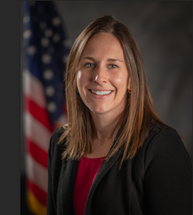 Tiffany Canfield
County Veteran Services Officer (CVSO) & Manager
tiffany.canfield@olmstedcounty.gov
507-328-6358
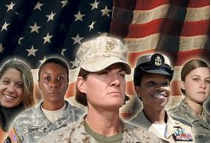
Women Veterans Spotlight
Happy August Sisters!!
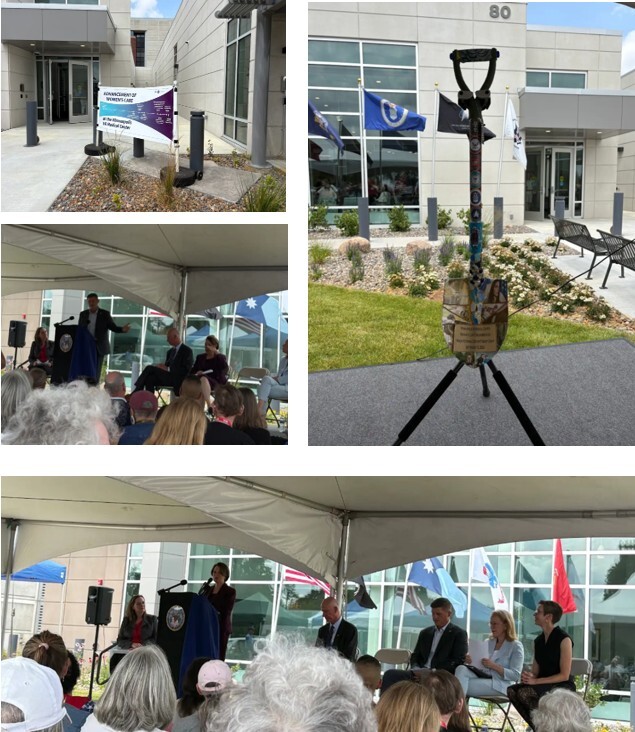
I had the honor of attending the grand opening of the Minneapolis VA Women’s Clinic. It was a wonderful opportunity to sit amongst other women veterans and experience history being made.
Minneapolis VA Opens Dedicated Women's Health Clinic
The Minneapolis VA Health Care System celebrated the grand opening of its new Women's Health Clinic on Friday, July 24, marking an important milestone in the continued commitment to serving women Veterans. The ribbon-cutting ceremony featured remarks from Minneapolis VA Health Care System Director Patrick Kelly, Congressman Brad Finstad, Congresswoman Kelly Morrison, and Women's Clinic Director Dr. Krebs, each recognizing the growing population of women Veterans and the importance of providing care in a space designed specifically for them.
The new Women's Health Clinic offers more than just a new location—it provides a welcoming, calming environment where women Veterans can receive comprehensive care in one place. Every aspect of the clinic was thoughtfully designed with women in mind, creating a space where Veterans can feel comfortable, respected, safe, and supported throughout their health care journey. From routine primary care and preventive screenings to specialized women's health services, the clinic reflects the VA's commitment to delivering personalized, high-quality care.
Why a Dedicated Women's Health Clinic Matters
Women are one of the fastest-growing populations within the Veteran community, and their health care needs are unique. A dedicated Women's Health Clinic provides:
-
Comprehensive care in one location, reducing the need for multiple appointments across different clinics.
-
Providers with specialized expertise in women's health and military-related health concerns.
- A comfortable, welcoming, and private environment designed specifically for women Veterans.
- Improved access to preventive care, reproductive health services, menopause care, mental health support, and chronic disease management.
- A health care experience that recognizes and honors the unique experiences
Creating a women-centered space also helps foster a stronger sense of community, encourages Veterans to seek preventive care, and helps ensure every woman Veteran feels seen, heard, and valued.
Interested in Receiving Your Care at the Women's Health Clinic?
Women Veterans currently enrolled in VA health care who would like to receive their care through the new Women's Health Clinic can simply call the Minneapolis VA and request to transfer their primary care to the Women's Health Clinic. VA staff can help determine eligibility and coordinate the transition.
If you have questions about enrolling in VA health care or accessing women's health services, Olmsted County Veteran Services is here to help. We are proud to support the women Veterans in our community and encourage you to take advantage of this outstanding new resource designed with you in mind.
-Tiffany
“You can’t raise the bar without raising a little hell”- so let’s raise some hell, shall we ladies??
Veteran Service Office Snapshot
June 2026
Total claims submitted to VA:
- Compensation: 81
- VA Healthcare: 13
- DIC: 0
- Burial: 9
- Survivor’s Pension: 0
- CHAMPVA: 0
- Records Request: 2
- Special Monthly Pension: 3
**Our office is in the process of switching to another software program. Numbers listed above may be on the low side.
Points of contact with veterans (office visits, incoming mail, phone calls
returned, emails returned, etc.): 108
Veterans in office: 71
Outreach visits: 2
Total phone calls: 202
Average number of calls per day: 7
Average call length: 3 minutes and 29 seconds
Veterans Program
Wednesday August 12th at 10:00 am
Rochester VFW Post 1215
2775 - 43rd St NW
Rochester, MN 55901
Please join us for an informative program designed to help you, as a veteran, know what is available to you.
Tiffany Canfield, Veterans Services Manager, will provide a broad overview of services and eligibility. There are many veterans that are unaware of benefits available to them.
Brenda Schultz, The Funeral Lady, will talk about Veterans Burial Benefits and how to get help applying to the National and State cemeteries in our area.
Coffee and donuts will be provided.
RSVP to Karen @507-328-6355 or send an email to:
ocvs@olmstedcounty.gov
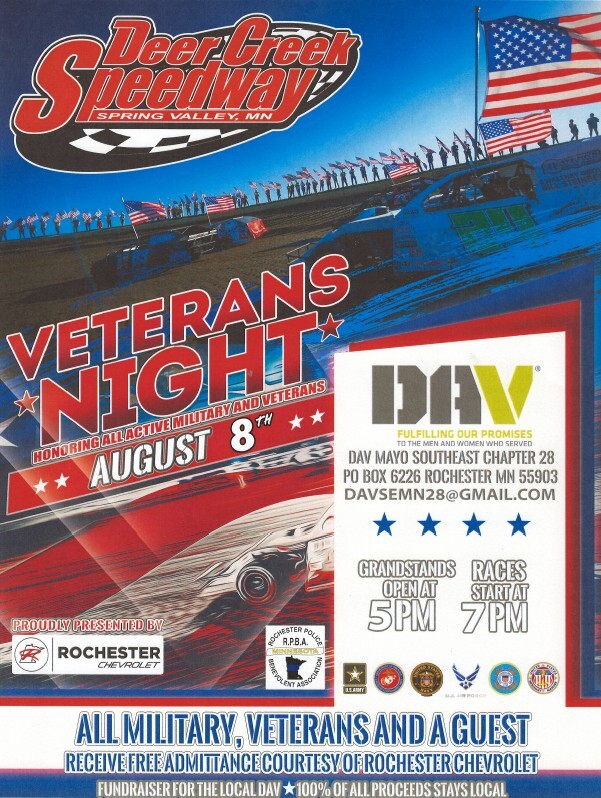
Deer Creek Speedway: Veteran's Night
Karen's Korner
For families of deceased veterans who were receiving a monthly payment from the VA (Compensation or Pension). Here are the documents you will need to bring with you when filing for the Burial Allowance:
- COPY of the Death Certificate
- Itemized Statement from the Funeral Home (please make sure that the statement is itemized and lists a separate amount for transportation.
If you have any questions, please feel free to call me at 507-328-6355
VA Life Insurance
Free life insurance is NOT available for veterans, but there are various life insurance options through the VA and private insurers.
Overview of Life Insurance Options for Veterans
Servicemembers’ Group Life Insurance (SGLI): While on active duty, military personnel are automatically enrolled in SGLI, which provides low-cost term life insurance. However, this coverage is not free, and it ends 120 days after leaving active duty
Veterans Affairs Life Insurance (VALife): This program offers guaranteed acceptance whole life coverage for veterans with service-connected disabilities. While it provides valuable coverage, it is not free; premiums are required
Other VA Insurance Programs: The VA offers several life insurance options, including Veterans' Group Life Insurance (VGLI), which allows veterans to convert their SGLI coverage to a renewable term policy after leaving service. Again, this is not free, and premiums will apply
Private Life Insurance: Veterans can also explore private life insurance options, which may offer competitive rates and coverage tailored to individual needs. However, these policies will also require payment of premiums
Conclusion
While veterans do not have access to free life insurance, they have multiple options for obtaining life insurance coverage through the VA and private insurers. It is essential for veterans to evaluate their personal circumstances and financial goals when considering life insurance. For more detailed information on specific programs and eligibility, veterans can visit the official VA website or consult with a financial advisor.
What to do if you have more questions
You can call the VA Life Insurance Center at 800-669-8477 (TTY: 711). Call for current hours.
We can help answer questions about these policies:
- VALife
- S-DVI
- Any VA life insurance policy that starts with a V, J, RS, or W
Medicare Corner
Turning 65 or planning to retire? Now is the time to learn about your Medicare options.
Many Veterans ask questions like:
- When should I enroll in Medicare?
- If I have VA health care, do I still need Medicare?
- What happens if I retire and lose my employer health insurance?
- Will my doctors and prescriptions still be covered?
One of the biggest misconceptions is that everyone should enroll in Medicare the month they turn 65. The right time to enroll depends on your individual situation, including whether you have employer-sponsored health insurance, VA health care, or other coverage. Planning ahead can help you avoid gaps in coverage, late enrollment penalties, and unexpected costs.
If you're approaching age 65, planning to retire, or have questions about how Medicare works with your VA benefits, consider speaking with a trusted Medicare counselor or your County Veteran Services Office. Understanding your options before making decisions can help ensure you choose the coverage that best meets your needs.
If you have any questions regarding Medicare, please contact:
Jill Fasbender, Licensed Agent & Owner of Med City Medicare Call or text 507-218-8377 or email jill@medcitymedicare.net. Her office is located at 2434 Superior Drive NW, Suite 101, Rochester, MN 55901
Benefits Processing in 2026
The Department of Veterans Affairs has dramatically reduced the time it takes to process disability claims, pension benefits and survivor compensation as of 2026, posting some of the strongest performance numbers the agency has recorded in recent years.
The average number of days needed to complete a disability claim fell from 141.5 days to 80.7 days since the start of the current presidential administration, a 43 percent reduction, the VA announced in April. The agency also reported that its claims-processing accuracy rate had risen to 94.02 percent, the highest 12-month accuracy rate in the past two years.
The numbers extended beyond disability claims. The average time to complete an initial Veterans Pension claim has dropped from 170 days to 57 days, a 66 percent reduction, while the average time to complete an initial Survivors Pension claim fell from 172 days to 73 days, a reduction of more than 55 percent.
Processing times for Dependency and Indemnity Compensation (DIC) claims, which provide benefits to surviving spouses, children and parents of service members who died in the line of duty or from a service-related illness or injury, dropped from 163 days to 73 days, a decline of more than 50 percent.
The backlog figures tell a similar story. In February 2026, the number of veterans waiting for VA benefits fell below 100,000 claims for the first time since 2020. The backlog of initial Veterans Pension claims older than 125 days was reduced from 3,514 to just 71, a 98 percent decrease. The Survivors Pension backlog dropped from 3,391 claims to 115, a 96 percent reduction. DIC claims in the backlog fell from 13,501 to 2,257, an 83 percent decrease.
VA also reported cutting the average time to complete burial claims from 70 days to 31 days, a reduction of more than 50 percent.
The agency processed more than 3 million claims in fiscal 2025, a record, and reached the milestone of 1 million completed disability claims for fiscal 2026 on Feb. 2, 2026, faster than at any previous point. VA is currently on pace to match or exceed last year's processing volume.
VA Secretary Doug Collins attributed the gains to focused leadership and the dedication of the agency's workforce.
The agency noted that roughly half of its Veterans Benefits Administration claims processors are Veterans themselves, a factor it cited as central to both accuracy and the ability to handle claims with the context that military service requires.
Veterans with questions about their benefits can contact VA through Ask VA at ask.va.gov.
PTSD (Part 2) Frequently Asked Questions
Most people who are exposed to a traumatic, stressful event experience some of the symptoms of PTSD in the days and weeks following exposure.
The following is a list of the most common, or frequently asked questions, about Post Traumatic Stress Disorder:
How does PTSD develop?
Most people who are exposed to a traumatic, stressful event experience some of the symptoms of PTSD in the days and weeks following exposure. Data suggest that about 8% of men and 20% of women go on to develop PTSD, and roughly 30% of these individuals develop a chronic form that persists throughout their lifetimes.
The course of chronic PTSD usually involves periods of symptom increase followed by remission or decrease, although some individuals may experience symptoms that are unremitting and severe. Some older veterans, who report a lifetime of only mild symptoms, experience significant increases in symptoms following retirement, severe medical illness in themselves or their spouses, or reminders of their military service (such as reunions or media broadcasts of the anniversaries of war events).
How is PTSD assessed?
In recent years, a great deal of research has been aimed at developing and testing reliable assessment tools. It is generally thought that the best way to diagnose PTSD-or any psychiatric disorder, for that matter-is to combine findings from structured interviews and questionnaires with physiological assessments. A multi-method approach especially helps address concerns that some patients might be either denying or exaggerating their symptoms.
How common is PTSD?
An estimated 7.8 percent of Americans will experience PTSD at some point in their lives, with women (10.4%) twice as likely as men (5%) to develop PTSD. About 3.6 percent of U.S. adults aged 18 to 54 (5.2 million people) have PTSD during the course of a given year. This represents a small portion of those who have experienced at least one traumatic event; 60.7% of men and 51.2% of women reported at least one traumatic event. The traumatic events most often associated with PTSD for men are rape, combat exposure, childhood neglect, and childhood physical abuse. The most traumatic events for women are rape, sexual molestation, physical attack, being threatened with a weapon, and childhood physical abuse.
About 30 percent of the men and women who have spent time in war zones experience PTSD. An additional 20 to 25 percent have had partial PTSD at some point in their lives. More than half of all male Vietnam veterans and almost half of all female Vietnam veterans have experienced "clinically serious stress reaction symptoms." PTSD has also been detected among veterans of the Gulf War, with some estimates running as high as 8 percent.
Who is most likely to develop PTSD?
- Those who experience greater stressor magnitude and intensity, unpredictability, uncontrollability, sexual (as opposed to nonsexual) victimization, real or perceived responsibility, and betrayal
- Those with prior vulnerability factors such as genetics, early age of onset and longer-lasting childhood trauma, lack of functional social support, and concurrent stressful life events
- Those who report greater perceived threat or danger, suffering, upset, terror, and horror or fear
- Those with a social environment that produces shame, guilt, stigmatization, or self-hatred
What are the consequences associated with PTSD?
PTSD is associated with a number of distinctive neurobiological and physiological changes. PTSD may be associated with stable neurobiological alterations in both the central and autonomic nervous systems, such as altered brainwave activity, decreased volume of the hippocampus, and abnormal activation of the amygdala. Both the hippocampus and the amygdala are involved in the processing and integration of memory. The amygdala has also been found to be involved in coordinating the body's fear response.
Psychophysiological alterations associated with PTSD include hyper-arousal of the sympathetic nervous system, increased sensitivity of the startle reflex, and sleep abnormalities.
People with PTSD tend to have abnormal levels of key hormones involved in the body's response to stress. Thyroid function also seems to be enhanced in people with PTSD. Some studies have shown that cortisol levels in those with PTSD are lower than normal and epinephrine and norepinephrine levels are higher than normal. People with PTSD also continue to produce higher than normal levels of natural opiates after the trauma has passed. An important finding is that the neurohormonal changes seen in PTSD are distinct from, and actually opposite to, those seen in major depression. The distinctive profile associated with PTSD is also seen in individuals who have both PTSD and depression.
PTSD is associated with the increased likelihood of co-occurring psychiatric disorders. In a large-scale study, 88 percent of men and 79 percent of women with PTSD met criteria for another psychiatric disorder. The co-occurring disorders most prevalent for men with PTSD were alcohol abuse or dependence (51.9 percent), major depressive episodes (47.9 percent), conduct disorders (43.3 percent), and drug abuse and dependence (34.5 percent). The disorders most frequently comorbid with PTSD among women were major depressive disorders (48.5 percent), simple phobias (29 percent), social phobias (28.4 percent), and alcohol abuse/dependence (27.9 percent).
PTSD also significantly impacts psychosocial functioning, independent of comorbid conditions. For instance, Vietnam veterans with PTSD were found to have profound and pervasive problems in their daily lives. These included problems in family and other interpersonal relationships, problems with employment, and involvement with the criminal justice system.
Headaches, gastrointestinal complaints, immune system problems, dizziness, chest pain, and discomfort in other parts of the body are common in people with PTSD. Often, medical doctors treat the symptoms without being aware that they stem from PTSD.
How is PTSD treated?
PTSD is treated by a variety of forms of psychotherapy (talk therapy) and drug therapy. There is no definitive treatment, but some treatments appear to be quite promising, especially cognitive-behavioral therapy, group therapy, and exposure therapy. Exposure therapy involves having the patient repeatedly relive the frightening experience under controlled conditions to help him or her work through the trauma.
Studies have also shown that medications help ease associated symptoms of depression and anxiety and help with sleep. The most widely used drug treatments for PTSD are the selective serotonin reuptake inhibitors, such as Prozac and Zoloft.
Cognitive-behavioral therapy appears to be somewhat more effective than drug therapy. However, it would be premature to conclude that drug therapy is less effective overall since drug trials for PTSD are at a very early stage. Drug therapy appears to be highly effective for some individuals and is helpful for many more. In addition, the recent findings on the biological changes associated with PTSD have spurred new research into drugs that target these biological changes.
Veteran in Crisis: What to Do
If you or someone you know is a veteran in crisis, you can use any of these methods to connect to the Veterans Crisis Line, 24/7:
- Call 988.
- Text 838255.
- Start a confidential chat online here.
- If you have hearing loss, call TTY: 800-799-4889.
You can also:
- Call 911.
- Go to the nearest emergency room.
- Go to the nearest VA medical center, regardless of discharge status or enrollment in VA health care.
Free Shoe Scam
VA Warns Veterans About Free Shoe Scam
Confirms Real Footwear Benefit
Scammers copied a real VA benefit. Three weeks in, the VA hasn't said where the fake shoe offer sends veterans who respond to it.
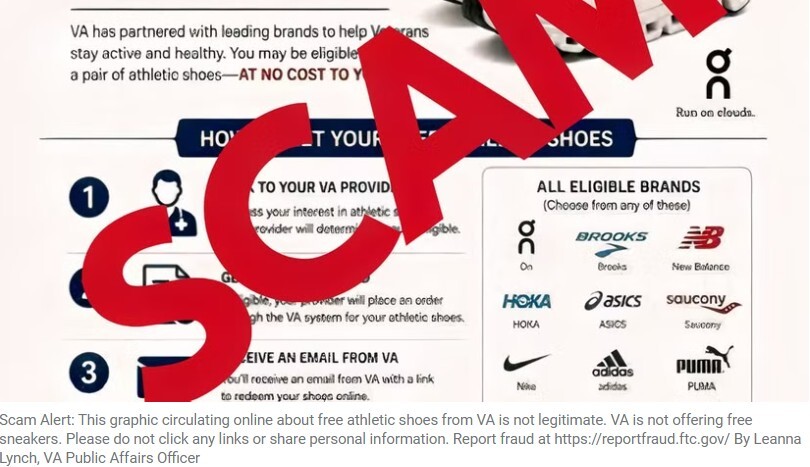
A graphic promising veterans free athletic shoes has circulated online since at least mid-June, dressed in Department of Veterans Affairs (VA) branding wrapped in the veneer of wellness language. It even carries a working agency phone number.
The VA published the image itself, stamped in red with a single word: "scam."
"This message is not from VA," the department said in an advisory posted June 17 out of Bedford, Mass., under the byline of public affairs officer Leanna Lynch. Scammers were using the offer to collect personal information, the notice said, warning veterans not to respond, click links or share anything personal.
What the advisory did not explain is why the counterfeit works so well. It is because the benefit is actually real.
There's an Actual Benefit Available
The VA issues footwear to certain veterans under certain conditions.
Under VHA Directive 1173.9, dated Oct. 22, 2021, updated July 12, 2024, the Veterans Health Administration provides therapeutic footwear and in-shoe orthoses when a clinician determines they are medically necessary.
Qualifying conditions include a high foot risk score, amputation, or mismatched sizing after limb loss. Credentialed pedorthists inside the VA's prosthetics service handle the fittings, using their speciality in the foot and lower limb to find suitable footwear.
Related programs deepen the impression that shoes are simply out there for the asking. Prevention of Amputation in Veterans Everywhere, VA's program for patients with diabetes or vascular disease, routes at-risk veterans toward protective footwear.
A separate annual clothing allowance, authorized under 38 CFR 3.810, pays veterans whose orthopedic devices wear out their clothes. That allowance is frequently mistaken for a shoe voucher. It is nothing of the kind.
Every legitimate path does share one distinctive feature. Each begins with a clinician; however, none begins with a flyer.
Veterans service officers spotted the distinction early. In Kearney, Neb., the Buffalo County veterans service office pushed a warning through the county sheriff on the same day the VA posted its own.
The notice said the message misused the VA name and reminded veterans that medically necessary footwear exists and is obtainable only through a primary care provider. Maryland VA Health Care System circulated the alert on social media. Regional television in Maine picked it up.
Any Leads?
Nobody has said much yet. VA told Fox News that the promotion came from no official program, ruling out its prosthetic representatives, the Central Office, and Whole Health.
According to that account, the flyer tells veterans they may qualify for shoes "at no cost to you." It displays recognizable athletic brands. It describes a redemption process that appears to involve a VA provider.
Absent from the public record is anything about the logistics involved. No agency has identified a phishing domain, a phone number, or a QR code destination. No confirmed victim has surfaced. VA characterized the intent as harvesting personal data. Characterization is not evidence, which, three weeks on, has yet to be produced.
Neither the VA nor the Federal Trade Commission has released a report on just how many veterans' lives it might have crept into. Whether a dozen veterans saw this flyer or a hundred thousand did remain, at this writing, a crucial question gone unanswered.
Black Market for Shoes
If you set the flyer against the broader fraud economy, a second possibility emerges, one that doesn't require stolen passwords. Free medical footwear has a market. That market has a magnetic attraction to malfeasance.
Orthotics fraud ranks among the most aggressively prosecuted health care crimes in the country. Federal investigators have documented a business model built on precisely the pitch this flyer makes. Telemarketers buy patient lists.
They call with an offer of free equipment. Names, birthdates, insurance identifiers, all of it gets harvested. Prescriptions arrive pre-filled at physicians' offices, where physicians sign them without meeting the patient. You can assume billing follows closely after.
Losses have run into ten figures. Investigators at the Department of Health and Human Services found in 2024 that Medicare lost roughly $1.2 billion to telemarketers who pushed orthotic braces to beneficiaries, often without any meaningful clinical assessment.
One New Jersey jury convicted a marketing company owner in February 2025 for his role in a $100 million scheme along those lines, a case worked on in part by the VA's own inspector general. Such schemes "compromise the integrity of VA's programs and services," VA Office of Inspector General Special Agent in Charge Christopher F. Algieri said when the Justice Department announced the verdict.
Regulators are still moving. On Feb. 25, the Centers for Medicare and Medicaid Services imposed a six-month nationwide moratorium on new Medicare enrollment for certain suppliers of durable medical equipment, prosthetics and orthotics, citing longstanding fraud.
Groundhog Day
Veterans were an obvious target before anyone drew this graphic. Military consumers filed 99,443 fraud reports with the FTC in 2024, according to the agency's Consumer Sentinel Network Data Book, still the most recent edition available.
Reported losses reached $584 million. Median loss was $700, compared with $497 for the general public. Veterans, as well as retirees, accounted for $419 million of the total. Impostor scams led every category, generating 44,587 reports worth nearly $200 million in losses.
Survey work by AARP Research last year found the pressure is close to universal. Among veterans polled, 39 percent had been solicited by someone claiming to represent VA or another government agency. Another 28 percent believed their veteran status made them a target. More than a quarter said they had lost money to fraud, most losing over $500.
Avenues to report these transgressions do exist. VA joined eight federal partners in August 2024 to launch VSAFE.gov, which came with a companion hotline at 1-833-38V-SAFE. Veterans can also file a report at reportfraud.ftc.gov, as the June advisory instructed.
Verification is easy. Simply ask a VA primary care provider about a therapeutic footwear evaluation. Confirm any benefit through VA.gov or a local facility. Of course, look out for your brothers and sisters by warning other veterans without forwarding the image, guidance Veterans Affairs issued for good reason. Every share puts the counterfeit in front of someone who might miss the attached warning.
July also happens to be Military Consumer Month. On July 7, the Federal Trade Commission convened a session on protecting service members from fraud. Three days later, the shoe flyer was national news.
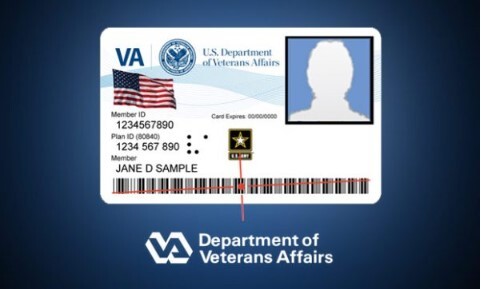
ID Cards at the Rochester VA Clinic
VA ID Cards may be obtained at the Rochester VA Clinic by appointment only on the following dates:
September 17, 2026
November 19, 2026
Please call the VA at 1-866-414-5058 to make an appointment in Rochester.
*The Minneapolis VA Medical Center issues ID cards daily.
Click HERE for more information on veteran ID cards.
JOBS
Olmsted County Veterans Organizations
Get involved! Support a local chapter! Check out these veteran organizations for becoming a member and member resources:
Local organizations
American Legion Post 551 (Eyota)
American Legion WM. T. McCoy Post 92 (Rochester)
American Legion Ivan-Stringer Post 164 (Stewartville)
Disabled American Veterans (DAV) - Mayo SE Minnesota Chapter 28
Honor Bound Veterans
Marine Corps League - THOR #606
- Address: PO Box 8490, Rochester, MN 55903
- Telephone: 507-251-6919
- Email: SemperVince@hotmail.com
- Point of contact:
- Mark Shuster
- Vince Reynolds
Minnesota POW / MIA Riders Association (Rochester)
Order of the Purple Heart - Chapter 7110, Rochester MN
Facebook: https://www.facebook.com/p/Purple-Heart-Chapter-7110-Rochester-MN-100079537844682/
Veterans of Foreign Wars (VFW) Post 9647 (Oronoco)
Veterans of Foreign Wars (VFW) Post 1215 (Rochester)
Local Service Organization Meetings
For a full list of local organizations and meetings, please click on the blue button.
"To promote the interests and welfare of veterans, their dependents and survivors and to enhance their quality of life through counseling, claims assistance, education, advocacy and special projects."
2100 Campus Dr. SE, Suite 200
Rochester, MN 55904
507-328-6355
|