CVSO Office Updates
HAPPY MAY!! This month, as we launch into spring, we are discussing “WHOLE Health” and how you can utilize this benefit through VA Health Care.
Getting Started with VA Whole Health A Veteran-Centered Approach to Better Living
The U.S. Department of Veterans Affairs’ Whole Health program is designed to help Veterans take charge of their health and well-being by focusing on what matters most to them—not just treating illness. This personalized, proactive approach empowers Veterans to work with their care teams to create health plans based on individual values, goals, and life priorities.
What Is Whole Health?
Whole Health shifts the focus from “What’s the matter with you?” to “What matters to you?” Veterans partner with their health care teams to build personalized plans that support physical, emotional, and mental wellness.
Getting Started
Veterans can begin their Whole Health journey in several ways:
- Visit the Whole Health website and complete the Personal Health Inventory Whole Health Home
- Talk with a VA health care provider about personal goals
- Enroll in Whole Health courses, including:
-
Introduction to Whole Health – A beginner-friendly course for Veterans and spouses
-
Taking Charge of My Life and Health – A deeper dive into personal wellness planning
Important: Veterans do not need to be enrolled in VA health care to attend the Introduction to Whole Health class, though enrollment is required for some ongoing services.
Available Services and Wellness Options
Whole Health offers a variety of supportive services, many available in-person, virtually, or through telehealth:
- Whole Health Coaching
- Chiropractic Care
- Acupuncture
- Biofeedback
- Clinical Hypnosis
- Massage Therapy
- Meditation
- Guided Imagery
- Tai Chi
- Qigong
- Yoga
Why It Matters
Whole Health helps Veterans build healthier lifestyles, manage chronic pain, reduce stress, improve mental health, and strengthen overall quality of life through self-care and complementary therapies.
How to Find Local Resources
Veterans can contact their nearest VA Medical Center and ask for Whole Health, Veteran, or Patient Educators to learn about available classes and services.
Helpful Resources
Live Whole Health. Live your best life. Explore the tools, support, and resources available to help you thrive—mind, body, and mission.
If you have any questions about Whole Health please feel free to reach out! You can contact us at 507-328-6355. We are happy to help get you connected to VA Health Care and the resources available to you all. We are grateful for you and that we get to do this work with you each day!
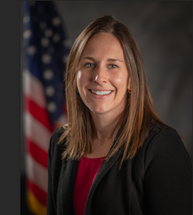 Tiffany Canfield
County Veteran Services Officer (CVSO) & Manager
tiffany.canfield@olmstedcounty.gov
507-328-6358
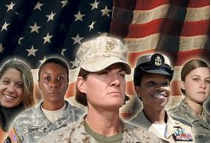
Women Veterans Spotlight
Another month has come and gone, and suddenly we are looking at May. May is Mental Health Awareness Month. Let’s make sure to take time to check in on one another, invite a friend for coffee, go for a walk, read a book, buy yourself flowers, whatever you need to do to snag that dopamine hit.
Mental Health Awareness Month for Women Veterans
May is Mental Health Awareness Month, and at our Veteran Services Office, we want to take time to recognize the unique experiences, challenges, and strengths of Women Veterans in our community.
Women are one of the fastest-growing groups within the Veteran population. While their service is diverse and invaluable, many face distinct mental health challenges—often shaped by their military experiences, transition to civilian life, and the balance of family, career, and identity after service.
Understanding the Need
Women Veterans may experience higher rates of:
- Depression and anxiety
- Post-Traumatic Stress Disorder (PTSD)
- Military Sexual Trauma (MST)
- Feelings of isolation or difficulty connecting with other Veterans
These challenges are real—but so is the support available.
You Are Not Alone
If you or a Woman Veteran you know is struggling, help is available—confidential, compassionate, and often right here in Rochester.
Key Resources:
-
Minnesota Department of Veterans Affairs (MDVA) Offers programs, outreach, and connections to mental health services specifically for Minnesota Veterans, including Women Veterans programming.
-
U.S. Department of Veterans Affairs – Women Veterans Health Care Provides comprehensive mental health services, including counseling, trauma recovery, and specialized care for MST. Access local care through the VA Health Care System.
-
VA Women Veterans Call Center Call or text 1-855-VA-WOMEN (1-855-829-6636) for help accessing benefits, care, and local resources.
-
Veterans Crisis Line Dial 988, then press 1, or text 838255 for 24/7 confidential support.
-
Make the Connection A powerful online resource where Veterans share real stories and find pathways to support.
-
Give an Hour Connects Veterans and their families with free mental health services from licensed providers.
Breaking the Stigma
Seeking help is a sign of strength—not weakness. This month, we encourage our community to:
- Start conversations about mental health
- Check in on the Women Veterans in your life
- Share resources and support
Every step toward awareness is a step toward healing.
If you are a Woman Veteran—or care about one—reach out today. Support is here, and your service deserves it~ 507-328-6358 will get you right to my phone!
-Love you all!!
-Tiffany
“You can’t raise the bar without raising a little hell”- so let’s raise some hell, shall we ladies??
Veteran Service Office Snapshot
March 2026
Total claims submitted to VA:
- Compensation: 101
- VA Healthcare: 12
- DIC: 2
- Burial: 19
- Survivor’s Pension: 6
- CHAMPVA: 1
- Records Request: 2
- Special Monthly Pension: 0
Points of contact with veterans (office visits, incoming mail, phone calls
returned, emails returned, etc.): 319
Veterans in office: 92
Outreach visits: 1
Total phone calls: 195
Average number of calls per day: 6
Average call length: 2 minutes and 56 seconds
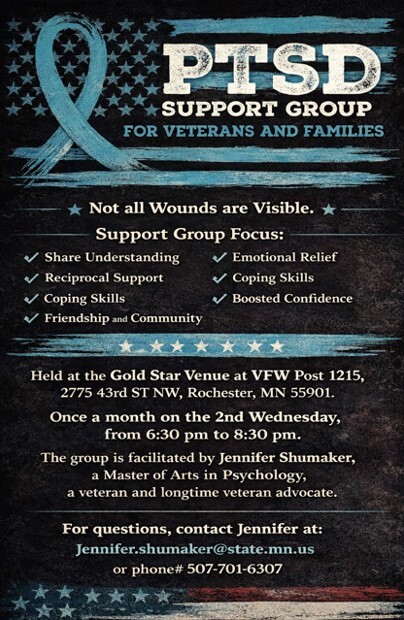
PTSD Support Group
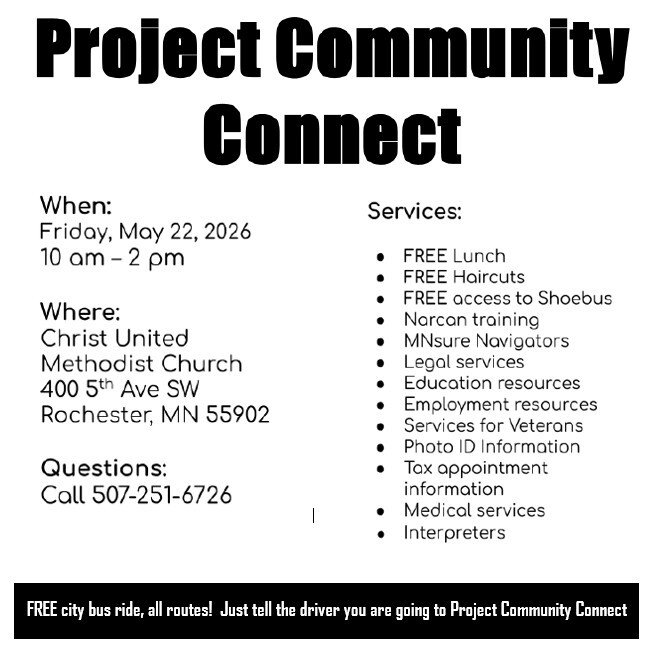
Project Community Connect
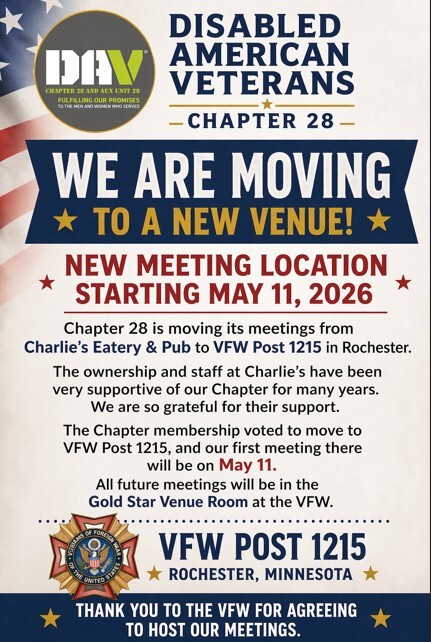
DAV Chapter 28 New Meeting Location
Our community has many homeless veterans in need of winter clothing. VFW Post 1215 is partnering with MACV (Minnesota Assistance Council for Veterans) to host a clothing drive specifically for winter attire. Please drop off your donations in the designated boxes at VFW Post 1215, 2775 43rd St NW, in Rochester, MN.
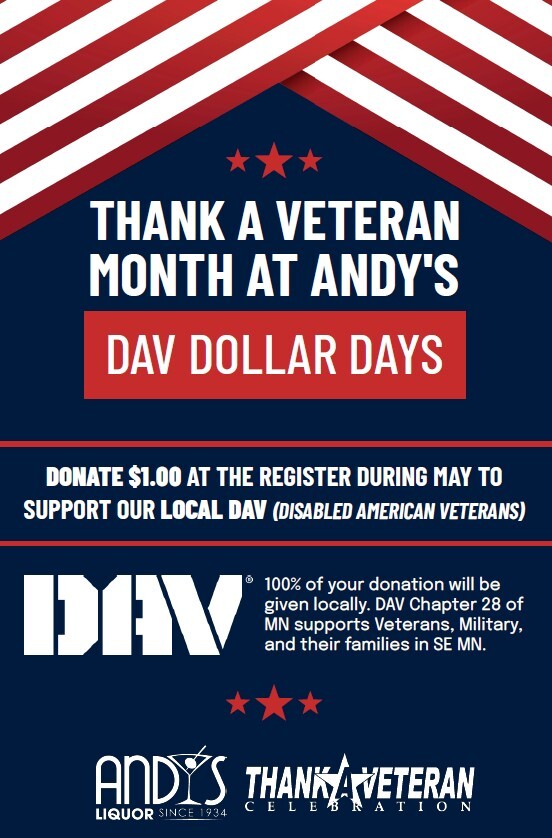
DAV Dollar Days at Andy's
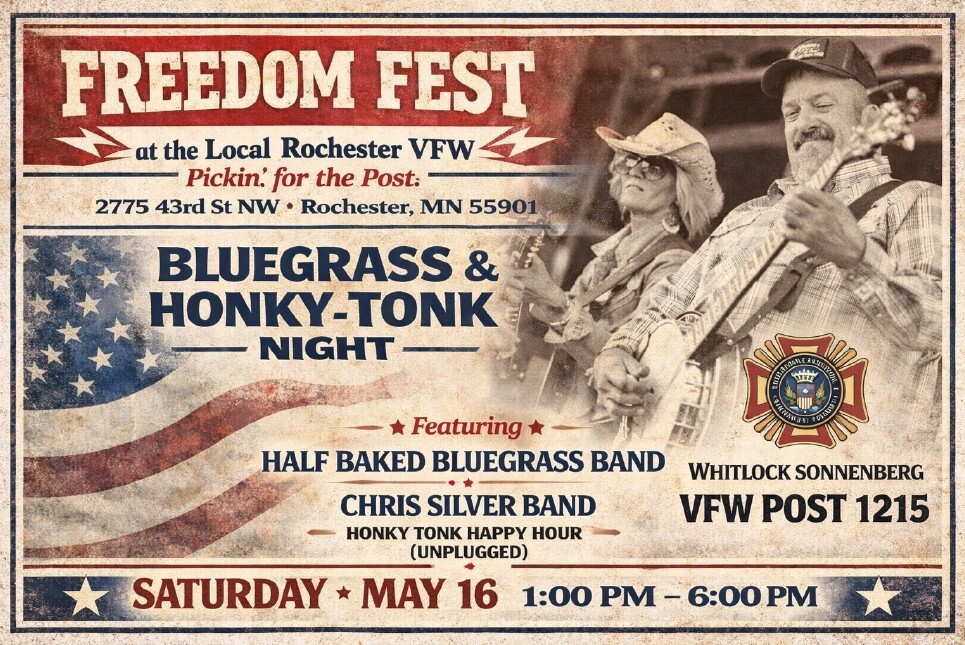
VFW Freedom Fest
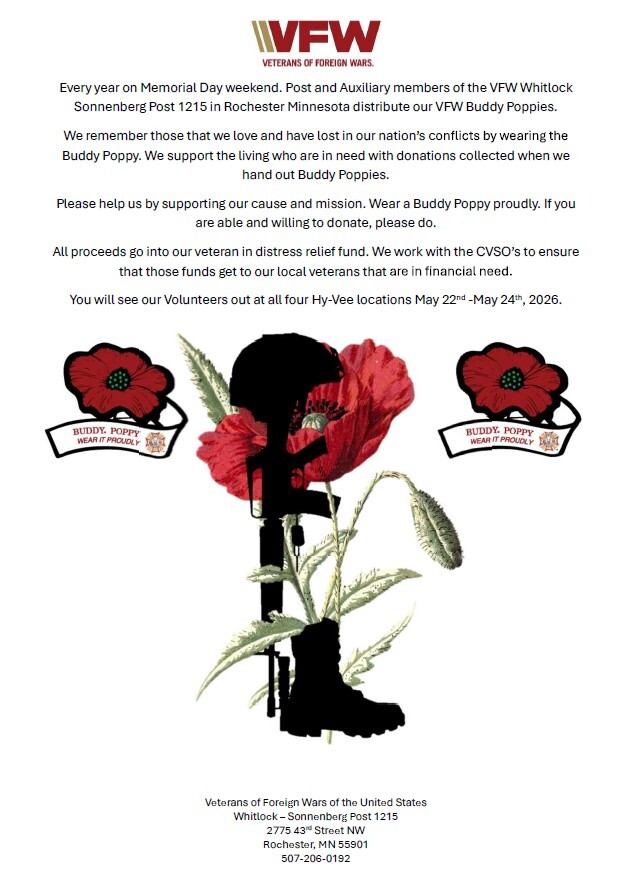
VFW 1215 Buddy Poppies
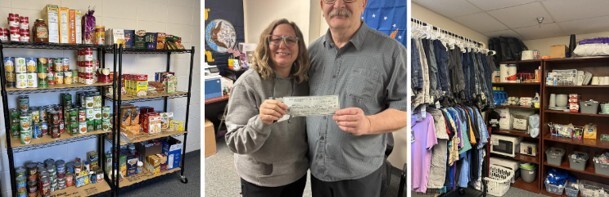
MACV Veterans Pantry
MACV has opened a new Veterans Pantry inside our Rochester office to support low-income Veterans in the area. The pantry helps fill a gap for Veterans living at MACV’s Ultima House and other Veterans across the Rochester community who may need access to basic food and household items. For many Veterans living on limited incomes, having a place to pick up everyday essentials can make a real difference in maintaining stability.
Typically, the pantry serves 3 Veterans per week, and Veterans who connect with MACV’s Rochester team are welcome to take what they need, whether that is food, hygiene products, or other basic supplies. The space also creates an easy way for MACV staff to check in with Veterans. A quick stop to grab groceries or household items often leads to a simple conversation that helps the team stay connected and offers support when needed.
Several community partners are helping spread the word and support the effort. Organizations, including The Landing MN, VFW Post 1215, Sons of the American Legion – Squadron 92, and the Elks Club, have helped ensure more Veterans in Rochester know this resource is available and provided essential donations.
Since opening in February, the pantry has continued to grow and relies on community donations. Current needs include dairy products and other food items, feminine hygiene products, women’s clothing, trash bags, and laundry detergent. Please call the pantry at (507) 225-2022 to learn more.
By creating a simple, accessible resource in the Rochester office, MACV is helping ensure that Veterans have another place to turn for support. It is a small but meaningful step toward helping Veterans maintain stable housing and stay connected to the services that help them move forward.
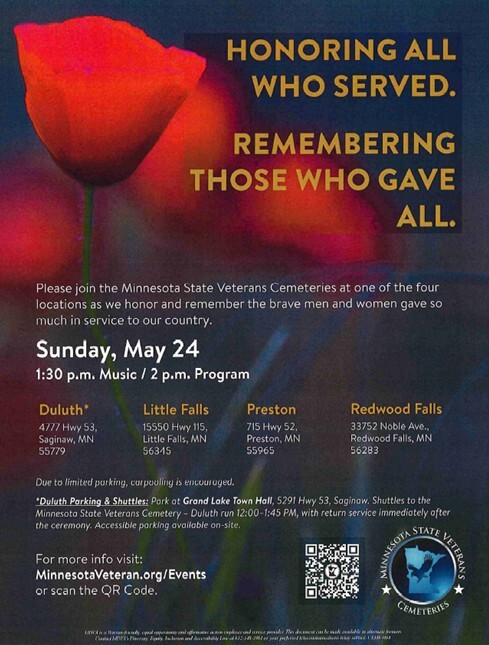
Memorial Day Program at MN State Cemeteries
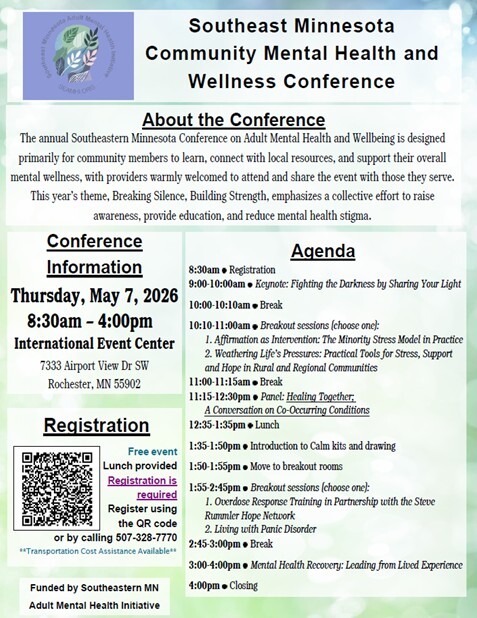
Mental Health & Wellness Conference
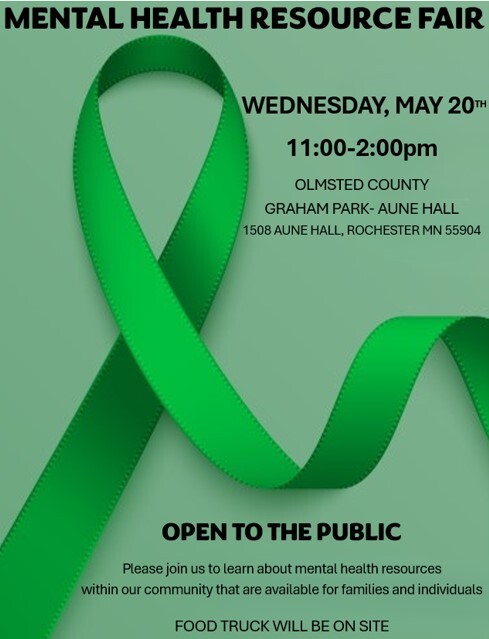
Mental Health Resource Fair
The Love Lives On Act
The Love Lives On Act seeks to remove or significantly relax that restriction by allowing surviving spouses to remarry earlier without permanently losing their DIC benefits.
Versions of the bill have been introduced in multiple Congresses, typically with bipartisan support, and aim to treat remarriage as a personal decision rather than a trigger for loss of earned benefits.
Under current federal law, surviving spouses of U.S. servicemembers who receive Dependency and Indemnity Compensation (DIC) lose those benefits if they remarry before age 55. DIC is a tax-free monthly payment administered by the Department of Veterans Affairs (VA) for spouses of servicemembers who die in the line of duty or from service-connected causes.
The remarriage restriction creates a bright-line rule: a surviving spouse who remarries before turning 55 forfeits DIC, while one who remarries after 55 may continue receiving it. Congress adopted this structure decades ago, and it remains largely unchanged.
Supporters frame the proposal as a modernization of survivor policy, arguing that current law forces younger widows and widowers, many of whom have children, to choose between financial stability and rebuilding a family life. In practical terms, the act would allow a surviving spouse to retain DIC even after remarriage, removing what advocates describe as a penalty for moving forward.
The Cases For, Against Reform
Advocates emphasize that DIC is not simply a needs-based benefit, but a form of compensation tied to a servicemember’s death. From that perspective, the benefit reflects a promise made to the servicemember that their family will be supported, independent of future personal decisions.
Many argue that remarriage does not erase the loss or the long-term impact on a family. They contend that surviving spouses often continue to bear emotional, financial and caregiving burdens connected to that loss, particularly when raising children of the deceased servicemember. They contend that modern policy should not discourage remarriage or create incentives for individuals to delay forming stable households.
Critics of the Love Lives On Act tend to focus on the underlying purpose of DIC. While the benefit is tied to service-related death, it also functions as income replacement, intended to offset the loss of a contributing spouse. From that perspective, remarriage can be seen as curing the defect that the benefit was designed to compensate for.
Under that logic, continuing payments after remarriage raises questions about whether the benefit remains appropriately targeted. If a surviving spouse forms a new household with another income source, critics argue, the original justification for ongoing compensation may weaken.
There are also fiscal considerations. Expanding eligibility to allow continued payments after remarriage would increase long-term federal spending on survivor benefits. While exact cost estimates vary by bill version, policymakers evaluating the proposal must weigh those costs against other budget priorities.
A Tension Between Compensation and Need
At the center of the debate is a fundamental question: what is DIC meant to do?
If DIC is primarily a form of compensation for a servicemember’s death and akin to a benefit earned through service, then remarriage should not affect eligibility. The loss occurred, and the obligation to the family remains.
If, however, DIC is viewed as a form of income replacement tied to dependency, then remarriage changes the underlying circumstances. In that case, continuing payments could be seen as extending a benefit beyond its original purpose.
The Love Lives On Act effectively resolves that tension in favor of the first interpretation, treating survivor benefits as enduring and independent of future marital status.
What the Debate Reveals
The discussion surrounding the Love Lives On Act reflects broader shifts in how policymakers understand military service, family structure, and long-term obligations to those left behind.
For supporters, the bill corrects an outdated rule that imposes unnecessary hardship and interferes with personal decisions. For critics, it raises legitimate questions about program purpose, fairness and cost.
What remains clear is that the issue is not simply legal or financial. It touches on how the government defines its responsibility to families after a servicemember’s death, and whether that responsibility changes as those families rebuild their lives.
Veterans Pension Rates 2026
Do you qualify for a Veterans Pension?
Many veterans of wartime service are completely unaware of the fact that if they are 65 or older and on a limited income, they may qualify for a Department of Veterans Affairs pension without being disabled.
You may also qualify for a Veterans Pension if you are a wartime veteran with a limited income and you are no longer able to work.
Veterans’ Pension Eligibility
You may qualify for a Veterans Pension if:
- You were discharged from service under other than dishonorable conditions AND
- You served 90 days or more of active duty with at least one day during a period of wartime, or:
- You are permanently and totally disabled or are age 65 or older.
You also must have limited income and a limited net worth or assets to qualify for a VA pension. Net worth includes your and your spouse’s assets and annual income. When you apply for Veterans Pension benefits, you’ll need to report all of these assets and income. The 2026 asset limit for VA pension is $163,699.
2026 VA Pension Income Limits (Effective Dec. 1, 2025)
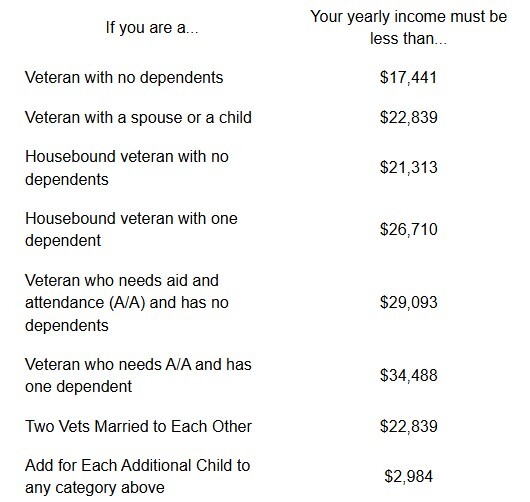 Some income is not counted toward the yearly limit (for example, welfare benefits, some wages earned by dependent children, and Supplemental Security Income). It's also important to note that your medical-related expenses are considered when determining your yearly family income.
VA Payment Rates
VA pays you the difference between your countable family income and the yearly income limit which describes your situation (see chart above). This difference is generally paid in 12 equal monthly payments rounded down to the nearest dollar.
VA Pension Payment Example
Joe (a single veteran) has an annual income of $5,000 and no assets. His annual income limit is $17,441. To determine Joe's pension, subtract his annual income of $5,000 from the $17,441 income limit, which gives him an annual pension rate of $12,441. This translates into a monthly pension check of approximately $1,036.75.
Apply for VA Pension Benefits
You can apply online through VA's website or contact your County Veterans Service Officer.
Aid and Attendance or Housebound Benefits
Aid and attendance (A&A) is a benefit paid in addition to a pension. This benefit can't be paid without pension eligibility. A veteran may be eligible for A&A when:
- They require the aid of another person in order to perform personal functions required in everyday living, such as bathing, feeding, dressing, attending to the wants of nature, adjusting prosthetic devices, or protecting themselves from the hazards of their daily environment.
- They are bedridden, meaning their disability requires that they remain in bed apart from any prescribed course of convalescence or treatment.
- They are a patient in a nursing home due to mental or physical incapacity.
- They are blind, or so nearly blind as to have corrected vision of 5/200 or less, in both eyes, or concentric contraction of the visual field to 5 degrees or less.
Housebound benefits are paid in addition to monthly pension. Like A&A, housebound benefits can't be paid without pension eligibility. A veteran may be eligible for housebound benefits when:
- They have a single, permanent disability evaluated as 100% disabling and, due to such disability, they are permanently and substantially confined to their immediate premises.
- They have a single, permanent disability evaluated as 100% disabling and another disability, or disabilities, evaluated as 60% or more disabling.
You can't get both aid and attendance and housebound benefits at the same time.
How to Apply for Aid and Attendance and Housebound Benefits
You can apply for aid and attendance or housebound benefits by writing to the VA office with jurisdiction over the claim. That would be the office where you filed a claim for pension benefits. If you aren't sure which office handles your claim, you can file the request with any VA regional office.
You should include copies of any evidence, preferably a report from an attending physician, validating the need for aid and attendance or housebound-type care.
The report should be in sufficient detail to determine that there is disease or injury with physical or mental impairment, loss of coordination, or conditions affecting the ability to dress and undress, to feed oneself, to attend to sanitary needs, or to keep oneself ordinarily clean and presentable.
The report should indicate how well the veteran gets around, where they go, and what they are able to do during a typical day.
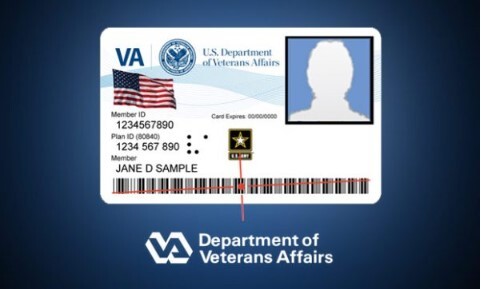
ID Cards at the Rochester VA Clinic
VA ID Cards may be obtained at the Rochester VA Clinic by appointment only on the following dates:
May 21, 2026
July 16, 2026
September 17, 2026
November 19, 2026
Please call the VA at 1-866-414-5058 to make an appointment in Rochester.
*The Minneapolis VA Medical Center issues ID cards daily.
Click HERE for more information on veteran ID cards.
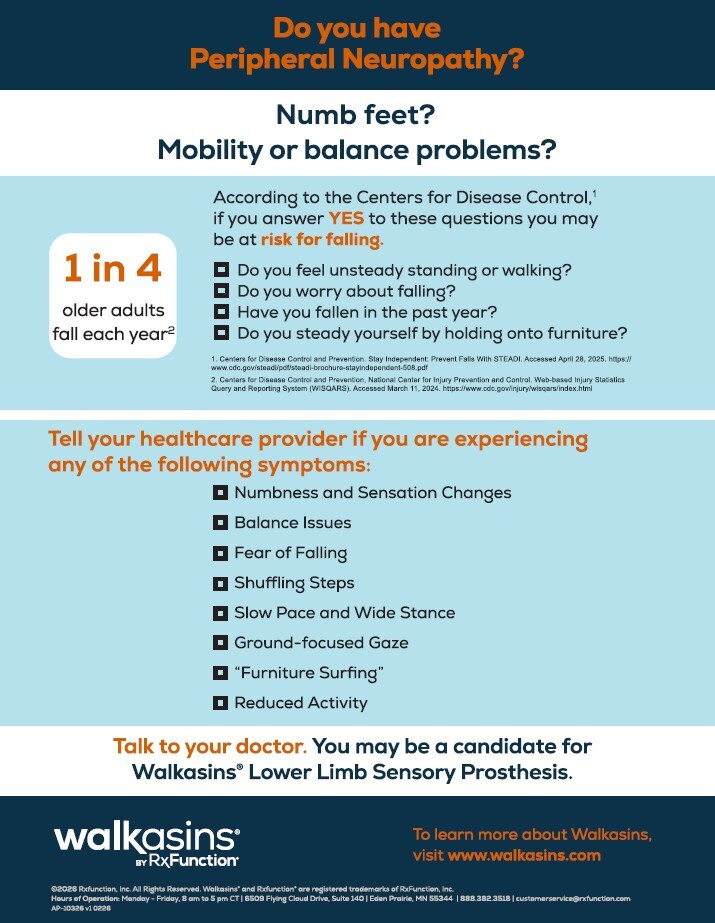
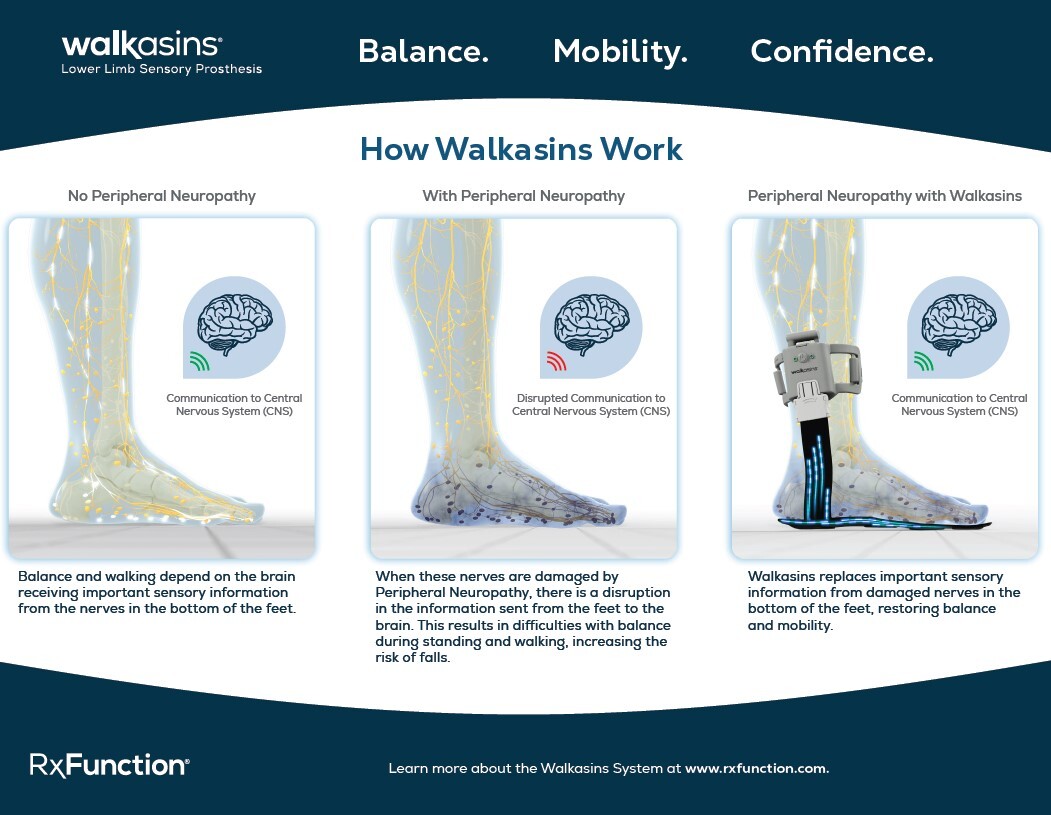
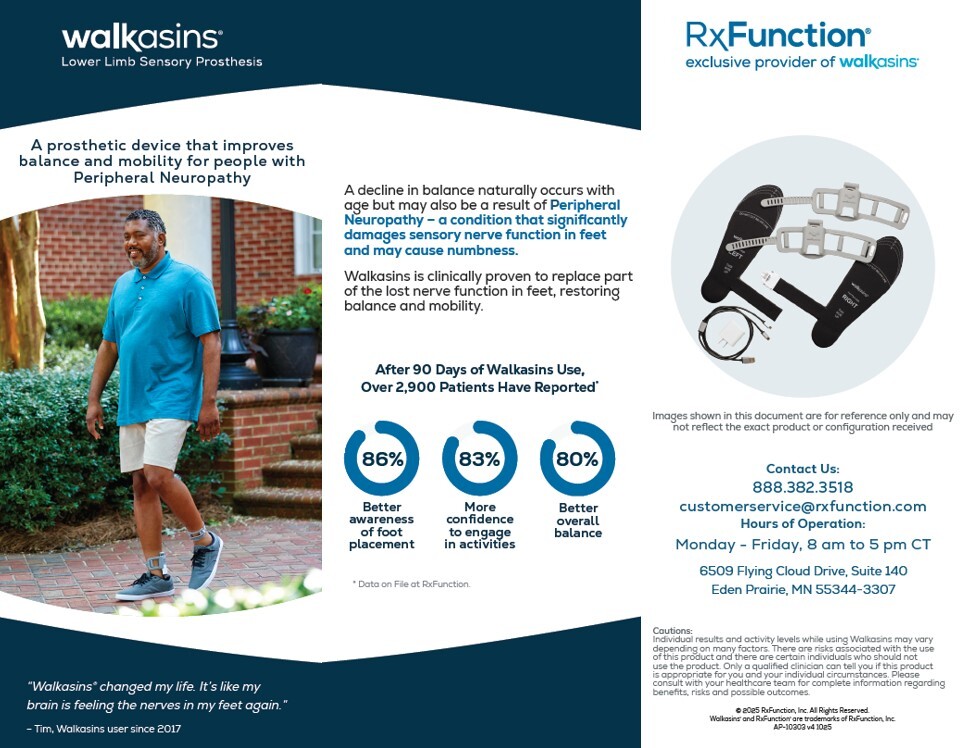
Do you have Peripheral Neuropathy?
Benefits Available to Surviving Spouses
During World War I, American families hung blue stars in their windows for every member serving in the military. When a loved one died in service, they replaced the blue star with gold. Each April, on April 5, America celebrates Gold Star Spouses Day, a national observance honoring the surviving husbands and wives of service members who made the ultimate sacrifice. At the Department of Veterans Affairs, that recognition comes with the commitment to make surviving spouses aware of every benefit available to help them rebuild their lives. Here is what is available in 2026.
Dependency and Indemnity Compensation
Dependency and Indemnity Compensation (DIC) is a tax-free monthly payment for eligible surviving spouses of service members who died in the line of duty or veterans who died from a service-connected condition. The 2026 base rate is $1,699.36 per month. Additional amounts may apply: $360.85 is added if the veteran was rated totally disabled for at least eight continuous years before death and the spouse was married to the veteran for those same eight years; $421.00 is added per child under 18; $359.00 is added for the first two years after the veteran’s death if there are children under 18. Aid and Attendance adds $421.00 if the surviving spouse is housebound or needs regular assistance with daily activities.
Surviving spouses who remarry can continue receiving DIC if they remarried on or after Jan. 5, 2021, and were at least 55 years old at the time; or if they remarried between Dec. 16, 2003, and Jan. 4, 2021, and were at least 57 years old. If a subsequent marriage ends for any reason, the surviving spouse can reapply for DIC.
What the PACT Act Changed for Surviving Spouses
The PACT Act added hypertension as a presumptive condition for Agent Orange exposure. Because high blood pressure is linked to heart disease, stroke, kidney failure and aortic dissection, surviving spouses of Vietnam-era veterans who died from any of those conditions may now be eligible for DIC that they were previously denied. The VA is required to review previously denied cases as if the PACT Act had been in effect at the time of the original claim. That means effective dates can reach back years, potentially resulting in significant back pay. If your DIC claim was denied before the PACT Act and your veteran’s cause of death involved the heart, blood vessels or kidneys, file a Supplemental Claim now.
Pending legislation would expand DIC further. H.R. 6047, the Sharri Briley and Eric Edmundson Veterans Benefits Expansion Act, would create a dedicated cost-of-living adjustment for DIC, separate from the Social Security COLA that currently drives the annual increase. The bill passed the House Veterans’ Affairs Committee in February. If enacted, it would increase the average DIC payment by approximately $23 in 2027 and $42 by 2036 for nearly 600,000 current recipients, according to Congressional Budget Office estimates.
VA Home Loan Guaranty: Unremarried surviving spouses of veterans who died in service or from a service-connected cause are eligible for a VA-guaranteed home loan with zero down payment and no private mortgage insurance. Surviving spouses who remarried after age 57 (on or after Dec. 16, 2003) may also be eligible.
CHAMPVA: Surviving spouses and dependents who are not eligible for Tricare may qualify for the Civilian Health and Medical Program of the Department of Veterans Affairs, which covers a portion of health care costs. More than 112,000 women of reproductive age are currently enrolled in CHAMPVA.
Education Benefits: Survivors’ and Dependents’ Educational Assistance (Chapter 35/DEA) provides up to 36 months of education and training benefits. The Fry Scholarship provides Post-9/11 GI Bill benefits to children and spouses of service members who died in the line of duty after September 10, 2001. Transferred Post-9/11 GI Bill benefits may also be available if the veteran transferred benefits before their death.
Tricare: Surviving spouses receive Tricare at active-duty dependent rates for three years after the service member’s death under transitional survivor status. After three years, costs adjust to retiree rates. Children remain covered until 21, or 23 if enrolled in school, with no enrollment fees or copays under Tricare Prime. If a surviving spouse remarries, they lose Tricare eligibility, but CHAMPVA may be restored if the remarriage ends.
Survivors Pension: Survivors Pension is a separate, tax-free monthly benefit for low-income, unremarried surviving spouses of wartime veterans whose death was not service-related. The veteran must have served at least 90 days on active duty (or 24 months if entering service after Sept. 7, 1980), including at least one day during a covered wartime period.
Additional one-time payments include Accrued Benefits (any VA compensation or pension due to the veteran before their death), the Month of Death payment (the veteran’s last month of benefits paid to the surviving spouse), and the Death Gratuity ($100,000 for survivors of service members who die on active duty).
Burial Benefits: Burial benefits include burial in a VA national cemetery at no cost, a government headstone or marker, a burial flag, and a Presidential Memorial Certificate. Surviving spouses may also be eligible for burial alongside the veteran.
How to Apply: For DIC and Survivors Pension, file form 21P-534EZ online at VA.gov, by mail or in person at a VA regional office. Consider filing an intent to file first to preserve your effective date while you gather evidence. For home loan eligibility, apply for a Certificate of Eligibility through VA.gov. For education benefits, apply through VA.gov’s education portal. A Veterans Service Organization can help you navigate the process at no cost. Call the VA at 1-800-827-1000, visit Ask VA online or contact your local County Veterans Service Officer for assistance.
JOBS
Olmsted County Veterans Organizations
Get involved! Support a local chapter! Check out these veteran organizations for becoming a member and member resources:
Local organizations
American Legion Post 551 (Eyota)
American Legion WM. T. McCoy Post 92 (Rochester)
American Legion Ivan-Stringer Post 164 (Stewartville)
Disabled American Veterans (DAV) - Mayo SE Minnesota Chapter 28
Honor Bound Veterans
Marine Corps League - THOR #606
- Address: PO Box 8490, Rochester, MN 55903
- Telephone: 507-251-6919
- Email: SemperVince@hotmail.com
- Point of contact:
- Mark Shuster
- Vince Reynolds
Minnesota POW / MIA Riders Association (Rochester)
Order of the Purple Heart - Chapter 7110, Rochester MN
Facebook: https://www.facebook.com/p/Purple-Heart-Chapter-7110-Rochester-MN-100079537844682/
Veterans of Foreign Wars (VFW) Post 9647 (Oronoco)
Veterans of Foreign Wars (VFW) Post 1215 (Rochester)
Local Service Organization Meetings
For a full list of local organizations and meetings, please click on the blue button.
"To promote the interests and welfare of veterans, their dependents and survivors and to enhance their quality of life through counseling, claims assistance, education, advocacy and special projects."
2100 Campus Dr. SE, Suite 200
Rochester, MN 55904
507-328-6355
|