The Minnesota Student Parent Alliance (MNSPA) is a group of organizations working together to make college more accessible for student parents in Minnesota. MNSPA works to break systemic barriers in education, healthcare, and social services that affect the lives’ of student parents and their families. By coordinating efforts and improving communication between these systems, MNSPA helps create a more supportive environment so student parents can succeed in school and in life.
This newsletter serves to uplift parenting student experiences, share about available resources and services, and highlight work being done to help student parents achieve their college dreams.
Student Spotlight
At 38, Heather DaCunha is rewriting the story of her life—not just for herself, but for her 2-year-old son, Jensen.
Heather spent almost her entire adult life working at her mother’s law firm as a secretary/legal assistant, but everything shifted when she found out she was pregnant at 36.
“I realized I couldn’t expect my son to value education if I didn’t show him what it looked like,” she says.
While she was pregnant, Heather started pursuing her education and earned her HSED. A week after receiving her HSED, Jensen was born.
She enrolled at Inver Hills Community College to pursue a paralegal degree, but her first semester, Spring 2024, was devastating.
“I failed every class except one,” she says. “It was discouraging, but I didn’t quit.”
Heather has no outside help so for every class and every assignment, she had to work around Jensen's needs.
“That usually means staying up late after I put him down for bed or getting up early, but there isn’t much extra time left between school and taking care of my son,” said Heather.
Things began to turn when she connected with her advisor, Rob Harris who has worked with her to make sure she can achieve her goals while still having her son by her side—from navigating financial aid, scholarships, and government assistance to exploring career paths.
After realizing her true passion was working with youth, she switched her major to psychology with a minor in child advocacy. Her dream is to work in juvenile justice where she can guide kids to better paths through therapy, programs, and support. She will transfer to the University of St. Catherine in spring 2026.
Heather currently works part-time at the campus food pantry at Inver Hills with Jensen in tow.
“He’s basically the mascot,” she laughs. “Everyone knows if I’m on campus, he’s with me.”
To other parenting students, Heather’s message is simple: “Ask for help. You can do it. It’s hard, but it’s worth it. You’re not alone.”
For Heather and Jensen, this journey means more than a degree, it means stability, a future, and proof that it’s never too late to start again.
Resiliency Tip
For students who are parenting in college, joy and play with their children can serve as a powerful resilience practice amid academic pressure, financial strain, and limited time. Between classes, assignments, and caregiving responsibilities, it may feel as though there is never enough time to meet every demand. Yet even brief moments of playful connection—reading a silly story before bed, dancing in the kitchen, or creating a quick game during a study break—can help regulate stress for both parent and child. These interactions release tension, strengthen connection, and foster a sense of emotional safety that buffers the effects of long days and competing responsibilities. In this context, play becomes a way to recharge rather than another obligation on an already full to-do list.
Joyful interaction also reinforces identity beyond the pressures of being a student-parent. When student-parents engage in play, they are not simply managing responsibilities; they are building trust, confidence, and shared meaning with their children. Navigating minor frustrations during a game or celebrating small victories together models adaptability and persistence—skills they actively apply in their academic journeys. In this way, play mirrors their own resilience: they show up, try again, and continue forward. Rather than detracting from academic success, moments of joy with their children can strengthen the emotional foundation that sustains both parenting and educational goals.
Over time, these small investments in joy accumulate. When exams feel overwhelming or unexpected challenges arise—such as childcare disruptions or financial stress, the memory of shared connection can provide grounding. Children learn that even during busy or uncertain times, they are valued and prioritized. In this sense, play is not a distraction from resilience; it is a daily practice in hope, flexibility, and love—qualities that carry student-parents through college and beyond.
SPSI Grantee or Student Parent Program Highlight
Inver Hills Community College
The following was submitted by Josie Neveu MA, LPC, Counselor at Inver Hills Community College:
Thanks to the incredible support from the Parent Support Initiative Grant, we were able to expand the resources available to our parenting students. Our Holistic Parent Support Program now includes a parent support specialist, monthly family events, a dedicated family study room, diapers and wipes for the academic year, a scholarship cohort, a monthly newsletter, a Teams site to connect parenting students, and an improved lactation space.
Our monthly family events are open to all students, and each event focuses on a different area of wellness. We intentionally schedule events on Friday evenings or non-school days to accommodate family and school schedules. We provide meals at every event, along with resources connected to that month’s wellness theme. We have seen great engagement, with about 50 participants attending each event.
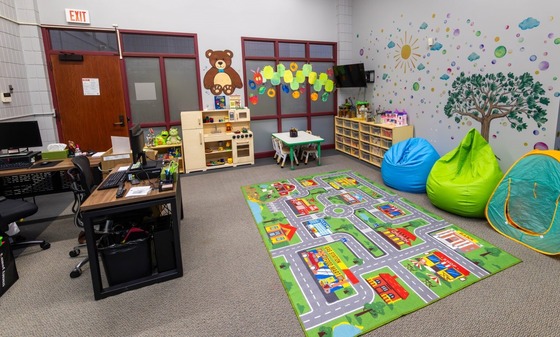
The dedicated family study room supports more than just the student by using a two-generational approach that considers both the student and their family. The room is safe and secure and includes toys, games, and crafts for a wide range of ages. It also has three large cubicles equipped with computers and study materials. The room is staffed by student workers who support parenting students and can interact with children when parents give permission. It has become a place where parenting students connect with each other and build community while their children play together. Inver Hills also recently featured the study room in a campus news article.
We also created a cohort of 25 parenting students who each received a $6,000 scholarship for the academic year. Each student then completed an intake appointment and orientation. Students identified one to three goals they wanted to work on during the year. Cohort members are asked to attend at least 50% of events and meet with student parent staff monthly. However, we remain flexible and supportive when life happens. I am proud to share that our cohort had a 100% retention rate from the fall to spring semester.
Student Parent Support Resource
In the spirit of promoting joy and play as a resilience factor for student parents and their families, we are pleased to share a few Minnesota-specific, family-friendly resources that highlight local adventures and enriching activities. Websites such as Family Fun Twin Cities offer creative ideas for exploring the Twin Cities with kids, while Explore Minnesota features a curated guide to Minnesota’s best kid-friendly things to do across the state. Families can also find parenting tips, local events, and community connections through Minnesota Parent. Together, these resources support families in finding meaningful moments of connection and fun.
You are cordially invited to All In: Planning the Future of Student Basic Needs Work, Minnesota’s first statewide summit on student basic needs. This one-day event will bring together campus and system level staff, administrators, and researchers to share best practices, new research, and critical resources related to student basic needs, financial wellness, and academic success. Participants will have the opportunity to network, provide feedback on state policy related to student basic needs, and explore opportunities related to data collection, research, and assessment. It will be a day well spent!
Who should attend: Anyone with an interest in postsecondary student basic needs work, institutional researchers who want to learn more about assessment work and opportunities related to this population, campus and system administrators committed to student success and attainment, and campus faculty and staff with an interest in expanding their campus’s ability to meet student basic needs.
Date: Monday, June 8th
Time: 9am-4pm
Location: St. Cloud State University
Cost: The event is free thanks to generous support from the Urban Institute, Joyce Foundation, Kresge Foundation, and ECMC Foundation.
A formal invitation and registration link will be sent out in early April, but we encourage you to put a hold on your calendar now! If you have any questions, please feel free to contact Missy Watschke (melissa.watschke@state.mn.us).
The Minnesota Student Parent Alliance (MNSPA)
Please email Miriam Cullimore at miriam.cullimore@state.mn.us to be added to the MNSPA newsletter mailing list, any relevant statewide announcements to be shared, or to nominate a student parent to highlight in the newsletter.