|
|
Having trouble viewing this email? View it as a webpage.
Sept. 22, 2026
Your September Cannabis Compliance Connector
In this issue:
|
|
Implementation of 2026 legislative changes to chapter 342

On Aug. 1, many legislative changes, including those related to cannabis and hemp, went into effect. Last month, OCM sent all cannabis and hemp applicants and license holders a message with the subject Updated guidance following the 2026 legislative session, which provided an overview of these legislative changes. The office has made numerous updates to materials and webpages to reflect these changes. We recommend reviewing the message linked above and OCM's website to stay informed of any changes that may have affected your license and/or business operations.
|
|
Lower-potency hemp edible (LPHE) businesses
Preparing for upcoming federal hemp changes
 Select image to open accessible PDF.
In November 2025, President Trump signed a federal spending bill that changed the definition of hemp under Title 7, Section 1639o. This change to federal law—which effectively bans hemp products containing more than 0.4 milligrams (mg) of THC per package—will take effect on Dec. 11, 2026, unless other federal action occurs.
The new federal definition clarifies what is federally legal as industrial hemp. The following products are excluded from the new definition of hemp, and therefore will become federally illegal:
-
The hemp plant and plant parts (including seeds) with more than 0.3% total THC concentration, including THCA (the previous definition included only delta-9 THC).
-
Intermediate hemp-derived cannabinoid products with more than 0.3% total THC.
-
Final hemp-derived cannabinoid products containing more than 0.4 mg total THC per container.
This federal definition change does not change how Minnesota law defines LPHE products and LPHE retailers, manufacturers and wholesalers, or the legality of those products in the state. LPHEs are defined in Minnesota Statutes, section 342.01, subdivision 50, and are allowed to be manufactured and sold under state law. Minnesota’s definitions of LPHE licenses and product types will not change after the federal definition changes on Nov. 12, 2026.
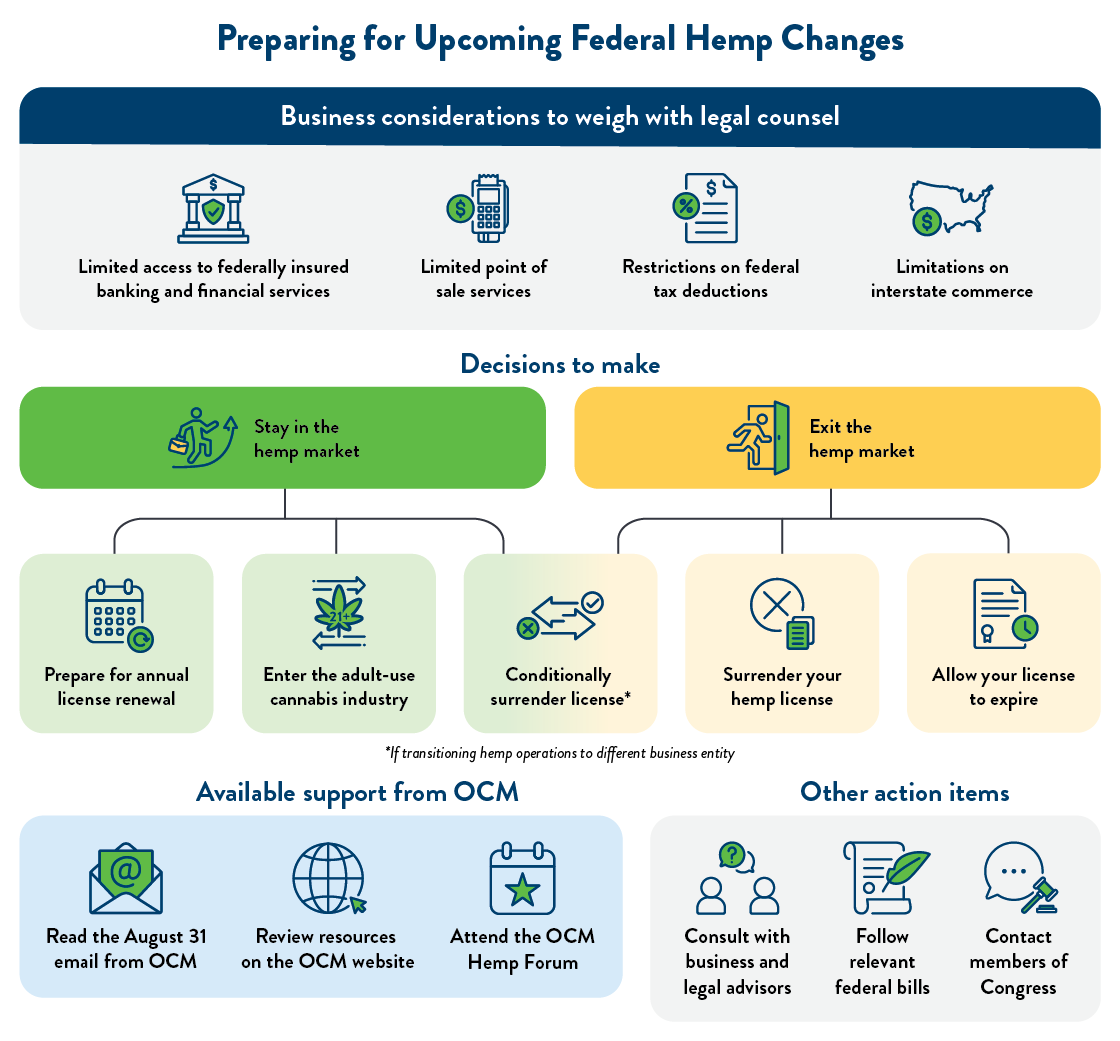
However, under the new federal definition, many products compliant under Minnesota law (e.g., packages containing more than 0.4 mg of THC) will become federally noncompliant. We recognize this will have a variety of impacts on businesses currently selling LPHE products, and the office strongly recommends businesses currently selling these products consult a lawyer to prepare. For example, similar to complexities currently faced in the cannabis industry, the federal change could result in:
-
Limited access to federally insured banking and financial services
-
Limitations on point-of-sale services
-
Restrictions on federal tax deductions
-
Limitations on interstate commerce
|
|
Cannabis and LPHE businesses
Endorsement updates
 Effective Aug. 1, there are several changes to the endorsements available to cannabis and hemp license holders following legislative changes passed earlier this year. OCM has made the necessary updates within Accela to reflect these changes on licenses; license holders may sign in to their Accela account to verify that a reissued license is available to download.
Many of the updates to endorsements were minor housekeeping changes. However, there were notable changes made to the law’s existing manufacturing endorsements, as well as the creation of a new cannabis flower packaging endorsement for retailers conducting deli-style sales.
-
The extraction and concentration endorsement is now split into three more specific endorsements: cannabis extraction and concentration, lower-potency hemp extraction and concentration, and creation of artificially derived cannabinoids.
-
Any cannabis business that was previously endorsed for extraction and concentration has been automatically converted to hold all three of these endorsements.
-
LPHE manufacturers previously endorsed for extraction and concentration have been automatically converted to hold both the lower-potency hemp extraction and concentration endorsement and the lower-potency hemp creation of artificially derived cannabinoids endorsement.
-
The production of consumer products endorsement is clarified to cover more comprehensively the various product types a manufacturer may make.
-
Any business that was previously only manufacturing pre-rolls has been automatically updated to hold a production of consumer products endorsement. Reminder, that you must include on your manufacturing plan the types of regulated products that you are manufacturing.
-
Businesses that intend to add deli-style sales must now apply for and obtain a cannabis flower packaging endorsement before starting deli-style sales.* A business must be licensed and endorsed for retail operations to be eligible for this endorsement. This is not a manufacturing endorsement and is not required for manufacturers packaging product.
*Any currently licensed business that wishes to change or add an endorsement can follow the instructions on the Making Business Changes webpages. The cannabis flower packaging endorsement requires updates to the Quality Assurance Final Plan of Record specifically.
|
|
OCM resource and hiring fair

OCM will host a hiring and resource fair on Thursday, Oct. 22, 2026, at the University of Minnesota Urban Research and Outreach-Engagement Center (UROC) in North Minneapolis. This full‑day event will bring together grant recipients, community partners, business license applicants, and resource providers for a day of connection, learning, and community‑centered support. The fair will highlight grantee progress, investment impacts, local capacity‑building, workforce development opportunities, and resources available to communities preparing for participation in Minnesota’s cannabis industry.
Date: Thursday, Oct. 22, 2026
Location: Robert J. Jones Urban Research and Outreach-Engagement Center (UROC) The Plymouth Room (Room 105), 2001 Plymouth Ave. N., Minneapolis, MN 55411
More details, including registration information and a full agenda, will be shared on the OCM website.
|
|
Cannabis businesses
Preliminary approval extensions
 Select image to open accessible PDF.
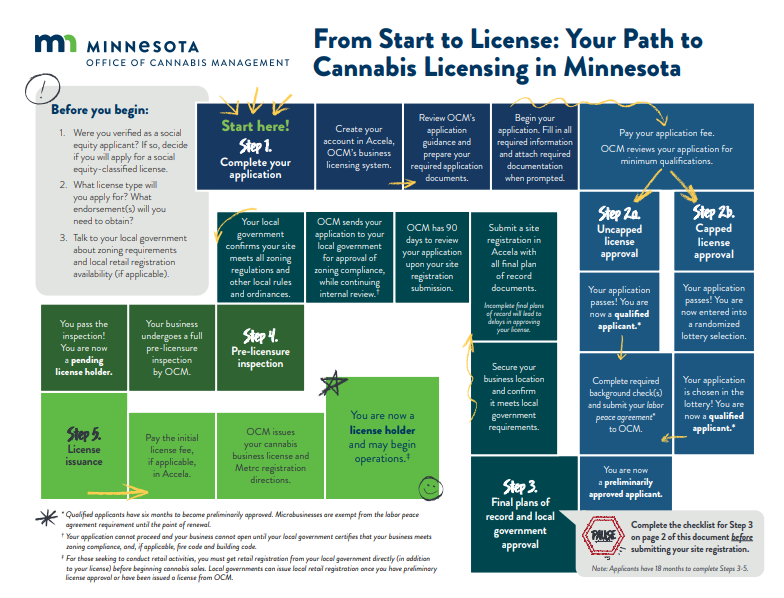
Applicants in preliminary approval status have 18 months to convert their approval to a license. Applicants can receive a six-month initial extension to this period by submitting a request to OCM. An additional six-month extension may be granted on top of that if applicants can show they are making good faith efforts to become licensed. This allows the potential for an additional 12 months following the initial 18-month window to give businesses the necessary time to build their business, secure funding, and manage approvals.
As applicants approach the end of their 18-month preliminary approval period, OCM will send notifications regarding the extension process, requirements, and next steps. To request a six-month extension of the preliminary license approval status, applicants must email OCM at ocm.licensing@state.mn.us.
To ensure timely processing and sufficient time to review your request, the office recommends that you submit your request for extension at least 30 days before your preliminary license approval expires. If you are not receiving emails from Accela regarding your application, check your spam folder!
A request must be submitted to OCM to be eligible for an extension. If you do not obtain your license within 18 months of preliminary license approval and do not request an extension, your preliminary license approval will expire and OCM cannot issue you a license.
Preliminarily approved applicants should continue to refer to the Qualified Applicant Guide for more information on how to convert their approval to full licensure.
|
|
Use of additional lab test batches in Metrc

On Aug. 11, OCM published a Lab Bulletin 2026-06 describing how to use lab test batches that have recently been added to Metrc. These lab test batches are called Additional + [Test category] lab test batches; for example, Additional Pesticides or Additional Potency lab test batches.
Additional lab test batches may be requested if:
-
A license holder evaluates additional risks of a contaminant being introduced to the product through the manufacturing steps and needs to add testing outside of the standard compliance testing. Based on increased risk, the required compliance testing lab test batch and the additional lab test batch may be requested.
-
A license holder requests reanalysis of a batch, and the testing facility uses the additional lab test batch to report the analyte(s).
- A license holder requests retesting after reanalysis. They request the additional lab test batch that corresponds to the required testing. The testing facility will use the additional lab test batch to report the retested analyte(s).
-
A license holder remediates product and needs to send a sample in for testing. They request the additional lab test batch that corresponds to the required testing. The testing facility uses the additional lab test batch to report the results.
For more information, please reference Lab Bulletin 2026-06 (Use of Additional Lab Test Batches).
|
|
Compliance testing for cannabis flower products
 All cannabis flower products require compliance lab testing of a representative portion of the product in the format that will enter the retail market. If a cultivator plans to sell their flower in pre-roll form, then no testing is required prior to packaging the flower into pre-rolls, but full compliance testing is required on the pre-rolls before sale. Similarly, if a cultivator has a harvest batch of flower and plans to separately package and sell buds as flower, single harvest kief, and shake/trim, then they should sort the batch into those forms, and test a representative portion of each separately prior to selling. The reason for this is that the potency and contaminants present in cannabis flower can concentrate differently into different parts of the plants. It is expected that kief would be more potent than the buds which would be more potent than the shake/trim. Accuracy in labeling requires an accurate potency for each product.
|
|
Harvest prep for cultivators

As we approach fall, many outdoor cultivators will begin to prepare for harvest. Even experienced cannabis cultivators may find that the logistics of a new farm, climate, strain, or harvest method are presenting unexpected challenges. We strongly encourage you to have a plan for how you will handle your harvest batches ahead of time. Many growers have indicated that they intend to have a licensed transporter take their product in a refrigerated truck immediately upon harvest, but this may not be logistically possible.
Please be aware that any material changes to your harvest plan, including adding new buildings for drying or storing cannabis must be submitted at least ten days prior to implementation. Get your material change requests in as early as possible to avoid delays.
|
|
New genetics for cultivators
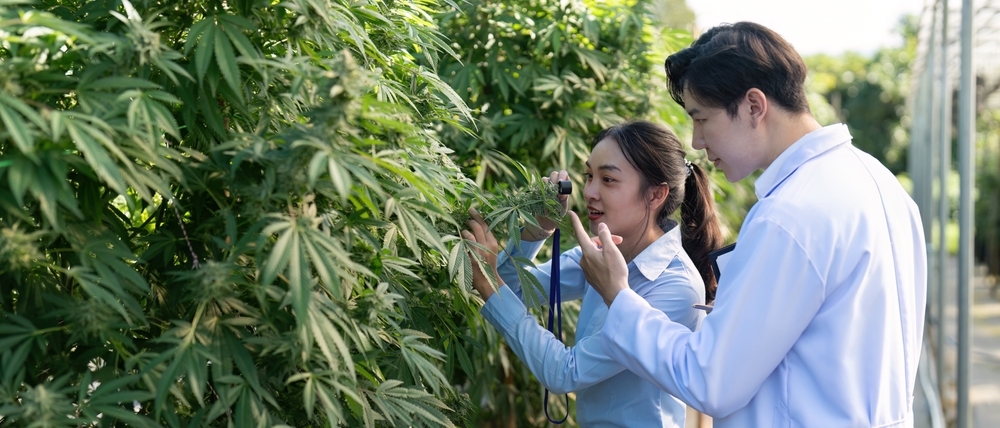 This is a reminder that license holders endorsed for cultivation activites must obtain cannabis genetics from an authorized source and enter those genetics into Metrc for tracking. Minnesota’s cannabis market is a closed-loop system, where all cannabis must be tracked from seed to sale to ensure that all products in the supply chain were legally sourced, grown, manufactured and sold.
Newly licensed/endorsed cultivators have 30 days from licensure or endorsement to add genetics into Metrc for inventory and tracking. After 30 days, a business must fill out the New Genetics (Seeds) External Transfer form to request approval from OCM to enter new genetics. Clones must be purchased from another Minnesota-licensed business and seeds from a commercial seed seller with a Minnesota seed permit.
|
|
Statewide Inventory Tracking and Management (Metrc)
OCM has partnered with Metrc to administer Minnesota's statewide seed-to-sale inventory tracking system, which includes planting, harvesting, manufacturing, testing, transportation and retail sales. All licensed cannabis businesses must register and use this system (including software, tagging, and labeling tools). Metrc is a complex system and as more businesses come online and begin using the system, the office will work to provide helpful information for navigating the tool.
|
|
Metrc bulletins are official communications issued to license holders from Metrc to provide critical updates on system functionality, enhancements, and compliant workflow changes. They can serve as step-by-step guides, offering industry operators clarity on data entry practices and technical requirements.
More on Metrc Support Bulletin 73: Transfer type definitions and manifest enfacements
This new Metrc support bulletin provides definitions of the new transfer types that are now available in Metrc. This includes the new processing transfer type that can be used for transferring product for a service (more information can also be found in GM-2026-05. The bulletin details how to upload the required PDF form when completing a processing transfer.
|
|
Metrc Learn is an online training platform designed for both state and industry Metrc users. It offers a large catalog of on-demand courses that users complete at their own pace. Newly licensed business owners must complete the Minnesota New Business Fundamentals course before gaining access to Metrc. Metrc Learn offers interactive training tailored to different cannabis license types, including cultivators, manufacturers, transporters, and retailers. Completing training in Metrc Learn provides cannabis businesses with the opportunity to learn how to efficiently navigate Metrc and properly record activities in the mandatory statewide track-and-trace system.
Minnesota Rules, part 9810.1301, subp. 6 requires that each system user must be trained and supervised by the track-and-trace system administrator. Considering adding modules from Metrc Learn as part of your employee onboarding and training process.
|
|

Important updates and reminders
-
Find data around cannabis cultivation, sales activities, and cannabis licensing in the state of Minnesota on OCM’s dashboard, Cannabis Market Monitor!
-
Bookmark the OCM Guidance Memos webpage to keep up with important decisions from the office.
|
|
|
Reminder: Background checks are required for cannabis business employees and contractors
All prospective cannabis business employees and volunteers must undergo a comprehensive local and national criminal background check conducted by a third-party consumer reporting agency or background screening company (Minnesota Statutes, section 342.151 subd. 2). Additionally, all employees must be trained according to the business's standard operating procedures (SOPs) and Minnesota Rules, part 9810.1102, subp. 2, no matter how long they are employed. Please keep this in mind as you plan for fall harvest help.
Upcoming opportunities to hear more about high-medical-need cannabis products

OCM is preparing to implement legislative changes passed in May 2026, streamlining the medical and adult-use cannabis supply chains. The new law requires the office to identify and publish a list of all high-medical-need products. Beginning Jan. 1, 2027, cannabis businesses with a medical cannabis retail endorsement must carry every product on that list.
The office has been working to develop the list of products, including through engagement with patients, providers, medical advocates and licensed businesses. Over the coming weeks, OCM will broaden that conversation. The office plans to connect with additional groups, including license holders authorized to manufacture cannabis products, medical cannabis combination businesses (which will transition to the cannabis macrobusiness license type under the new law), medical cannabis patients and providers, and others.
If you are part of one of those groups, watch for an invitation from OCM. Anyone who would like to share input in the meantime can reach the office at cannabis.info@state.mn.us.
The office expects to publish a guidance memo with the completed list of high-medical-need products in the coming weeks, with guidance to follow. To learn more about this and other recent legislative updates, visit our website.
|
|
|
|
|
|