|
|
Having trouble viewing this email? View it as a webpage.
Aug. 20, 2026
Your August Cannabis Compliance Connector
|
|
Cannabis and Lower-Potency Hemp Edible Businesses
Detailed guidance on advertisement warnings, outdoor advertising and signage
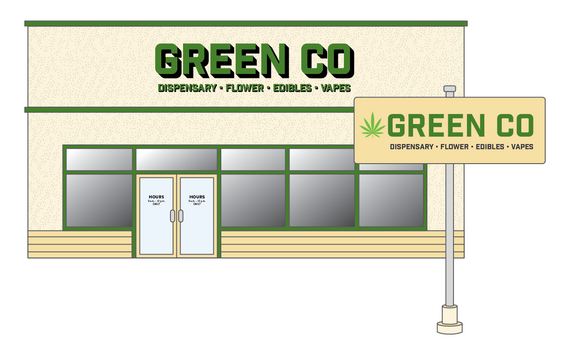 Example of a business with one sign affixed to the building and one parking lot sign, in compliance with state law. State statute allows a hemp or cannabis business to erect up to two fixed outdoor signs to the exterior of the building or property of a hemp or cannabis business.
On Aug. 7, the Minnesota Office of Cannabis Management (OCM) issued Guidance Memo 2025-07 (Cannabis and hemp advertising guidance) in response to the need for additional clarity on advertising and signage requirements for licensed operators. OCM is providing further clarification on requirements outlined in the original cannabis law. Note that these are not new requirements.
Required warnings
Minnesota law requires that all advertisements for cannabis and lower-potency hemp edible (LPHE) products contain a warning developed by OCM. In consultation with industry and public health professionals, OCM has developed required warnings that accompany any published advertisement for a cannabis business, a hemp business or any cannabis product or lower-potency hemp edible product (including hemp beverages).
Any advertisement (whether in print, radio, television, online, or through social media) for either a cannabis or hemp business, cannabis flower, a cannabis product, an LPHE, or a hemp-derived consumer product must contain the following warning language.
Cannabis businesses, cannabis flower and cannabinoid products:
Warning: Cannabis products are not for use by anyone under the age of 21. Cannabis use may cause drowsiness, affect focus, reaction time, and decision-making. These products are not evaluated or approved by the FDA. Pregnant people should avoid cannabis due to the risk of low birth weight, premature birth, stillbirth, and harm to fetal brain development.
Hemp businesses, lower-potency hemp edibles, and hemp-derived consumer products:
Warning: Hemp products containing THC are not for use by anyone under the age of 21. Using hemp products containing THC may cause drowsiness, affect focus, reaction time, and decision-making. These products are not evaluated or approved by the FDA. Pregnant people should avoid hemp products containing THC due to the risk of low birth weight, premature birth, stillbirth, and harm to fetal brain development.
Review Guidance Memo 2025-07 for additional guidance on advertising hemp and cannabis products.
Outdoor advertising, signage and billboards
An outdoor advertisement is defined in Minnesota Statutes, section 342.01, subd. 58, as “an advertisement that is located outdoors or can be seen or heard by an individual who is outdoors and includes billboards; advertisements on benches; advertisements at transit stations or transit shelters; advertisements on the exterior or interior of buses, taxis, light rail transit, or business vehicles; and print signs that do not meet the requirements in Minnesota Statutes, section 342.64, subd. 2, paragraph (b), but that are placed or located on the exterior property of a cannabis business." Any window or door sign that is visible from outside the business would be considered an outdoor advertisement.
Outdoor advertisements for cannabis or hemp are not allowed under any circumstances. LPHE businesses may advertise other goods or services they offer (such as food, liquor, etc.) but cannot include, depict or mention LPHE products in any manner.
Examples of common outdoor advertisements that are not allowed:
- Hanging vinyl banners
- Tent or feather flag or sandwich board signs
- Neon cannabis leaf or dispensary sign in window
- Window wrapping or posters in window facing outward displaying cannabis imagery or products
Cannabis and hemp businesses may erect up to two fixed outdoor signs. These signs must meet certain requirements. First, the signs must be fixed to the exterior of the cannabis or hemp business’ building or on the property of the cannabis or hemp business (meaning that the signs cannot be easily removed). Second, these signs are subject to the limitations described in Minnesota Statutes, section 342.64, subd. 1.
Download a printable handout containing illustrations and descriptions of allowed/not-allowed signage and outdoor advertisements are below, including examples of outdoor signage/advertisement combinations that are compliant with state law.
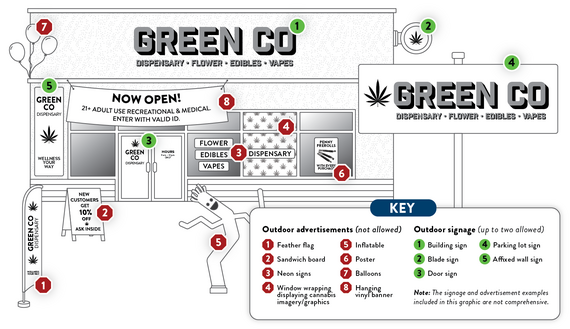 Types of allowed/not-allowed outdoor signage and advertisements are noted with a numbered green signal (circle) or numbered red stop sign (octagon).
The preceding information provided by OCM is for guidance only. OCM enforces all laws and rules by applying the law or rule to specific facts on a case-by-case basis.
[Back to top]
|
|
Cannabis Technical Authority updated July 1

Changes have been made throughout the document, but they are largely for ease of use, readability, and to incorporate information previously announced through lab bulletins. On the last page of the document, you will find a revision log that lists the technical updates made to the document with this update to Version 2.0.
Note that none of the test analytes or test limits are changed. This update does not affect what testing is required for products, or how testing is requested or reported through Metrc.
-
A new table of contents with hyperlinks to help you navigate the document.
-
New section numbers throughout the whole document, eliminating the need to reference page numbers.
-
Clarifications that the CTA applies to both cannabis and hemp products.
-
Additional definitions.
-
A redesigned chart illustrating the flow of product testing.
-
Metrc item categories listed for each product test category.
-
Updated lab sample package quantity tables.
-
An increase in the lab sample size required for infused edible products to reflect the 25-gram portion required for microbial testing.
|
|
Making a representative sample for compliance testing

Proper sampling procedures are essential to ensure that representative samples are analyzed and therefore testing results are accurate for the whole batch of product or material. Sampling procedures must include proper collection, labeling, preservation, and storage by trained personnel to ensure sample integrity and chain of custody are maintained. The steps in the sampling procedure must be followed exactly every time to reliably and consistently provide the laboratory with a representative sample.
Licensed cannabis/hemp manufacturers and cultivators must follow a statistically valid sampling method by developing their own validated method or by following the method as detailed in the Cannabis Technical Authority (Section 7.2). It is the responsibility of the license holder to adopt a sampling standard operating procedure (SOP) that minimizes imprecision and bias and lists chronological steps to ensure a consistent and repeatable method. All staff collecting samples for compliance testing must be trained on proper procedures and periodically monitored by the manager or owner to ensure the procedures are consistently followed. Cannabis product sampling must be done in areas that are under video surveillance, and those videos must be available for OCM review to ensure compliant sampling of all batches.
The amount of sample required for testing may vary due to the sample matrix, analytical methods, and laboratory-specific procedures. The amount sampled must take into account the compliance sample size required for laboratory testing, additional product for stability or homogeneity testing (if required), and the retention sample size, which must be retained and stored by the business for six months after the expiration date, after which they can be destroyed.
The Cannabis Technical Authority, Section 7.2.c, presents a procedure that may be adopted by license holders to perform the representative sample collection. The office will periodically review the sampling documentation, sampling videos, and interview authorized sample collection employees to ensure compliance with the representative sampling requirements, including creation and storage of the retention sample.
The representative compliance sample and retention sample must be entered into Metrc for all cannabis products. Please review Metrc Support Bulletin 54 for specific guidance on how to enter the sample information into Metrc.
[Back to top]
|
|

A certificate of analysis, also known as a “COA” is a formal document showing laboratory testing results for a product. Every product that enters the cannabis or LPHE market must be tested and shown compliant with the standards in the Cannabis Technical Authority. The COA will show things like the specific batch number tested, the report date, the testing date, the sample weight, the analytes that were tested and the results for each.
Businesses will use the product’s COA to make the product label. The product label is what the customer sees when making a purchase. A product label will necessarily have less information than what is found on the COA. The COA has some technical information that is not necessary for a customer to see. However, the product manufacturer must make the original COA available upon request.
Cannabis plants make THC in its acidic form, which is called THCA, this form is non-intoxicating. THCA converts to the intoxicating form called delta-9 THC through heat, burning/smoking, and slowly over time through natural degradation. This chemical process is natural and called decarboxylation.
Minnesota has always considered total THC when determining if a plant or product is “hemp” or “cannabis,” this is the total potential amount of intoxicating delta-9 THC in the products. Total THC is determined post-decarboxylation, using the following formula: (THCA x 0.877) + delta-9 THC = total THC. This means that cannabis flower cultivated, harvested, and tested for sale by licensed businesses in Minnesota may show THCA as part of the cannabinoids detected through testing and reflected on the COA and/or label of the flower.
Over the course of recent years, during the national discussions regarding lower-potency hemp products, “THCA” has been used by some people to describe “hemp” - this is not accurate. However, any flower product that meets the state law’s standards for total THC is adult-use cannabis. Cannabis retailers and wholesalers should be aware that cultivators and manufacturers may report the THC amount in several different ways on the cannabis product label. Reporting THCA and delta-9 THC separately as cannabinoids that make up the total THC content is compliant, and so is reporting the total THC, which would combine the two into a single unit by using the formula above.
|
|
Business resources from Minnesota state agencies

License holders and applicants are encouraged to explore the small business development resources available across Minnesota state agencies.
-
General business support from the Department of Employment and Economic Development (DEED):
-
Apprenticeship and dual training for cannabis workers
-
Pollution prevention and environmental regulations
-
Industrial Hemp Development Act (Minnesota Statutes, chapter 18K)
-
Tax inquiries
|
|
|
Cannabis businesses
Check your email for license renewal application reminders

The first cannabis business licenses issued last summer have completed the renewal process, and more cannabis business licenses are nearing their annual renewal point. This is a reminder that all license holders must renew annually by the license expiration date. OCM will send renewal reminder emails 90, 60, and 30 days prior to expiration. Licenses must be renewed on or before the expiration date. These emails will go to the license holder email address on file with OCM and are sent through Accela at NoReply@accela.com. If your business’ contact information has changed, be sure to update it to ensure you are receiving these important communications.
If a license renewal has not been approved by the expiration date, even if it is under review, the license holder must cease all operations as of the expiration date. Please visit OCM’s License Renewal webpage for more information.
|
|
|
Product storage
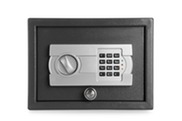
Per Minnesota Rules, part 9810.1104, subp. 1A:
A cannabis business must ensure that product storage areas are used only for the storage of regulated products. A cannabis business must store regulated products in a manner that ensures that there is no mixing between batch numbers or different types of regulated products.
-
Nothing but regulated products and items used for processing orders are allowed to be stored in the regulated product storage areas.
-
If you have questions about this, please contact your area inspector.
|
|
|
Preparations for a streamlined supply chain
Following legislative changes this past spring, the office is working to prepare for the streamlining of the medical and adult-use cannabis supply chains, which are currently bifurcated into two separate supply chains. Under the current framework, businesses can participate in both supply chains if they have the applicable endorsement and the ability to maintain distinct supply chains from seed to sale.
Under the new framework, the point of distinction between adult-use cannabis and medical cannabis moves to the point of retail sale, where a cannabis product is sold to either a medical patient or an adult-use customer. The new framework will include additional endorsement changes—particularly to the medical cannabis combination business license type, which will be converted to a macrobusiness license type—but will maintain the overall endorsement structure and medical registry program. These changes go into effect Jan. 1, 2027.
As Jan. 1, 2027, approaches, the office will share additional information—including guidance for existing license holders impacted by the transition, and guidance for new operators who may be interested in the new medical endorsement options in a streamlined system. Operators should watch for newsletters, guidance memos, and website updates for more information. The office encourages license holders with interest in entering the medical cannabis market to plan ahead and engage with OCM and their business advisors on any questions.
[Back to top]
|
|
Statewide Inventory Tracking and Management (Metrc)
OCM has partnered with Metrc to administer Minnesota's statewide seed-to-sale inventory tracking system, which includes planting, harvesting, processing, testing, transportation and retail sales. All licensed cannabis businesses must register and use this system (including software, tagging, and labeling tools). Metrc is a complex system and as more businesses come online and begin using the system, the office will work to provide helpful information for navigating the tool.
|
|

Metrc support bulletins are official communications issued to license holders from Metrc to provide critical updates on system functionality, enhancements, and compliant workflow changes. They can serve as step-by-step guides, offering industry operators clarity on data entry practices and technical requirements.
More on Metrc Support Bulletin 68: Transfer best practices
This new Metrc support bulletin provides best practices for both sending and receiving transfers in Metrc. Commonly observed errors include incorrect packages being listed on the transfer manifest, incorrect package quantities, packages left off the manifest, and incorrect item names or categories used for packages. It is the responsibility of both the sending and receiving license holders to ensure that packages placed on a transfer manifest are accurate. The sending license holder should verify the accuracy of each package listed on the manifest, and the receiving license holder should also verify the transferred packages before receiving them into the facility's inventory. If the receiving license holder identifies errors or discrepancies, the transfer manifest should be rejected and the product returned to the sending license holder for correction and reshipped under a new transfer manifest.
|
External transfer process in Metrc for hemp concentrate and hemp-derived consumer products
Effective July 1, 2026, cannabis businesses must submit a transfer request to OCM for all hemp concentrates and hemp-derived consumer products they wish to add to their Metrc inventory. OCM will verify the requested product is compliant with Minnesota Statutes, section 342.34, subdivision 5(c) by reviewing the certificate of analysis (COA). Each batch must be approved individually.
|
|
Important updates and reminders

-
Find data around cannabis cultivation, sales activities, and cannabis licensing in the state of Minnesota on OCM’s dashboard, Cannabis Market Monitor!
-
Bookmark the OCM Guidance Memos webpage to keep up with important decisions from the office.
|
|
|
|
|
|