|
Having trouble viewing this email? View it as a webpage.
April 28, 2026
Check out the latest edition of Cannabis Insider
In this issue:
News and Updates
Government Relations Updates
Resources and Reminders
News and Updates
More than 200 cannabis licenses issued and two new testing facilities
OCM recently passed the milestone of 200 cannabis licenses issued. As of April 22, the number of cannabis licenses OCM has issued is up to 202 (52 of which are licensed for cultivation activities). In addition, OCM has licensed more than 1,700 businesses for lower-potency hemp edible (LPHE) retail, manufacturing, or wholesaling.
Among the newest cannabis license holders are two cannabis testing labs: Adams Independent Testing and True North Analytical. This brings the total number of licensed testing facilities in Minnesota to five. Learn more about which fields each of them can test (microbial, pesticides, heavy metals, etc.) and find their contact information on the Licensed Testing Facilities webpage.

Justice Department reschedules medical cannabis to Schedule III status

On April 23, the acting United States attorney general signed an order reclassifying state-licensed medical cannabis as a less-dangerous drug, giving licensed medical cannabis business owners a potential tax break and opening cannabis up to broader research. The order changes the way medical cannabis is regulated, shifting licensed medical cannabis from Schedule I to the less strictly regulated Schedule III.
OCM is actively monitoring the developments with the Justice Department’s order rescheduling medical cannabis to Schedule III status and is reviewing its impact on Minnesota’s medical cannabis market. Once we have done a full review, the office will provide guidance for next steps. There are still several unknowns as part of this federal order, and OCM will continue to work with several regulatory partners to assess the impact on Minnesota's medical cannabis program.
Note: On June 29, there will be an administrative hearing to consider broader rescheduling of non-medical cannabis from Schedule I to Schedule III.
|
CanGrow grantees announced and application opens for next round
Four organizations have been awarded funding from the state’s CanGrow grant program that helps farmers enter or expand into the cannabis industry. OCM is also accepting applications through June 1 for the next round of CanGrow funding to provide people with the education, knowledge and training to enter and succeed in Minnesota’s cannabis cultivation industry.
“With the establishment of Minnesota’s adult-use cannabis industry, we are creating financial opportunities that foster a fair, equitable and sustainable market,” said OCM Executive Director Eric Taubel. “CanGrow grants are intended to create a strong knowledge base of cannabis cultivators and entrepreneurs while keeping to our commitment to social equity by empowering those who face barriers to joining the market.”
The four recipients of technical assistance grants include programs offering compliance training, education, business planning, mentorship, assistance with legal and environmental concerns, and opportunities to share knowledge and best practices.
First round of CanGrow grant awardees
-
Technical assistance grants
-
Wise Education Technology, doing business as Oaksterdam University (St. Paul), is awarded $49,985 for its Creating a Compliant Cultivation Plan, an industry-recognized online, on-demand, comprehensive Horticulture Mastery Certification Program with one-on-one and group coaching to support business license applicants in developing viable and compliant commercial cultivation plans and facilities.
-
Seeds Worth Sowing (Minneapolis) is awarded $49,990 for its From Barriers to Business: Social Equity Cannabis Workforce and Enterprise Support project. This project will provide culturally responsive technical assistance, hands-on training, and regulatory guidance to support social equity-qualified farmers to enter or expand within Minnesota’s legal cannabis industry. Seeds Worth Sowing—in collaboration with Minnesota Black Farmers Association, Grand Risings Farm, and other trusted partners—will deliver workshops, site tours, one-on-one consulting, and grant navigation resources.
-
Minnesota Cannabis College (Minneapolis) is awarded $49,950 for its Cannabis Compliance Navigator: Empowering Social Equity Farmers program. This initiative aims to equip 50 social equity-eligible farmers in Minnesota with the knowledge and tools to navigate the legal cannabis industry's regulatory framework. Through a structured 12-month program, participants will receive comprehensive training, mentorship, and resources to achieve licensure and establish compliant cannabis operations.
-
Leech Lake Financial Services (Cass Lake) is awarded $49,999 for its Cannabis Training Program, a new program that helps develop successful local cannabis farmers as part of the local and statewide economy. This training will help increase the success of current farmers by expanding their cannabis farming knowledge and skills.
-
Loan financing grant
-
Leech Lake Financial Services (Cass Lake) is awarded $382,910 for administering loans to individual farmers through its Cannabis Loan Fund. LLFS is expanding their loan portfolio to include financing for cannabis farmers on or near the Leech Lake Reservation to fund the start-up or expansion of cannabis farming, allowing for a stronger entry to the cannabis industry as part of the local and statewide economy.
Learn more about CanGrow and how to apply on the CanGrow webpage.

Apply by April 30 for cannabis farmer training with Oaksterdam University
CanGrow grant recipient, Oaksterdam University, will support up to 15 Minnesota cannabis farmers in developing and maintaining cultivation plans. Cultivation plans are an important roadmap for business development and implementation of standard operating procedures, allowing businesses to increase efficiencies, reduce waste, and help the business stay compliant. Oaksterdam University pairs their industry recognized Horticulture Mastery Certification with one-on-one coaching from their chair of horticulture, Joey Ereñeta, and Minnesota attorney and cannabis business consultant, Jen Randolph Reise.
Oaksterdam University supported farmers facing barriers to education and employment in the cannabis industry since 2007, working to accelerate market entry and sustain businesses.
Do you know a farmer in Minnesota who may be interested and qualify? Reach out to support@oaksterdamuniversity.com by April 30 to let them know you are interested.

OCM accepting lower-potency hemp edible (LPHE) license applications
OCM is accepting business license applications for the three lower-potency hemp edible (LPHE) license types: LPHE retailers, LPHE manufacturers, and LPHE wholesalers. Applications are accepted and reviewed on an ongoing, rolling basis.
OCM processed more than 2,200 license applications from businesses that applied last October to manufacture and sell the popular products, which include hemp-derived THC beverages and gummies. Business owners who wish to apply, reapply, or make changes to existing licenses may now do so. OCM will review applications and issue licenses on an ongoing, rolling basis.
“We now have more than 1,700 licensed hemp-derived THC businesses in Minnesota, and we’re taking steps to ensure they can continue to prosper and participate in the marketplace selling products that consumers want,” said OCM Executive Director Eric Taubel. “Having hemp and cannabis businesses licensed and operating under the same statute is crucial to our work of fostering an equitable cannabis industry that prioritizes public health and safety, consumer confidence, and market integrity.”
Resources for those applying for an LPHE license are located on the Application Process webpage.

March social equity mixer focuses on cannabis business capital readiness
For the fourth installment of OCM’s Social Equity Mixer series, community members, license holders, aspiring entrepreneurs, and partners gathered at the Wildwood Library in Mahtomedi (Washington County) to discuss cannabis capital readiness.
A panel of cannabis entrepreneurs and OCM's general counsel led a discussion centered on the realities of securing and structuring early-stage capital in Minnesota’s emerging cannabis market, emphasizing that successful funding pathways are built on strong relationships, clear financial planning, and disciplined compliance – not chance. Panelists explored how business owners must intentionally build a "balanced capital stack" across debt, equity, and available grant resources, while preparing for the “valley of death” between initial investment and revenue generation.
The conversation also highlighted the added pressures of the “green tax,” the importance of clearly documenting financial contributions to maintain compliance and control, and the value of assembling a trusted advisory bench to navigate complex decisions. Attendees were encouraged to leverage community-based resources such as the Neighborhood Development Center, Elevate Hennepin, and the Small Business Development Center to extend their capacity without overextending their budgets.
Ultimately, the session reinforced that entrepreneurs who understand their numbers, communicate a clear and compelling vision, and build strategically aligned partnerships are best positioned to launch and sustain compliant, competitive cannabis businesses in Minnesota.
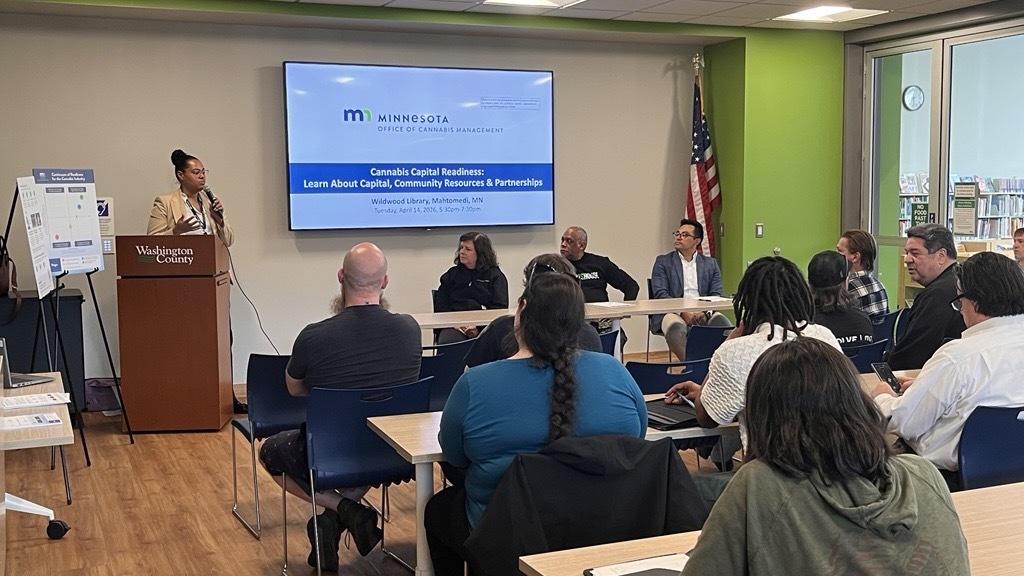 OCM Social Equiy Director Jessica Jackson speaks at March social equity mixer.
[Back to top]
Government Relations Report
OCM at the Minnesota State Capitol
The 2026 Minnesota Legislative Session is in its final month, and OCM continues to engage with interested parties and legislators on the office’s policy proposals and other bills related to the agency’s work. Please continue to reach out to your legislators to let them know how these proposals will impact you, whether you’re an applicant or license holder, consumer, medical patient or caregiver, or otherwise involved.
As a reminder, OCM’s policy proposals are summarized in this handout: 2026 Legislative Policy Proposals. These policies were developed through extensive discussion with interested parties on what is working in state law and what needs improvement. Examples include allowing hemp products to use a QR code to list their source material and permitting individuals to hold both a hemp and a cannabis license.
The office is also supportive of the proposal to streamline the medical and adult-use supply chains. Extensive conversations with patients, advocates, businesses, legislators, and others informed this bill (SF 4541 / HF 4397). The proposal is patient-focused, creating requirements and incentives for businesses to ensure the availability of medical products and serving areas of the state with limited access to businesses serving the medical market.
 [Back to top]
Resources and Reminders
Latest Minnesota Student Survey shows youth cannabis use continued to decline in 2025
The Minnesota Department of Health recently announced that there continues to be a steady decline in youth cannabis use since 2013, with 96% of students reporting not having used cannabis in the last month, according to the Minnesota Student Survey.
This is the first student survey conducted since Minnesota legalized adult-use cannabis, and it showed healthier trends related to student use and perceptions of harms. Early cannabis use is a key risk factor for health and social problems, and research shows that starting regular use before or around ages 15 and 16 is associated with greater risk. OCM is encouraged by these results and committed to keeping cannabis out of the hands of children.
OCM-sponsored bills under consideration in the Legislature would give OCM authority to take action against unlicensed sellers and allow the office to deny a license for retailers with previous violations, like selling products to children.
For more information, check out the MDH press release: Youth cannabis use continued to decline in 2025.
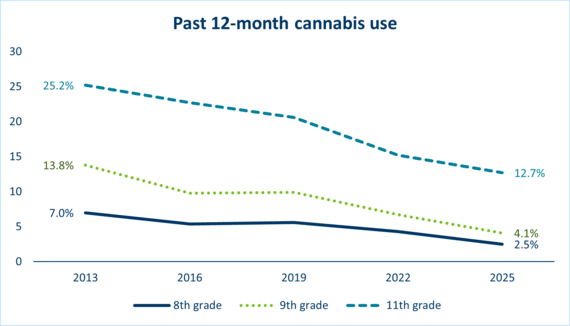 Minnesota has seen a 57.7% decrease statewide of self-reported past 12-month cannabis use from 2013 (14.9%) to 2025 (6.3%) amongst eighth, ninth, and 11th graders combined.
Annual petitions process
Starting in July 2026, OCM will open its annual online petition process for the following topics:
- Approval of a new medical cannabinoid product
- Approval of a new medical delivery method for a cannabinoid product
- Approval of a new product category
- Approval of the use of a cannabinoid in lower-potency hemp edibles
- Approval of the manufacture and use of an artificially derived cannabinoid
- Declaration of a cannabinoid as nonintoxicating
Per Minnesota Rules, part 9810.1003, subp. 2, petitions will be accepted during the month of July, specifically between the first and last business day of that month each year. This process is governed by Minnesota Rules, chapter 9810, and Minnesota Statutes, chapter 342.
Check out the Petitions Process webpage for more information.
 [Back to top]
|