|
Having trouble viewing this email? View it as a webpage.
March 31, 2026
In this issue:
News and Updates
Government Relations Updates
Resources and Reminders
News and Updates
First leg of Connecting with Community Listening Tour featured good conversations, snow and wind
Earlier this month, OCM kicked off its statewide listening tour to engage community members in meaningful, face-to-face discussion about the state’s growing adult-use cannabis market and medical cannabis program.
The first stop on the tour took OCM to Pine City, where staff met with Pine County officials for a productive conversation about business licensing – including discussion about how state policy and rules interact with local ordinances around zoning and compliance. Pine County—located in east central Minnesota along the I-35 corridor—has unexpectedly become a hub for cannabis cultivation in the state, with nine businesses currently licensed to grow cannabis in the county. The county’s location relative to central and northern parts of the state positions it nicely to serve multiple population centers. While this has created economic opportunity and jobs, it has also spurred conversations around how local communities approach zoning of cannabis cultivation sites.
"We wanted to stop at the county where we actually gave our first license," Taubel told the reporter. "The first cannabis license in Minnesota went to a farm in Pine County growing cannabis outdoors, so we thought it'd be a great opportunity to check in about nine months into that first license and see how it's going with the county. Hear what they're hearing, see what their concerns are, and talk about what we can kind of do together to advance the cannabis industry over the next couple of years."
A little further up I-35, OCM staff met with members of the Fond Du Lac Band of Lake Superior Chippewa near Cloquet. There, discussion focused on the coordination between Tribal regulatory authorities and state regulatory authorities.
Wrapping up Thursday, OCM staff visited several cannabis retail dispensaries in Cloquet and Duluth, where they had informal conversations with staff and owners about their experiences in obtaining a license and starting up a business in a complex environment where demand for products is greater than the available supply. The office values feedback from industry, and these discussions were helpful to hear directly from businesses to inform the office’s work moving forward as more businesses open across the state.
On Friday, Executive Director Taubel and OCM government relations staff met with a local legislator, but Mother Nature conspired against us, causing temperatures to drop. By midmorning, snow and heavy gusts of wind blowing across Lake Superior complicated road (and parking lot) conditions, forcing Lake Superior College to close their campus for the day.
With more than 100 people registered to attend the listening session, OCM was disappointed to end the trip with a canceled public event, but we remain committed to rescheduling the listening session in the future.
Future legs of the tour will include conversations with recipients of the office’s grant programs that economically reinvest in communities impacted by enforcement of cannabis laws. Stay tuned for additional announcements about where the office is headed next on its Connecting with Community Listening Tour across the state!
|
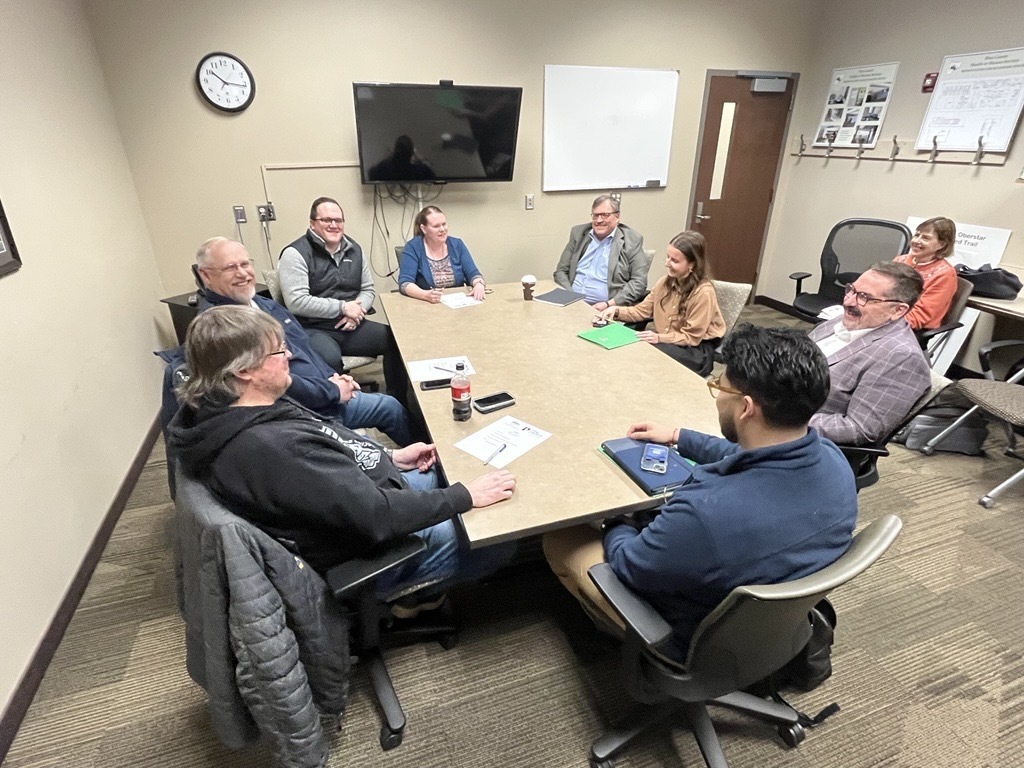 Pine County officials met with OCM staff and Commissioner Thom Petersen of Minnesota Department of Agriculture to discuss cannabis policy and the state’s growing cannabis market.
Lower-potency hemp edible (LPHE) license applications will reopen April 1
On April 1, OCM will begin accepting business license applications for the three lower-potency hemp edible (LPHE) license types: LPHE retailers, LPHE manufacturers, and LPHE wholesalers. Applications will then be accepted and reviewed on an ongoing, rolling basis.
Last October, OCM received more than 2,200 applications from hemp businesses – including more than 2,000 from retailers seeking to continue or begin selling LPHEs in businesses ranging from smoke shops, big box liquor stores, nail salons and event venues. By March 31, all applicants for LPHE licenses from 2025 will receive an approval or denial from OCM. Those who wish to reapply—or apply for the first time—may do so, beginning April 1. Updated resources for LPHE license applicants will be available on OCM’s website on April 1.
“We know there are businesses waiting eagerly for the office to reopen applications for LPHE licenses, whether because their application was denied or they missed the opportunity to apply during last year’s window,” said OCM Executive Director Eric Taubel. “With a federal ban of these products approaching in November—and uncertainty over efforts to delay or overturn that ban—we are offering Minnesota businesses a way to continue to participate in the market in a way that ensures products are safe and businesses are compliant with state law.”
Beginning April 1, all hemp businesses will transition to regulation under chapter 342. Once licensed by OCM, all license holders must adhere to the requirements of statute and rule, including the product testing, labeling, and local registration requirements of licensure. LPHE license holders should review Guidance Memo 2025-03 as well as the resources available on OCM’s website for more information about the transition to licensure.
For more information, check out the press release on this topic.

Governor Walz signs two additional cannabis compacts
On March 9, Governor Walz signed a Tribal-state cannabis compact with the Lower Sioux Indian Community. The following day, Governor Walz signed a Tribal-state cannabis compact with the Shakopee Mdewakanton Sioux Community.
While the specifics of each Tribal-state compact and agreement are unique to each Tribal Nation, each agreement contains the same commitments to safeguard consumer well-being through product testing, data gathering, and analysis, ensuring consistency for customers throughout Minnesota's cannabis market.
With these additional finalized cannabis compacts, the state has completed compacting negotiations with those Tribal Nations who are interested. The state will continue to engage in an ongoing basis with Tribal regulatory partners and Tribal Nations on the issue of cannabis.
Learn more on our Compacts and Cooperative Agreements webpage.
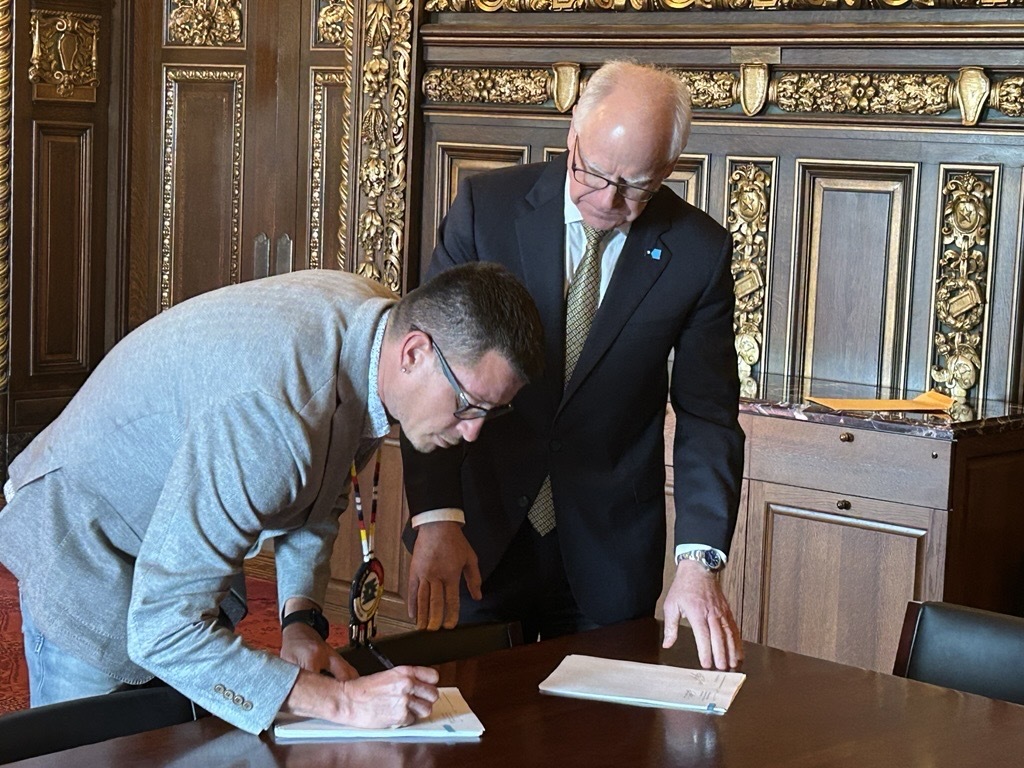 Council President Joseph O’Brien and Governor Tim Walz at the signing of the cannabis compact between the state of Minnesota and the Lower Sioux Indian Community.
Licensing and market update

Minnesota’s cannabis market continues to grow! As of March 30, the number of cannabis licenses OCM has issued is up to 178 (42 of which are licensed for cultivation activities). More than half of the licenses issued to date are social equity classified licenses. In addition, OCM licensed more than 1,600 sites for lower-potency hemp edible (LPHE) retail sales.
|
Certified Medical Cannabis Consultant Training Program approved by OCM

Certified medical cannabis consultants (CMCCs) are specialists trained to provide patients with expert, accurate information about medical cannabis. Their role is to fill a critical gap in the medical system, as traditional professional programs often do not cover this topic in depth.
A cannabis business authorized to sell medical cannabis to registered medical cannabis patients must employ either a pharmacist or a CMCC to have availability for patient consultations. By integrating CMCCs into the medical cannabis market, patient access to reliable advice is significantly improved. This approach expands the network of qualified professionals beyond the limited number of pharmacists, ensuring more patients receive specialized guidance tailored to their specific needs. Ultimately, the use of CMCCs enhances patient care and knowledge.
As OCM approves more training programs, we will provide updates in this newsletter and on our website.
|
[Back to top]
Government Relations Updates
Gov. Walz signs bipartisan bill allowing Minnesota hemp businesses to continue using out-of-state testing facilities through May 2027
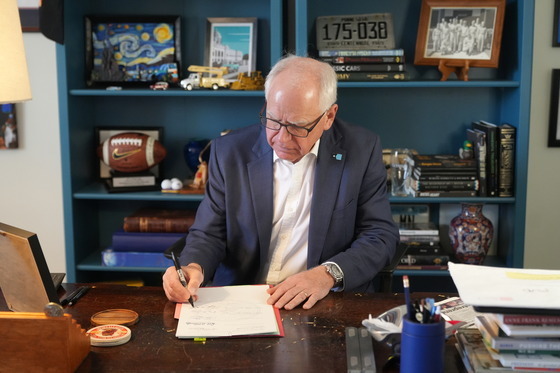
On March 27, Governor Tim Walz signed a bill passed by the Minnesota Legislature allowing businesses manufacturing lower-potency hemp edibles (LPHEs) to continue using out-of-state testing facilities until May 31, 2027, as long as those labs are able to meet criteria established by the Minnesota Office of Cannabis Management (OCM). Championed by legislative partners, Senator Lindsey Port and Representative Jess Hanson, the allowance will immediately relieve the pressure on both the hemp and cannabis supply chains that was created by the limited capacity of the state’s current three licensed testing facilities, allowing businesses to keep up with product demand created by eager customers and new businesses entering the market.
Business leaders in the state’s LPHE industry—which includes low-dose THC edibles and the THC beverages that have become ubiquitous in Minnesota breweries—worked with OCM and state legislators to craft this bipartisan bill. OCM Executive Director Eric Taubel testified in support of the change as it provides immediate relief to licensed LPHE and cannabis businesses who are facing extended wait times for products to be tested.
“Minnesota is not alone – every state has had challenges with lab capacity at launch of their adult-use markets, because of the rush of new businesses preparing to enter the market needing to test new products,” said Taubel. “Cannabis and hemp businesses have been frustrated with this bottleneck in the supply chain, but this bill allows us to build our in-state capacity while hemp businesses continue using out-of-state testing facilities until next year."
Learn more by checking out the press release.
OCM proposals in the Minnesota Legislature
The office has six agency proposals that have been introduced as bills. Earlier this year, OCM published a 2026 Legislative Policy Proposals providing a high-level summary of each of these proposals. These bills are:
-
SF 4403 (Dibble, Port) / HF 4199 (Hanson, J.) - Technical/housekeeping
-
SF 4402 (Dibble, Port) / HF 4200 (Hanson, J.) - Data practice updates and clarifications
-
SF 4540 (Dibble) / HF 4398 (Hanson, J.) - Cannabis business regulatory updates
-
SF 4429 (Port, Klein, Dibble) / HF 4201 (Hanson, J.) - Product labeling and hemp business regulatory updates
-
SF 4519 (Dibble) / HF 4202 (Hanson, J.) - Local control clarifications
-
SF 4401 (Dibble, Port) / HF 4203 (Hanson, J.) - Increased efficiency in legislative reporting
Additionally, the office helped develop two proposals that are not agency bills but have our support:
OCM encourages everyone impacted by Minnesota Statutes, chapter 342 and the cannabis laws in Minnesota to engage in the legislative process. If you have ideas or recommendations about how to improve the law, please contact your local legislators and follow along with the Legislature this session. Please also feel free to contact the office to share your feedback. Session began on Feb. 17 this year and will conclude in May. Your voice is welcome!
 [Back to top]
Resources and Reminders
OCM wants to engage with you!
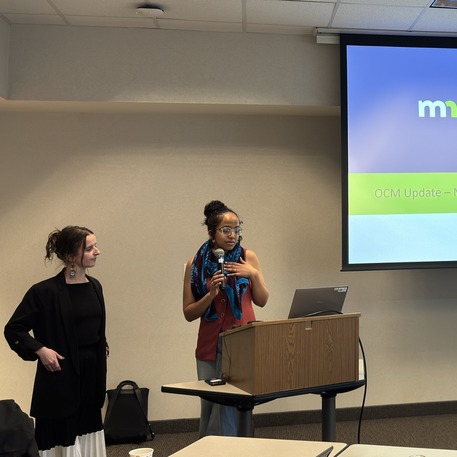
OCM enjoys participating in community events and forums, as well as attending meetings and other opportunities that keep us engaged with our external partners. Our community engagement ranges from general overviews about OCM to subject-specific discussions, like licensing and grants.
Are you interested in engaging with us? Learn more on our engagement request page.
Merone Melekin and Sophie Leininger speaking at an event.
|