For Immediate Release
Media Contact: January 15, 2026
Jim Walker
(651) 387-2430
jim.walker@state.mn.us
Office of Cannabis Management launches
market dashboard
Dashboard and newly released legislative reports provide
insight into market launch activities in 2025 and anticipated market growth in 2026
Today, the Minnesota Office of Cannabis Management (OCM) debuted the Cannabis Market Monitor, a new dashboard that provides the public with monthly statistics about the state’s growing adult-use and existing medical cannabis markets, including aggregate licensing data, monthly and annual retail sales, retail sales by product type, and monthly planting and harvest data.
“We are excited to make this dashboard available, offering Minnesotans a transparent window into the work of the office,” said Executive Director Eric Taubel of the Office of Cannabis Management. “Whether you are interested in understanding the big picture, looking into month-to-month sales by types of products, or projecting the next wave of available products, the data are now available to you.”
The aggregate licensing data paint a detailed picture of the number of businesses engaged in a particular activity. For example, by the close of 2025, the state had licensed four large-scale cultivation businesses. Yet, at that same time there were 24 total businesses authorized to cultivate cannabis, including microbusinesses and mezzobusinesses that cultivate at a smaller scale, and medical cannabis combination businesses that are able to cultivate cannabis flower for both the medical and adult-use markets, subject to size limitations in law.
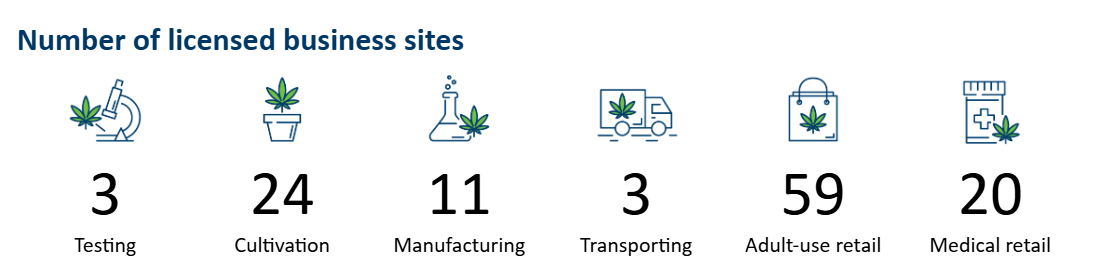 Figure 1: Cannabis Market Monitor breaks down activities at licensed business sites in addition to simply providing licenses by type.
The state issued its first licenses to cannabis businesses last June and the number of licensed businesses steadily grew throughout the year. At the end of 2025, 118 cannabis business licenses were issued in total by OCM. More than half (55%) of those licenses were issued to businesses qualifying as social equity applicants. Further, at the close of the year there were four license types where 100% of the licenses issued were to social equity applicants, including cultivators, manufacturers, mezzobusinesses and retailers.
“Launching an equitable cannabis market isn’t easy, and most states that have tried have come up short,” said Jess Jackson, OCM’s director of social equity. “While we have work to do, the early data suggest that social equity applicants and businesses will play an important role in Minnesota’s market.”
In addition to licensing data, Cannabis Market Monitor also offers a big-picture view of Minnesota’s cannabis market overall, with the following highlights:
- During the past 12 months, the state experienced $122.5 million in overall combined sales of adult-use and medical cannabis across more than 1.2 million total transactions.
-
Since the launch of adult-use sales at state-licensed retailers in September, there have been approximately $31.1 million in sales of adult-use products and $31.7 million in sales of medical cannabis products.
-
The median price of cannabis flower per gram over the past 12 months was $9.17 per gram for medical cannabis and $13.54 per gram for adult-use cannabis.
-
Breaking down the data by product type shows that cannabis flower was most popular during this period, followed by concentrates (used for vaping), then by preroll cannabis cigarettes, and finally, edibles. This distribution is likely a result of limited availability of non-flower products early in the market launch and may change over time.
-
Consumers’ changing preferences for different types of cannabis products can be seen over the past four years.
-
Note that the dashboard is not used to calculate approximate tax revenue generated from the cannabis taxes or the total amount of intoxicating-cannabinoid products sold in Minnesota. The Minnesota Department of Revenue tracks information on the cannabis tax, sales and use tax, and other state taxes.
“If 2025 was about launching the market, 2026 will be about market growth across the state,” continued Taubel. “We are well on our way to building an equitable cannabis industry that prioritizes public health and safety, consumer confidence, and market integrity.”
Finally, Cannabis Market Monitor offers a look at planting and harvest data from state-licensed cultivators. As of the end of 2025, the number of living plants in the state’s seed-to-sale tracking system totaled nearly 66,000. The number of cannabis plants planted by month is also available, showing initial capacity building with the state’s first licensed cultivation activities beginning in June, and production increasing as more cultivators received licenses throughout the fall and into winter. These data may offer insight into when additional products may be on their way to market.
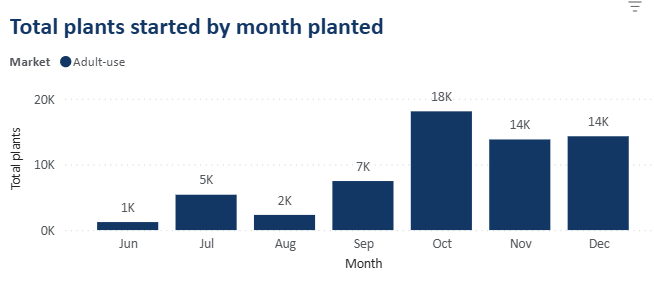 Figure 2: Cannabis Market Monitor also provides planting and harvesting data.
The Office of Cannabis Management also posted its annual reports to the Legislature to its website today. The reports offer insight into the office’s work this last year to launch the application and licensing process for cannabis businesses, transition the existing medical cannabis program and hemp-derived cannabinoid industry to the licensing framework, and establish grant programs designed to support farming businesses and community reinvestment.
###
Having trouble viewing this email? View it as a webpage.
|