|
Having trouble viewing this email? View it as a webpage.
November 25, 2025
In this issue:
News and Updates
Government Relations Updates
Resources and Reminders
News and Updates
Licensed cannabis businesses continue to grow
The number of licensed cannabis businesses continues to grow as preliminarily approved applicants work to complete all license requirements.
Here are some facts* about licensing, by the numbers!
- 3,540 – Cannabis license applications received
- 91 – Licensed cannabis businesses overall
- 51 – Licensed businesses that are social equity classified (57% of all licensed businesses)
- 74 – Licensed microbusinesses (15 are initially focused on cultivation)
- 3 – Licensed testing facilities**
- 2 – Licensed wholesalers
- 3 – Licensed transporters
- 30 – Transporter license applicants in the final stage of licensing
- 3 – Licensed cultivators
- 2 – Licensed mezzobusinesses
- 2 – Licensed retailers
- 5 – Tribal Nations with signed Tribal-state compacts***
- 1,418 – Preliminarily approved applicants in the final stage of licensing
- 2,222 – Applications received for lower-potency hemp edible licenses
OCM will continue to issue licenses to businesses who are ready with their final locations and documentation to move forward in the licensing process. Visit our Summary Application Data webpage for the latest numbers!
* Figures are as-of Nov. 25, 2025
** Do you need testing facility services? Find testing facility contact info.
*** Looking to connect with a compacted Tribal Nation? Visit our Tribal Nations webpage.
Federal ban on hemp products
Earlier this month, the president signed a spending package ending the 42-day federal government shutdown. A provision within that package would effectively ban hemp products containing more than 0.4 milligrams of THC – including lower-potency hemp edibles (LPHE) such as gummies and seltzers. The ban on hemp products won’t be implemented for a year, but the potential impacts on Minnesota’s hemp-derived THC industry could be significant.
In the weeks since the bill’s passage, there has been a great deal of discussion about the ban, and how it will impact Minnesota businesses who are currently operating within the state’s regulatory framework. With approximately 11 months remaining before the ban takes effect, it is possible that the federal government will issue guidance for states who have implemented programs to safely regulate the sale and manufacture of hemp-derived products.
In the meantime, OCM is proceeding with implementation of Minnesota Statutes, chapter 342, including issuing licenses for the sale and manufacture of lower-potency hemp edibles. The office continues to have discussions with the Minnesota Legislature and members of the hemp industry to chart a path forward for the thousands of hemp businesses in Minnesota and those who rely on them to purchase the products that they enjoy.

CanRenew grant application open until January 12
OCM is accepting applications for the next round of funding for the CanRenew community restoration grant program, designed to help communities affected by cannabis prohibition. The application window runs through January 12, 2026, at 4:30 p.m. CST.
The $10.9 million CanRenew program, established in the 2023 cannabis bill, invests in communities disproportionately impacted by cannabis prohibition, fostering development, safety, and stability. By funding projects focused on economic development, social determinants of health, violence prevention, civil labor aid, and youth engagement, CanRenew supports organizations making a meaningful impact in community renewal. CanRenew grant funds are not intended to support cannabis business operations and cannot be used on revenue-generating projects. “During the first round of funding, 150 organizations applied for grants, requesting more than $22 million to fund important community programs,” said Jess Jackson, OCM’s director of social equity. “At a time of increasing need and tightening budgets, CanRenew funding has the opportunity to make a difference where it matters most. We are proud to provide financial support to communities to help mitigate the long-lasting effects of cannabis prohibition.”
During the last opportunity to apply for CanRenew, the program awarded $1 million to eligible organizations throughout the state. Information about grantees selected in the last round are available on OCM’s CanRenew webpage. This round, CanRenew grant awards are expected to range from $2,500 to $2,000,000 depending on the tier level for which they are applied.
For more information on CanRenew and CanGrow grant opportunities and how to apply, please visit the Minnesota Office of Cannabis Management website.
Individuals interested in learning more about the RFP and how to apply are encouraged to attend one of OCM's informational and technical sessions. Register using the links below:

Governor Walz signs Tribal-state cannabis compacts
In October, Governor Walz signed three Tribal-state cannabis compacts with Prairie Island Indian Community, Fond du Lac Band of Lake Superior Chippewa, and Leech Lake Band of Ojibwe. In establishing Minnesota’s cannabis law, the state Legislature directed the governor to negotiate intergovernmental agreements—cannabis compacts—with Tribal Nations sharing territory with Minnesota to strengthen public health and safety, secure an equitable and well-regulated cannabis market, and provide financial benefits to both the state and Tribal Nations.
Although the specifics of each Tribal-state compact are unique to each Tribal Nation, all of them contain the same commitments to put public health and safety first through product testing, data gathering and analysis, ensuring consistency for customers throughout Minnesota's cannabis market. Each of the compacts contains provisions that create opportunities for Tribal Nations to partner with state-licensed businesses to sell Tribally grown cannabis products at wholesale into the state market.
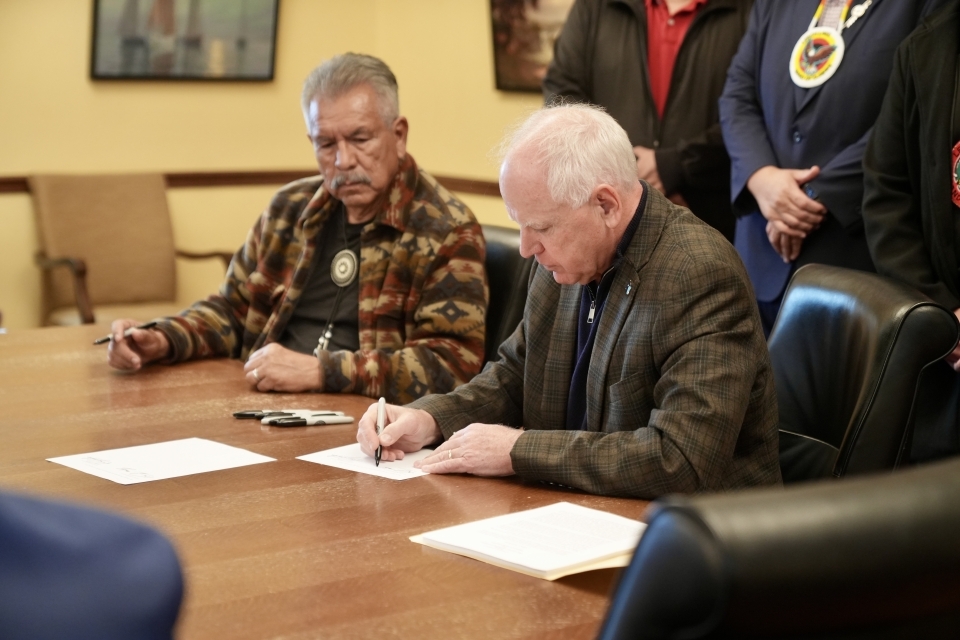 Governor Walz and Leech Lake Band Chairman Faron Jackson sign cannabis compact.
Final call: submit your curriculum for the medical cannabis consultant training program

Are you an organization or individual with expertise in medical cannabis education? OCM invites you to submit a curriculum for approval to become an official training provider for certified medical cannabis consultants (CMCCs).
Why this opportunity matters
All medical cannabis retailers in Minnesota must employ either a Minnesota-licensed pharmacist or a certified medical cannabis consultant (CMCC).
OCM is responsible for the CMCC program, and all CMCCs must complete an OCM-approved training program before they can work in retail settings.
By becoming a training provider, you help:
-
Address the critical gap in traditional education by training specialists.
-
Significantly improve patient access to reliable medical cannabis advice.
-
Enhance patient care by expanding the network of qualified professionals beyond pharmacists.
The submission process is open to anyone who can meet the necessary requirements – it is not limited to license holders or traditional educational institutions. This is your chance to play a foundational role in upholding the highest standards of public health and safety in Minnesota's evolving cannabis industry.
Ready to help set the standard for medical cannabis education in Minnesota?
Submit your training program curricula for the CMCC program by Monday, December 1, using the submission form.
For questions about this program, please contact us.
|
Become a grant reviewer!

Community members, subject matter experts, and advocates are invited to join our competitive grantmaking process at OCM as reviewers. By participating, you’ll help ensure fairness, transparency, and diversity in how grants are awarded. This opportunity also allows you to expand your skills and provide valuable feedback to improve OCM’s future grant processes. Grant reviewers will review the grant programs housed within the Division of Social Equity at OCM, CanRenew, and CanGrow.
|
[Back to top]
Revisor updates to chapter 342

The Office of the Revisor at the Minnesota State Legislature has updated Minnesota Statutes, chapter 342 on their website to reflect the changes made to the cannabis law as passed by the Legislature in the 2025 legislative session. Please reference this link to find the most up-to-date statutory language. OCM has also posted a summary of the legislative changes from the 2025 session on our website: Summary of Cannabis Policy Changes 2025.
|
[Back to top]
Resources and Reminders
Study on the effects of cannabis on sleep in cancer patients
On October 21, a study was published by the National Library of Medicine on the effects of tetrahydrocannabinol (THC) and cannabidiol (CBD) on sleep in cancer patients. One of the coauthors of the study is OCM’s own Susan Park, who serves as an informatician within the data and analytics division.
This study examined associations between cannabis use patterns and disturbed sleep severity in adult cancer patients in the Minnesota Medical Cannabis Program.
Using anonymized data collected from the program's patient self-evaluations (which until changes were made by the Legislature this year, were required prior to each medical cannabis purchase), researchers examined patients' disturbed sleep scores over time and compared them to their baseline scores. Patients rated disturbed sleep severity on a 0-10 numerical scale (ranging from “no disturbed sleep” to “severe disturbed sleep”), and the patients' average scores within the first three months of participation were analyzed and compared to baseline.
Results indicated that cancer patients falling into the highest CBD dosage group (using greater than 14.32 milligrams per day on average) were more likely to achieve greater improvements in sleep disturbances than those using less CBD on average per day. Whether those improvements would be considered clinically meaningful, however, is not fully understood. Some caution should also be taken in the interpretation of the results, given that patient dosage calculations were based on what they purchased versus what they actually consumed.

Participate in University of Minnesota cannabis study on chronic pain

The University of Minnesota is looking for research participants for a study on the neurobehavioral impacts of medical cannabis treatment in chronic pain patients. The study is analyzing the effects of medical cannabis on cognition and MRI-based brain function. Participants can expect the study to last four months, involving two in-person visits. Interested? Learn more about the qualifications and fill out this survey to be considered.
|
|