|
Having trouble viewing this email? View it as a webpage.
October 6, 2025
In this issue:
News and Updates
Government Relations Updates
Resources and Reminders
News and Updates
Lower-potency hemp edible (LPHE) license application window now open
OCM is accepting business license applications for lower-potency hemp edible retailers, lower-potency hemp edible manufacturers, and lower-potency hemp edible wholesalers until Oct. 31 at noon CDT. Under Minnesota Statutes, chapter 342, a business is required to apply for and obtain an LPHE license to continue selling lower-potency hemp edible products in Minnesota. All hemp registrants that do not apply for an LPHE business license in this window must cease all sales of LPHEs on Oct. 31. LPHE licensing resources are available on our General Licensing Process webpage.
OCM will hold a webinar, Navigating Lower-Potency Hemp Edible Licenses, on Tuesday, Oct. 7, from noon to 1 p.m. CDT. If you would like to attend, please register on Microsoft Teams.
More than 50 cannabis business licenses issued, including second capped cultivator license
As preliminarily approved license applicants continue to complete their final plans of record and secure approvals with local units of government, OCM continues to issue licenses to businesses who are ready to move forward in the licensing process. Of the license types that are not limited in number under statute, OCM has issued 51 cannabis business licenses, including 46 microbusinesses (12 of them have cultivation endorsements), two testing facilities, two medical combination businesses, and one event planner (as of October 6). For the license types limited in number under statute, OCM has issued three licenses, including two cultivators and one mezzobusiness.

Newly licensed testing facilities establish critical safeguards for cannabis products
On September 10, OCM issued the first license to a testing facility, ChRi Laboratories in St. Paul. A week later, Legend Technical Services in St. Paul became the second licensed testing facility in the state. The licensing of labs establishes a pathway for new cannabis products to be tested for contaminants like pesticides, microbes, heavy metals, toxins, and residual solvents. For details about licensed testing facilities—including contact information and, if applicable, the tests they are currently authorized to conduct—visit our Licensed Testing Facilities webpage.
Additional testing facilities are expected to receive licenses soon, which will create additional lab capacity for testing as businesses expand the products available to customers.

Adult-use cannabis sales expanding across Minnesota

Retail sales of legal, adult-use cannabis products are underway across Minnesota thanks to several recent developments in the state’s work to launch the adult-use cannabis market. Customers looking to purchase legal cannabis in Minnesota have more options available to them today, as regulated products become available through a complex supply chain that is taking shape.
“We’re at a point where critical work streams have come together, allowing state-licensed retailers to begin selling adult-use cannabis products to customers,” said OCM Executive Director Eric Taubel. “We’ve seen immediate interest from state-licensed businesses to work with Tribal Nations to carry Tribally grown products on their shelves as they open their doors to eager customers.”
|
Governor Walz signs second Tribal-state cannabis compact with Mille Lacs Band of Ojibwe
On Sept. 10, Governor Tim Walz signed the second Tribal-state compact authorized under state statute. The agreement outlines how the state of Minnesota and the Mille Lacs Band of Ojibwe will promote a cooperative and mutually beneficial relationship to regulate cannabis and promote public health and safety.
In establishing Minnesota’s cannabis law, the state Legislature directed the governor to negotiate intergovernmental agreements—cannabis compacts—with Tribal Nations sharing territory with Minnesota to enhance public health and safety, ensure a lawful and well-regulated cannabis market, encourage economic development, and provide financial benefits to both the state and Tribal Nations.
“This is an exciting development in the rollout of Minnesota’s adult-use cannabis market,” said OCM Executive Director Eric Taubel. “The many newly licensed businesses preparing to open their doors to adult-use customers are eager to partner with Mille Lacs. This compact will open up unique opportunities that benefit the state, Mille Lacs, state-licensed businesses, and Minnesota cannabis consumers. We look forward to seeing these unique and innovative partnerships develop and flourish across the state.”
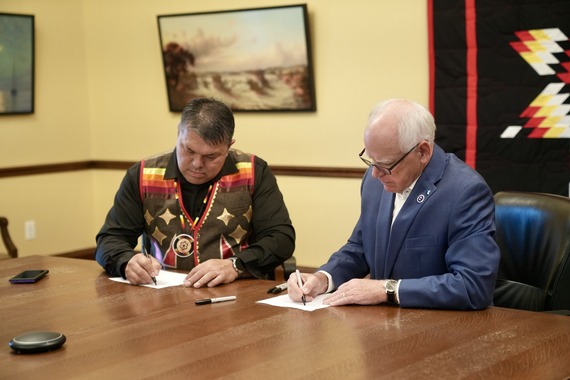 Chief Executive Virgil Wind of the Mille Lacs Band of Ojibwe and Governor Tim Walz sign a Tribal-state cannabis compact on Sept. 10, 2025
Medical cannabis consultation certification curriculum submission

OCM is asking organizations to submit their curriculum for the medical cannabis consultation certification program! OCM is tasked with developing and maintaining the certified medical cannabis consultant (CMCC) program. CMCCs will work to provide medical cannabis consultations to registered medical cannabis patients, as experts on medical cannabis. A cannabis business authorized to sell medical cannabis to registered medical cannabis patients must employ either a pharmacist or a CMCC to have availability for patient consultations. In developing this program, OCM must approve training programs for CMCCs. To learn more, please review the Certified Medical Cannabis Consultant: Training Program Submission Guidance, which outlines OCM’s requirements for CMCC training program curricula.
OCM will accept submissions of training program curriculum for the CMCC program from Monday, November 3, 2025, to Monday, December 1, 2025. Visit the Medical Cannabis Consultant Training Programs webpage for more information.
|
[Back to top]
Developing a legislative proposal: streamlining the supply chain

In the 2025 legislative session (Laws of Minnesota, chapter 31, section 107), OCM was tasked with developing a proposal to unify the supply chain for medical and adult-use cannabis by the Legislature. The proposal must address adult-use cannabis and medical cannabis to allow for the cultivation, manufacturing, storage, and use of equipment in a manner that promotes efficiency, permits co-location, and authorizes the use of equipment for multiple purposes. The proposal must preserve access to medical cannabis for rare and childhood diseases. OCM is committed to developing a proposal that centers the office’s mission while protecting medical patients’ access to product.
As OCM develops this proposal, OCM is committed to engaging with interested members of the public to ensure this proposal maintains OCM’s principles of a safe, equitable market with high consumer confidence. OCM has begun to meet with interested parties and will continue to hold meetings as this proposal works its way through the development process.
|
[Back to top]
Resources and Reminders
Metrc Q&A town hall
OCM contracted with Metrc to develop and administer a digital tracking infrastructure, which traces cannabis products starting from cultivation through processing, testing, distribution and sale. To help cannabis business owners navigate Metrc, the company is hosting a virtual town hall Q&A session on Tuesday, October 7 at 3 p.m. CDT. During this session, Metrc and OCM representatives will be available to answer pre-submitted questions from cannabis business owners and discuss available resources. To attend, please register in advance. Submit questions for this event through the question submission form.
CanRenew community restoration grant
The next opportunity to apply for CanRenew funds will come later this year in advance of fiscal year 2027, when funding for grantees increases to $10 million annually. CanRenew community restoration grants support eligible organizations that make investments in communities disproportionately affected by the enforcement of cannabis laws, identified as communities where residents are eligible to be social equity applicants. Learn more about this grant program by visiting the CanRenew webpage.
Minnesota Department of Health (MDH) launches ‘Be Cannabis Aware’ Campaign
MDH launched the “Be Cannabis Aware” campaign on Sept. 25, which provides cannabis facts, tips and tools for conversations with youth and young adults. The goal of this campaign is to build awareness among youth in Minnesota about the risks of using cannabis. Minnesotans must be 21 years of age or older in order to purchase or consume adult-use cannabis. The Be Cannabis Aware website offers helpful resources for youth and mentors alike.

Cannabis event licensing
OCM is accepting applications for cannabis event organizer licenses and cannabis testing facility licenses on an ongoing, rolling basis. The first licensed cannabis event took place on Sept. 27. OCM had a booth at this event and enjoyed talking with the public about what the office does.
Learn more about the Cannabis Event Organizer license by visiting our General Licensing Process webpage.
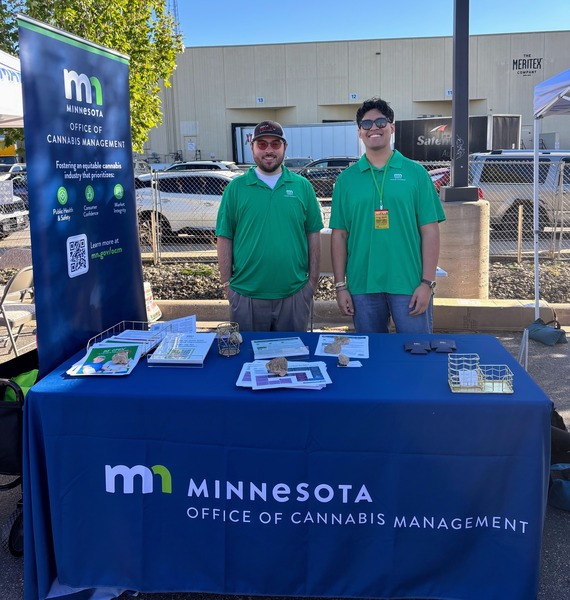 Ben and Ruben at OCM booth at Legacy Cup, on Sept. 27.
Dual-Training Pipeline Legal Cannabis Fall Industry Forum
The Minnesota Department of Labor and Industry is hosting a virtual Minnesota Dual-Training Pipeline Legal Cannabis Fall Industry Forum on Oct. 22 from 1-2 p.m. CDT on Microsoft Teams.
The industry forum is a great opportunity to learn about Minnesota Dual-Training, network with others in the industry, get updates on the program, discuss potential new occupations and the refresh of current occupation competency models, and more!
If you have any questions prior to the industry forum, email pipeline.program@state.mn.us.
|