|
Having trouble viewing this email? View it as a webpage.
September 22, 2025
Welcome!
As the Minnesota cannabis industry continues to develop, we strive to provide you with the information you need to succeed and to be a partner for your business. We’ve added qualified and preliminarily approved applicants to our distribution list for this newsletter, which contains important guidance and information from OCM’s compliance and enforcement team.
Lower-Potency Hemp Edible (LPHE) License Application Window Opening in October
OCM will accept business license applications for lower-potency hemp edible retailers, lower-potency hemp edible manufacturers, and lower-potency hemp edible wholesalers from Oct. 1 at 8 a.m. CDT to Oct. 31 at noon CDT. LPHE licensing resources are available on our General Licensing Process webpage.
OCM will also be holding a webinar, Navigating Lower-Potency Hemp Edible Licenses, on Tuesday, Oct. 7, from noon to 1 p.m. CDT. If you would like to attend, please .
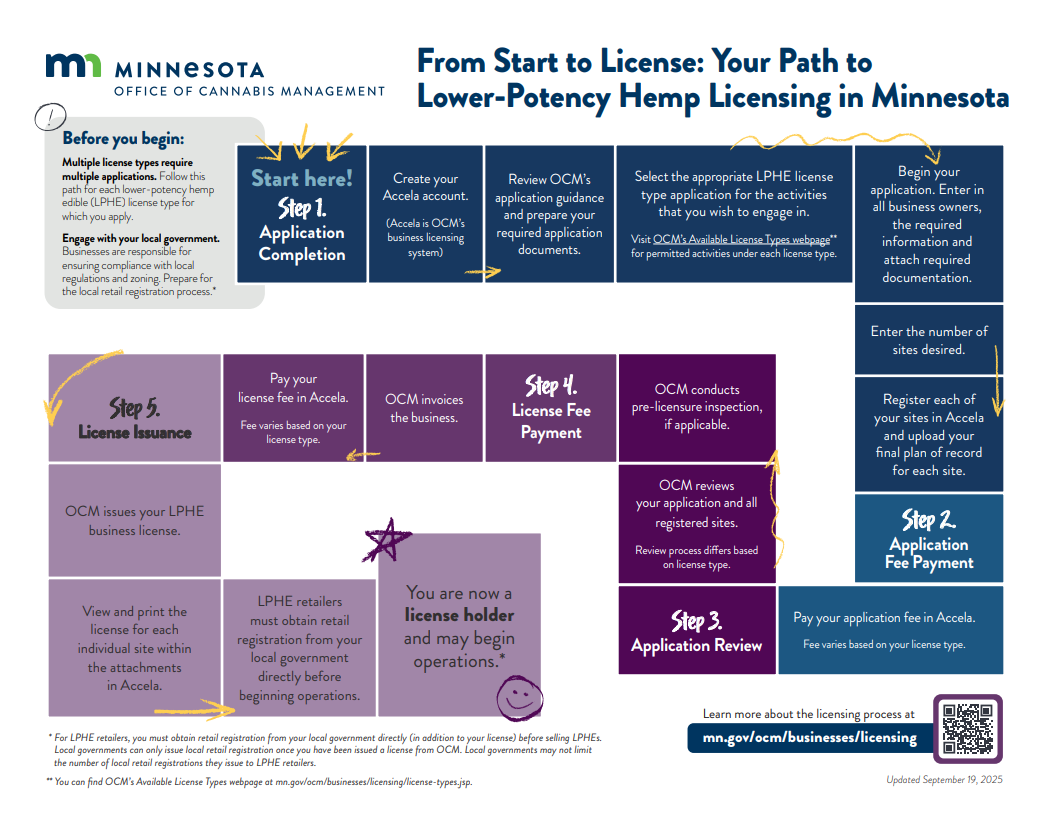 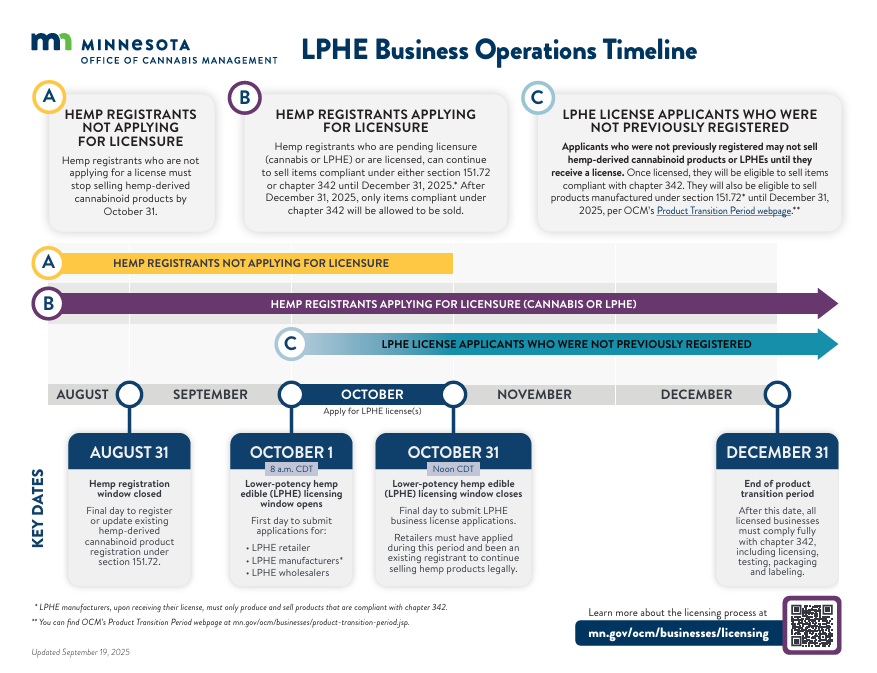 Select image to access PDF
Retail Registration and Working with Local Governments - Cannabis Business Licenses
As allowed in state law, many cities and counties have established a cap on the number of retail registrations available in their jurisdiction. This means that not all retail applicants interested in a specific jurisdiction will be able to operate in that location, even if they qualify for state licensure. OCM is committed to inspecting all qualified applicants for licensure. However, if a retail registration is not also granted, a business is prohibited from conducting retail sales (Minnesota Statutes, section 342.22). Local governments manage and direct the local retail registration process. OCM continues to strongly recommend applicants work directly with local governments regarding the availability of retail registrations prior to making any business decisions that may lead to an irreversible loss should they not be able to secure a retail registration.
-
If you do not obtain a retail registration, and would like to find a new location before completing licensure, you may cancel your initial site registration while retaining your preliminary approval status. You can then submit a new site registration when you are ready. Important reminder: You have 18 months from time of receiving your preliminary approval status to complete the final steps of licensure.
-
If you do not obtain a retail registration but have already received a license at your initial site, then you may relocate your licensed business per the procedures in Minnesota Statutes, section 342.12 and proceed with a new site registration in the new locality under your existing license, pending new review.
In accordance with Minnesota Statutes, section 342.13(h), local governments may limit the availability of local retail registrations for cannabis retailers, cannabis microbusinesses with retail endorsements, and cannabis mezzobusinesses with retail endorsements.

OCM is now accepting cannabis event organizer license applications. Event organizers who intend to host adult-use cannabis product retail sales must work with cannabis retailers that have been licensed under Minnesota Statutes, section 342. Hemp-related events (offering only products compliant with Minnesota Statutes, section 151.72) are still allowed without a cannabis event organizer license. However, it is the hemp event organizer’s responsibility to ensure that the event remains in compliance with regulations under state law and no cannabis products are being sold. Please visit OCM’s website for more information, including an event checklist outlining requirements for compliance.
[Back to top]
Applicants: Be Ready to Operate within 90 Days of Site Registration and Submitting Final Plans of Record
-
If a license applicant has received preliminary license approval and has submitted a site registration, OCM has a statutory requirement to act on that application within 90 days of receiving final plans of record and site registration in Minnesota Statutes, section 342.14.
- OCM must have complete information to confirm that a business is ready to operate and maintain full compliance with cannabis regulations.
-
If OCM cannot proceed with an application, the site registration will be closed out. This does not mean that a license application is denied.
-
An applicant has 18 months from the date they received preliminary approval to obtain final license approval.
-
An applicant can resubmit a site registration to start the 90-day window again.
-
When submitting (or resubmitting) a site registration, it is important that a business has met all local requirements and is ready to operate immediately, or the local government might not be able to confirm compliance, potentially causing a delay in license approval.
 |
[Back to top]
Cannabis Posting Tax Delinquency List
The Cannabis Posting Tax Delinquency List is a public list of businesses subject to cannabis tax and are 10 or more days late in filing or paying one of these taxes and fees: sales tax, cannabis tax, withholding tax, corporate income tax, S corporation tax or partnership minimum fees.
The Minnesota Department of Revenue (DOR) will notify you at least 10 days before you are placed on the list (Minnesota Statutes, section 270C.726). Read on to understand the differences and responsibilities between a business on the list or not on the list along with some frequently asked questions.
A business on the list: applicable to any business selling taxable cannabis or hemp products
✅ Can continue to operate by selling current product inventory only.
🚫 Cannot purchase any additional product for resale.
|
PRODUCT
|
SUBJECT TO SALES TAX
|
SUBJECT TO
CANNABIS TAX
|
|
Cannabis-derived and hemp-derived products
|
Yes
|
Yes
|
|
Delivery charges
|
Yes, when the product is subject to sales tax
|
Yes, when the product is subject to sales tax
|
|
Mandatory service charges, including credit cards surcharges
|
Yes, when the product is subject to sales tax
|
Yes, when the product is subject to sales tax
|
|
Cannabis accessories, including vape related equipment and pipes
|
Yes
|
No
|
|
Growing equipment and supplies, including seeds
|
Yes
|
No
|
|
Nonintoxicating topical products
|
Yes
|
No
|
|
Cannabis plants
|
Yes
|
No
|
Q: If a business is not yet licensed under Minnesota Statutes, section 342, are they exempt from this provision?
Q: Are wholesalers currently selling hemp derived cannabinoid products subject to the posting requirement?
A: Yes, any business currently selling taxable hemp or cannabis products are subject to the posting requirement.
Q: Does the posting requirement apply to out-of-state hemp businesses?
A: Yes, more information on import and export requirements will be made available as more businesses become licensed under Minnesota Statutes, section 342.
To be removed from the Cannabis Posting Tax Delinquency List, you must pay your tax liability in full using secured funds. For more information, reference the DOR website resources below.
If you have additional questions about the Cannabis Posting Tax Delinquency List or if you need help paying your cannabis taxes, you can contact the Department of Revenue by submitting an inquiry through the Cannabis Tax Assistance Form.

Cannabis and Pesticides
Since pesticides are regulated by the Environmental Protection Agency (EPA) and cannabis is still considered federally illegal to grow, the EPA has not approved any pesticide for application to cannabis crops. Therefore, the table of pesticides listed on page 9 of OCM's Cannabis Technical Authority: Standards for Sampling and Testing Cannabis Products does not constitute a list of compounds approved for application to cannabis or hemp plants. The table lists compounds for which cannabis will be tested. It includes both high risk compounds and compounds that might be suitable for use on cannabis and/or hemp.
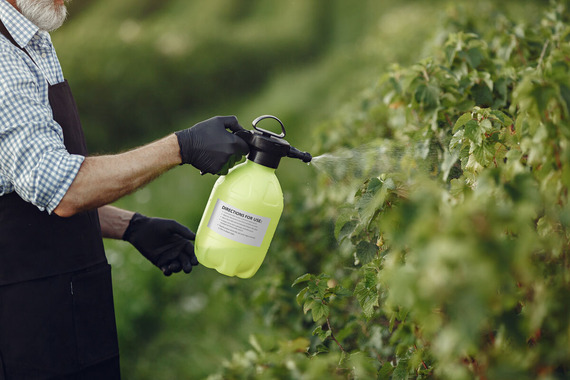
Prior to applying a pesticide to a hemp or cannabis crop, read and understand the information on the label. Refer to the label’s DIRECTIONS FOR USE section to determine if it is appropriate for your intended application. Here you will find information on both proper applications and prohibitions. Pay close attention to the prohibitions contained on a product label. These can include statements regarding weather conditions, plant growth stage, non-target organisms, etc. It is important to know that pesticide applications in the United States are regulated under the Federal Insecticide, Fungicide and Rodenticide Act. Therefore, a violation of any statement on a pesticide label is a violation of federal law. The Minnesota Department of Agriculture is authorized to regulate pesticide use in Minnesota.
|