|
Note from the Director
Fall 2025
Happy fall to everyone reading this and we hope everyone had a happy recovery month! For the Office of Addiction and Recovery (OAR) fall is one of our favorite times of the year. The weather turns cooler. Kids are back to school. The football season is in full swing. And during Recovery Month in September people in recovery, across the state, celebrated the countless gifts our recovery has brought us.
At the state of Minnesota we celebrated in multiple ways - with a proclamation from Governor Walz and lighting up the 35W Bridge purple, by attending the annual Walk for Recovery at the Capitol, by launching new public awareness campaigns, and by having the State of Minnesota be the first state nationally recognized as a Recovery Friendly Workplace.
OAR also brought on two new members, with Nathaniel Dyess joining as the new Policy Director and Ashley Wolf coming on board as a Recovery Corps Volunteer. We are thrilled by these two new additions to the team and excited for the work ahead with them.
The last few months were also full of important events and capstones. In addition to Recovery Month celebrations, OAR attended overdose awareness events in Hastings and Mankato, partnered with the Minnesota Medical Association on a webinar on medicines for opioid use disorder in jails, and helped plan and presented at the 2025 American Indian Substance Use Disorder Summit at Lower Sioux. September also brought to a close the medicines for opioid use disorder in jails workgroup, co-chaired by the Minnesota Sheriff’s Association and Minnesota Medical Association, which issued the groups final report this month.
|
|
News and Updates
 Amazing turnout at the annual Walk for Recovery.
|
|
Recovery Month
OAR participated in multiple events for national recovery month including presenting a webinar for all state employees about recovery and tabling at the annual walk for recovery.
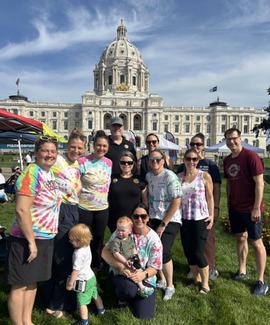 The Office of Addiction and Recovery was joined by Department of Corrections staff at the Walk. The Minnesota Department of Health also had table where they shared recovery and harm reduction resources.
2025 American Indian SUD Summit
OAR supported the American Indian Advisory Council in planning and producing the 2025 American Indian SUD summit hosted by Lower Sioux in Morton, MN. The summit consisted of a Tribal and urban native leaders panel, breakout sessions on key issues like harm reduction, traditional healing, and others. OAR Director Jeremy Drucker spoke about the progress made from the 2023 summit, the current state of SUD in Minnesota, and helped facilitate a conversation about where the community saw the work heading moving forward.
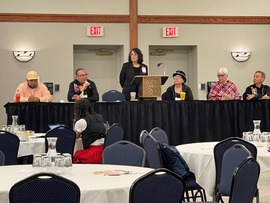 Carl White, Tom Barrett, Christine Renville, Pam Hughes, Betty Poitra, and Rich Latterner participated in the American Indian Advisory Council (AIAC) panel.
Public Engagement
In addition to the Recovery Month events and American Indian SUD summit, OAR also participated in many other public engagement events including overdose awareness gatherings in Hastings and Mankato and participating in the annual State of Reform conference as a panelist discussing behavioral health services for incarcerated individuals.
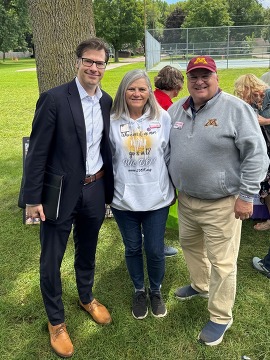 OAR Director Drucker and Fentanyl Free Communities leaders Michelle Hein and John Quincy at Overdose Awareness Day in Mankato.
|
State of Minnesota Certified as Recovery Friendly Workplace
In September, the State of Minnesota as an employer was the first state government to be nationally certified as a recovery friendly workplace (RFW). This certification followed an executive order issued by Governor Walz in October of 2024 directing the state to become recovery friendly. Recovery friendly workplaces support their communities by recognizing recovery from substance use disorder as a strength and by being willing to work intentionally with people in recovery. RFWs encourage a healthy and safe environment where employers, employees, and communities can collaborate to create positive change and eliminate barriers for those impacted by addiction.
The Office of Addiction and Recovery along with the Minnesota Department of Health and the Minnesota Safety Council are currently convening a steering committee to develop a Minnesota focused statewide Recovery Friendly Workplace.
 MOUD in Jails
Thousands of individuals pass through Minnesota’s jails every year, many of whom have an opioid use disorder (OUD). Without sufficient treatment during and after incarceration, hundreds die after release each year, and public safety is negatively impacted. The MOUD in Jails Workgroup brought together partners across healthcare and criminal justice sectors in Minnesota to develop recommendations that improve treatment during and after incarceration in jail. The workgroup issued its final report in September with recommendations for increasing access.
The recommendations are designed to not just stand alone but also complement and enhance other key strategies across Minnesota to improve outcomes for individuals involved in the criminal justice system and their communities. These recommendations are intended to inform ongoing discussions around the Department of Corrections 2911 Rulemaking, the Department
of Human Services 1115 Reentry Waiver, state and county decisions around opioid settlement funds, and other public discussions related to reducing opioid overdoses in Minnesota.
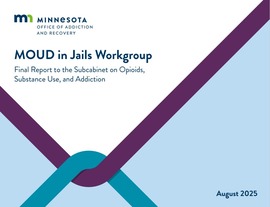 Click on the report image to view a PDF online.
Task Force on Holistic and Effective Responses to Illicit Drug Use
This legislatively created task force administered by the Office of Addiction and Recovery issued their final report to the legislature in September. The charge of the task force was to review and prioritize recommendations from a previous legislative report on effective responses to illicit drug use. The Task Force consisted of law enforcement, public health practitioners, county attorneys, and others.
The revised Task Force on Holistic and Effective Responses to Illicit Drug Use - Legislative Report can be found at the Minnesota Legislative Reference Library and on the Task Force webpage.
Drug policing recommendations identified by Rise Research are included in their report, Evidence-Based Approaches to Drug Policy: A Road Map for Minnesota.
|
|
Strategies
The Office of Addiction and Recovery works across state and local governments to coordinate and align efforts, and better target the state's role in addressing addiction, treatment, and recovery. The office conducts robust public engagement to build relationships with communities to ensure people with direct experience identify key priorities to meet the needs of their communities.
Healthy Beginnings. Child Care and Early Education. Mental Health and Well-being. Housing Stability.
|
|
|
|