|
April 2025
The last few months at the Office of Addiction and Recovery (OAR) have been eventful, to be sure. The legislative session is in full swing and OAR policy bills are advancing, key initiatives like the 1115 Reentry Waiver and Recovery Friendly Workplaces continue to move forward, and we are seeing that overdose deaths in 2024 are likely to decline significantly. Mixed in with this good news are some very troubling developments at the federal level that threaten to upend the progress we are making here in Minnesota.
Last week the federal government abruptly announced the immediate cancellation of $226 million in federal funds to the Minnesota Department of Health (MDH) and an additional $27 million in behavioral health related funding to the Department of Human Services (DHS). The suddenness of these pullbacks forced the agencies to issue immediate stop work orders to hundreds of grantees doing important work across Minnesota. Programs impacted include children’s behavioral health grants, drug prevention programs in schools, naloxone procurement and distribution, critical treatment and recovery programs for vulnerable populations, and much more.
Additionally, earlier this month the US House of Representatives passed a budget resolution that could result in $880 billion in cuts to Medicaid over 10 years. While specific proposals are yet to be unveiled cuts of this magnitude would result in $1.6 billion less per year to Minnesota, putting at risk this vital health care program serving 1.3 million Minnesotans, including many experiencing substance use disorder. Medicaid pays for half of all substance disorder treatment services in the state, making it the largest payer of mental health services. Without full federal participation in the Medicaid program, Minnesota will be forced to make very difficult decisions that could affect the health and wellbeing of over a million of our fellow residents. On top of this the federal government also announced that it was slashing the workforce of the Substance Abuse and Mental Health Administration (SAMSHA) by 50% and initiating massive layoffs in other key governmental agencies that play a role in addressing substance use and misuse.
MDH is projecting that when 2024 overdose fatality numbers are finalized Minnesota will see around a 37% reduction in deaths compared to the peak in 2022. These reductions were achieved by the collective efforts of state, federal, local, community, and Tribal partnerships. They were also the result of a strong bipartisan consensus and collaboration between the state and lawmakers from both sides of the aisle. The cuts being made and those being contemplated by the federal government, just as we are getting our arms around the opioid and overdose crisis, will have significant consequences on our ability to keep people alive and provide the onramps to recovery that will benefit every community across Minnesota.
|
|
The Police-Assisted Addiction and Recovery Initiative (PAARI) National Award
The Police-Assisted Addiction and Recovery Initiative (PAARI) provides essential training, strategic guidance, support, and resources to help law enforcement agencies nationwide develop and implement Law Enforcement Deflection and diversion programs. During the 9th annual Leadership Awards, held at the Tampa River Center in Florida, OAR Director Jeremy Drucker was honored among other individuals whose support of PAARI programs has been instrumental to the organization’s success. Drucker received a Leader in Government award along with U.S. Senator Cory Booker and Massachusetts State Senator John Velis.
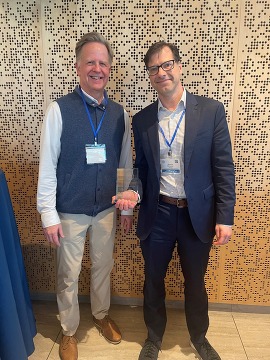 Paul Ostrow, Fentanyl Free Communities Foundation, was also in attendance representing Minnesota at the PAARI annual conference.
Governor’s Advisory Council Year-end Report
The Governor’s Advisory Council released its second year-end report which shares the story of the council's second year – a year defined by collaboration, learning, and progress. Included were recommendations to the Governor and legislature on how to improve services and supports for individuals experiencing substance use disorder. You can access the report on the Governor’s Advisory Council on Opioids, Substance Use, and Addiction website.
The Council also welcomed two new members: Janice Mehle, from Chisholm, and Khou Vang, from South Saint Paul, Minnesota. The next Council meeting will be on April 1 in person in Saint Paul.
You can learn more about the Advisory Council on the Governor’s Advisory Council on Opioids, Substance Use, and Addiction website.
 MOUD in Jails interim report
Hundreds of individuals pass through Minnesota’s jails every day, many of whom have an opioid use disorder (OUD). Without sufficient treatment during and after incarceration, hundreds die after release each year, and public safety is negatively impacted. The MOUD in Jails Workgroup brought together partners across healthcare and criminal justice sectors in Minnesota to develop recommendations that improve treatment during and after incarceration in jail. These recommendations are designed to not just stand alone but also to complement and enhance other key strategies across Minnesota to improve outcomes for individuals involved in the criminal justice system and their communities.
The interim report reflects three key recommendations that quickly gained unanimous approval from the workgroup. Because the overdose crisis continues to severely impact our communities, the workgroup felt it was important to release recommendations for which there was consensus quickly rather than wait to publish a comprehensive final report. The workgroup hopes that these recommendations can inform ongoing discussions around the Department of Corrections 2911 Rulemaking, the Department of Human Services 1115 Reentry Waiver, state and county decisions around opioid settlement funds, and other public discussions related to reducing opioid overdoses in Minnesota.
|
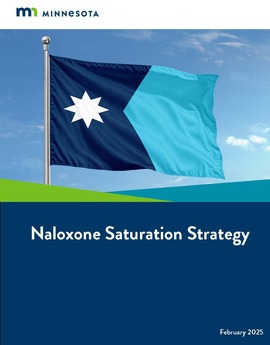
Naloxone Saturation Strategy
In July 2023, an interagency group from Minnesota was selected to participate in a Substance Abuse and Mental Health Services Administration (SAMHSA) sponsored naloxone saturation policy academy to learn from other states and develop a statewide naloxone distribution action plan. The group discussed how to create a distribution policy and strategy that gets naloxone to Minnesotans in the quantity and format they need. They recognized that partners and other leaders in the community needed to be part of this planning. As a result, the action plan centered on organizing a Minnesota-specific naloxone saturation convening that would inform the development of a statewide distribution and saturation strategy.
The resulting State Saturation Strategy sets forth guiding principles, key pillars, and specific approaches to achieve naloxone saturation, which refers to a community’s capacity to respond effectively to opioid overdoses by ensuring that naloxone is widely available, accessible, and ready for use whenever an overdose occurs. The strategy is intended to be iterative and responsive to changes of a particularly fluid and dynamic illicit drug landscape.
 Task Force on Holistic and Effective Responses to Illicit Drug Use reports
Last legislative session a task force on holistic and effective responses to illicit drug use was passed into law, and the Office of Addiction and Recovery was directed to administer that task force. The purpose of the task force is to review the reports on approaches to address illicit drug use in Minnesota that were prepared by Rise Research in accordance with legislation passed in the 2023 session. Both the Task Force Legislative report and the reports from Rise Research can be found at the Minnesota Legislative Reference Library.
Public Engagement
Over the last several months the Office of Addiction and Recovery continued to engage with the recovery community to hear directly from people experiencing the impacts of the opioid epidemic and substance use disorder.
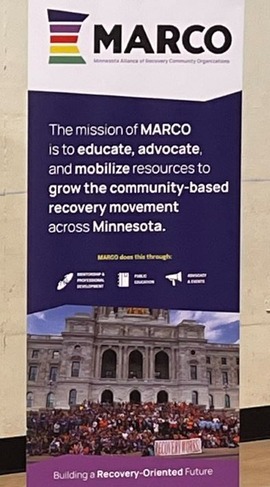 On Thursday, March 12 OAR Director Drucker addressed the recovery community at Recovery Day on the Hill, hosted by the Minnesota Alliance of Recovery Community Organizations (MARCO).
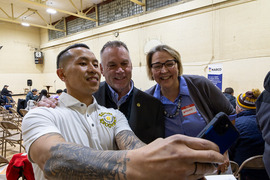 On Thursday, January 16, the Minnesota Alliance of Recovery Community Organization (MARCO) held a townhall co-hosted by KOOM Recovery, an emerging RCO serving the Hmong and Asian communities.
Wendy Jones (Chair of the Governor’s Advisory Council on Opioids, Substance Use, and Addiction), Representative Dave Bakker, and Assistant Commissioner Teresa Steinmetz participated alongside OAR Director Jeremy Drucker and other community, city, and county leaders.
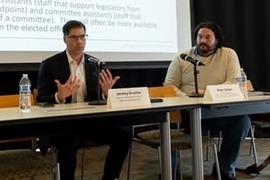 Jeremy Drucker and Brian Zirbes, Executive Director of the Minnesota Association for Recovery and Chemical Health, spoke at the Minnesota Alliance of Recovery Community Organization's (MARCO) daylong advocacy workshop.
|
|
Strategies
The Office of Addiction and Recovery works across state and local governments to coordinate and align efforts, and better target the state's role in addressing addiction, treatment, and recovery. The office conducts robust public engagement to build relationships with communities to ensure people with direct experience identify key priorities to meet the needs of their communities.
Healthy Beginnings. Child Care and Early Education. Mental Health and Well-being. Housing Stability.
|
|
|
|
|