|
|
A note from the office
March 2024
2024 is off to a strong start after a successful foundational year. Many of the over $200 million in substance use disorder investments signed into law last year are beginning to go out the door, including key parts of the Department of Health’s Comprehensive Overdose and Morbidity Act. This Act included important community-based prevention efforts, such as overdose prevention support for Minnesotans experiencing homelessness, and measures to expand community partnerships and connect individuals with behavioral health services and medicines for opioid use disorder through the Tackling Overdose With Network (TOWN) initiative.
In addition to the funding signed into law by Governor Walz, the Opioid Epidemic Response Advisory Council (OERAC) issued $20 million dollars in funding through its RFP process to address prevention, harm reduction, treatment, recovery, and workforce needs in communities across Minnesota. More detailed information about those investments will be released shortly on OERAC’s website.
In addition to the significant investments made through the 2023 budget and OERAC, the Governor’s supplemental budget for 2024 includes funding to reduce overdoses and recidivism among incarcerated Minnesotans.
This proposal, known as a Medicaid 1115 Re-entry Waiver, would allow Minnesota to partner with the federal government and provide Medicaid funding for pre-release services for individuals up to 90 days before a person’s release. The waiver would improve access to important services like medicines for opioid use disorder, substance use treatment, and care coordination.
The investments being made will save lives and improve outcomes and care for Minnesotans experiencing substance use disorder. There are still challenges ahead. More work needs to be done to support our provider partners across the substance use continuum to ensure every Minnesotan has access to the support and care they need to achieve and sustain recovery.
|
|
Governor’s 2024 Budget Recommendations
While this year’s proposed supplemental budget is modest compared to the previous year’s historic investment, the Governor nonetheless is recommending a transformational investment to reduce recidivism and overdoses across the state. This proposal implements the first phase of a federal 1115 Medicaid Demonstration Waiver that will provide reimbursement for certain physical and behavioral health services in prisons and jails 90 days prior to a person’s release. This proposal will implement the first phase of this waiver in three state and seven local facilities, enabling people eligible for Medicaid to access these services prior to and post release. The proposal also provides ongoing funding for the Bridging Benefits program, which assists people identified as high risk for recidivism with accessing supports upon release.
 Governor’s Advisory Council on Opioids, Substance Use, and Addiction
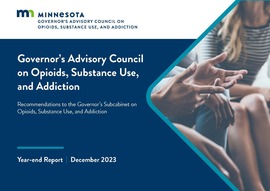
In January, the Governor’s Advisory Council released its year-end report documenting its inaugural year's work. Included were recommendations to the Governor and legislature on how to improve services and supports for individuals experiencing substance use disorder. You can access the report on the Governor’s Advisory Council on Opioids, Substance Use, and Addiction website.
The Council also welcomed four new members: Dr. Gavin Bart, Brandy Brink, Suzanne Nash, and Lynn Redleaf. The next Council meeting will be on April 2nd in person in Onamia, Minnesota.
You can learn more about the Advisory Council on the Governor’s Advisory Council on Opioids, Substance Use, and Addiction website.
 Opioid Roundtable with Governor Walz and U.S. Rep. Angie Craig
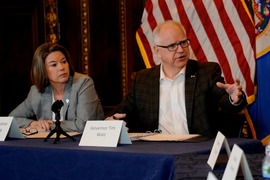
Last month the Office of Addiction and Recovery (OAR) participated in a roundtable discussion with Governor Walz and U.S. Rep. Angie Craig to bring awareness to the opioid crisis and highlight state and federal efforts to curb this deadly epidemic. Other participants included Shakopee Police Chief Jeff Tate, Native American Community Clinic CEO Dr. Antony Stately, Change the Outcome’s Hannah Kazempour, Metro Diversion Project Executive Director Rashad Ahmed, and Bridgette Norring, a mother and advocate whose son died from fentanyl poisoning. Roundtable participants articulated the need for a comprehensive set of strategies to address the opioid epidemic, including prevention, harm reduction, treatment and recovery, and the importance of tailoring for those approaches to the needs of the community.
|
 North Minneapolis Listening Session
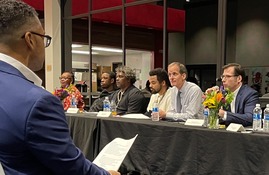
The Office of Addiction and Recovery, in partnership with Twin Cities Recovery Project, sponsored a listening session in December in North Minneapolis. Panelists included Dr. Gavin Bart, Dr. Peter Hayden, Turning Point President Emeritus Dr. Jonathon Lofgren, Pearl Evans from the Minnesota Department of Health, and others. The listening session focused on the effectiveness of medicines for opioid use disorder and what policies would be most helpful for the community in the fight against the opioid epidemic.
 Transit Ride Along
In December Addiction and Recovery Director Jeremy Drucker joined Metro Transit General Manager Lesley Kandaras, Metro Transit Chief Ernesto Morales, and members of the Metro Transit Homeless Action Team, riding along the Green Line from St. Paul to Minneapolis to better understand how substance use and homelessness are impacting transit. The Subcabinet on Opioids, Substance Use, and Addiction’s unsheltered action team is working on ways to improve how interrelated systems such as Metro Transit, city and county law enforcement, and human services, and other regional initiatives work together to provide services and supports for homeless Minnesotans experiencing behavioral health issues.
 Law Enforcement Opioid Summit
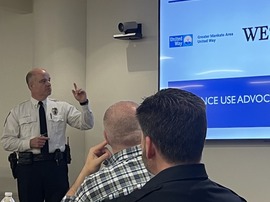
On March 5, the Office of Addiction and Recovery, in partnership with the Minnesota Department of Public Safety, hosted a law enforcement opioid summit. The goal of the summit was to build and strengthen relationships by bringing leaders in law enforcement together to exchange ideas and discuss the challenges we are facing throughout Minnesota. The half-day summit gave insight to state leaders developing policies and programs that will work for the different and varied communities across our state. Presentations included an overview of the Office of Addiction and Recovery, a keynote from a longtime law enforcement leader and professor of drug policy at Brown University Brandon del Pozo, information on Blue Earth County’s Yellow Line Project from Mankato Deputy Public Safety Director Matt DuRose, and a summary of efforts underway in Hennepin County from Sheriff Dawanna Witt.
|
|
Strategies
The Office of Addiction and Recovery works across state and local governments to coordinate and align efforts, and better target the state's role in addressing addiction, treatment, and recovery. The office conducts robust public engagement to build relationships with communities to ensure people with direct experience identify key priorities to meet the needs of their communities.
Healthy Beginnings. Child Care and Early Education. Mental Health and Well-being. Housing Stability.
|
|
Contact Us.
Website: www.mn.gov/mmb/oar
Email: addictionandrecovery.mmb@state.mn.us
|
|
|
|
|