Lauri Hicks, DO
Director, Office of Antibiotic Stewardship, Division of Healthcare Quality Promotion, National Center for Emerging and Zoonotic Diseases, Centers for Disease Control and Prevention
What is your professional experience with antibiotic resistance?
During my training in infectious diseases, I encountered several situations where patients did poorly because they were infected with antibiotic-resistant bacteria. I also realized that in many situations there were opportunities to improve antibiotic prescribing that could benefit patients and improve their outcomes. When I rejoined CDC in 2007, I advocated for expansion of our activities to improve how antibiotics are used.
How does your work involve issues of antibiotic use?
I lead CDC’s Office of Antibiotic Stewardship. Our office works across the spectrum of human healthcare (doctor’s offices, hospitals, nursing homes, etc.) to improve how antibiotics are used. We measure antibiotic use so that we know where we need to target our efforts. Additionally, we work with partners to implement programs and practices and educate the general public and healthcare providers.
From your perspective, what is most challenging about antibiotic use and stewardship?
The biggest challenge with improving antibiotic use is that it involves changing behavior, and changing behavior is notoriously difficult. For example, nearly 80% of visits for uncomplicated bronchitis, a condition that doesn’t warrant antibiotic use, lead to an antibiotic prescription. For many years, patients have received antibiotics for bronchitis, so understandably many patients expect antibiotics when they have a routine case of bronchitis. Doctors report that patient satisfaction influences their decision to prescribe. There is also a widespread perception that antibiotics are harmless drugs, but taking antibiotics when they are not needed can be dangerous and lead to unintended consequences, such as the sometimes deadly Clostridium difficile diarrhea.
|
MDH
We are pleased to announce two upcoming free, educational webinars focused on antibiotic stewardship core element implementation. These sessions are part of MDH’s ongoing efforts to support clinicians, pre-professional students, infection preventionists, and stewardship champions in improving diagnosis, treatment, and antibiotic use.
Antibiotic Stewardship Core Element Implementation in Minnesota Long-term Care Facilities
-
Date/Time: Wednesday, Nov. 18 | noon–1 p.m. CT
-
Presenter: Ameya Phadnis, PharmD
Antibiotic Stewardship Core Element Implementation in Acute Care Hospitals
-
Date/Time: Thursday, Nov. 19 | noon–1 p.m. CT
-
Presenter: Maggie Kauffeld, PharmD, MBA
CDC
Outpatient Antibiotic Stewardship Core Elements for Critical Access Hospitals Webinar
-
Date/Time: Wednesday, Nov. 18 | 1–2 p.m. CT
- Discover how health systems can strengthen outpatient antibiotic stewardship and improve antibiotic use. This virtual webinar will explore updates to CDC’s Core Elements of Outpatient Antibiotic Stewardship and share practical strategies and real-world examples for putting the updated guidance into action.
CDC: Antibiotic Stewardship Trainings
- Antibiotic stewardship training course for healthcare professionals, offering more than 10 credits of continuing education, including a module specific to dental antibiotic stewardship.
American Society of Health-System Pharmacists (ASHP)
U.S. Antibiotic Awareness Week 2026: Translating Antimicrobial Use Data into Stewardship Action
-
Date/Time: Thursday, Nov. 19 | 1–2 p.m. CT
- As part of the annual observance for USAAW, a representative from CDC will review the 2023 baseline for the National Healthcare Safety Network (NHSN) Antimicrobial Use (AU) Standardized Antimicrobial Administration Ratio (SAAR) data, including interpretation and recognition of signals. Two antimicrobial stewardship pharmacist leaders will demonstrate how to translate a data signal into a stewardship opportunity and how to prioritize possible interventions. They will each describe implementation of a stewardship intervention and options for evaluation.
- Limited to ASHP members
Connecticut Department of Public Health
-
Date/Time: Nov. 18-24, 2026 | 2–3 p.m. CT
- Description:
- Wednesday, Nov. 18: Rooting Out Antibiotic Resistance: Cases in Dental Antibiotic Stewardship
- Thursday, Nov. 19: From Diagnosis to Duration: Case-Based Pediatric Stewardship for Respiratory Infections
- Friday, Nov. 20: Antimicrobial Stewardship in Urgent Care
- Tuesday, Nov. 24: Challenges of Antibiotic Stewardship in Long Term Care
-
Learn more about the series, schedule, and speakers: Connecticut Department of Public Health USAAW Webinar Series Flyer (PDF)
Society of Infectious Diseases Pharmacists (SIDP)
SIDP Education Center is a portal providing both Accreditation Council for Pharmacy Education (ACPE)-accredited and/or Board Certified Infectious Diseases Pharmacist (BCIDP) credit for clinical pharmacists. It provides educational activities on infectious disease pharmacotherapy for pharmacists and allied‐health disciplines. Most activities are free or reduced cost to SIDP members.
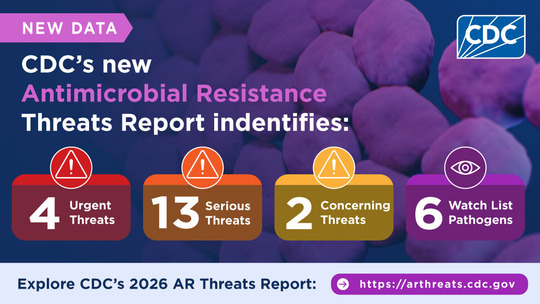
CDC has released the 2026 update to its Antimicrobial Resistance Threats Report in the United States (AR Threats Report), providing the most comprehensive estimate to date of the impact of drug-resistant pathogens on human health in the United States. The report identifies 19 pathogens as urgent, serious, or concerning threats. Each year, these bacteria and fungi cause an estimated 9.7 million infections and 50,800 deaths. The report also includes a watch list of six additional pathogens that are being monitored as potential threats.
Different from previous reports, the 2026 update to the AR Threats Report is now a CDC website designed to enhance user experience, improve access to data, and support more regular updates going forward. The report includes burden estimates, patient stories, downloadable graphics, and more. Explore the 2026 update and share the report with your networks to help guide policies, investments, innovations, and interventions to combat antimicrobial resistance.
|