|
View this as a webpage
We hope your fall has been full of color. In addition to the start of the autumn season, this time of year also marks the start of a new federal fiscal year (FY). With the beginning of FY 2027 comes new policies, new data, new arrivals, and a steady continuation of the work we are all here to do.
At the end of every fiscal year, the federal administration releases a new Presidential Determination (PD) establishing the number and regional allocations of refugees the United States may admit in the year to come. On Sept. 25, 2026, the Trump administration announced a PD of 17,500 refugees for FY 2027, with arrivals to be primarily from South Africa. Refer to Presidential Determination on Refugee Admissions for Fiscal Year 2027.
In addition to the new PD, the beginning of FY 2027 also marked the official start of Medical Assistance (MA) eligibility changes for many populations, including newcomers like refugees and other individuals eligible for Office of Refugee Resettlement (ORR) benefits. More on these changes and resources can be found below.
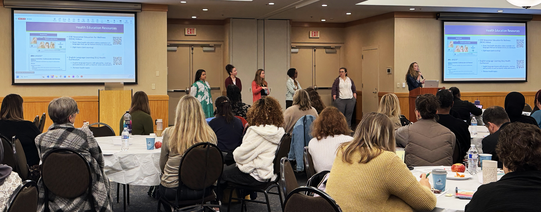
The Refugee Health and International Program recently hosted the 2026 Refugee Health Forum. The theme for this year’s forum, “Adapting Together for Refugee Health,” may serve as a guiding principle as we enter this new fiscal year. As we encounter policy and landscape changes, we can all work together to respond and continue to practice the dynamic and collaborative work that is crucial to refugee and immigrant health.
Thank you for all you do! Take care and stay well.
The Office of Refugee Resettlement (ORR) published a Federal Register Notice: Period for Refugee Cash Assistance and Refugee Medical Assistance; Correction on Oct. 1, 2026, announcing an increase in the eligibility period for Refugee Medical Assistance (RMA) and Refugee Cash Assistance (RCA). This expansion will be effective for eligible individuals arriving on or after Jan. 1, 2026.
RMA is a federal health insurance program for people with refugee status who have recently arrived in the U.S. For more information, review the ORR Dear Colleague Letter 26-05: Extension of Refugee Cash Assistance and Refugee Medical Assistance Eligibility Period to 12 Months.
Beginning Oct. 1, 2026, federal policy changes under H.R.1 limited Medical Assistance (MA) eligibility for refugees and other ORR-benefit eligible recipients. Most adults entering the U.S. on or after this date will not qualify for MA until they become lawful permanent residents (LPRs). The following groups will continue to qualify for MA if all other eligibility criteria are met:
- Children under age 21.
- Pregnant refugees.
- Cuban and Haitian entrants.
Refugees and other ORR-benefit eligible recipients who are not eligible for MA will likely qualify for one of the following coverage options upon arrival or once their ORR-eligible immigration status is granted:
- Refugee Medical Assistance (RMA): Short-term coverage for individuals within 12 months of arrival or ORR eligible status grant. RMA coverage is similar to MA.
- MinnesotaCare.
- Employer-sponsored insurance.
Transitions for MinnesotaCare after Sept. 30, 2026 (Non-LPRs)
- Individuals were transitioned from MA to either RMA or MinnesotaCare.
- Those within 12 months of arrival or status grant will transition to RMA until the end of their twelfth month after arrival or status grant.
- After RMA ends, individuals may enroll in MinnesotaCare. Monthly premiums must be paid before the start of coverage. For example, a premium paid in September 2026 would begin coverage on Oct. 1.
- There are several alternative payment options for the Refugee Health Assessment (also known as the Domestic Medical Screening):
- RMA covers the Refugee Health Assessment for eligible adults within their first 12 months of arrival.
- Children may continue to be covered through MA.
- A flat fee payment, available through the Minnesota Refugee Health Program, may be available for people who don’t quality for MA or RMA.
LPR Exception
Unlike other immigrants, refugees who become lawful permanent residents are exempt from waiting five years before becoming eligible for federal public benefits (the five-year bar); they may qualify for MA immediately upon adjustment of status.
Refugee and Immigrant Helpline
Contact the Refugee and Immigrant Helpline at 1-800-814-4806 or dhs.rpo.helpline@state.mn.us if your clients need resources, services, or guidance on health insurance options. Please do not send private information via email.
Malaria Screening in Refugees from South Africa
A recent CDC alert has been issued advising against routine domestic malaria screening or presumptive treatment for refugees from South Africa. This alert may be found in CareRef, a clinical decision application, when viewing clinical recommendations for refugees arriving from South Africa under the section, CDC Health Alerts for U.S.-Bound Refugees, Interim Guidance: Domestic Screening and Treatment of Parasites for Refugees from South Africa (notification issued 2026-09-16).
Malaria infections in South Africa are generally caused by the parasite Plasmodium falciparum (P. falciparum). Malaria in South Africa is endemic in only a small area of the northeast and eastern part of the country in select low-altitude areas:
- KwaZulu-Natal Province: Districts of uMkhanyakude, King Cetshwayo, and Zululand.
- Limpopo Province: Districts of Mopani, Vhembe, Capricorn, Greater Sekhukhune, and Waterberg.
- Mpumalanga Province: District of Ehlanzeni.
- Kruger National Park in the districts of Limpopo and Mpumalanga, just west of the South Africa-Mozambique border.
Most refugees from South Africa entering the U.S. have not resided in these areas. Note that Minnesota guidance recommends testing refugee arrivals who are symptomatic and have been in endemic areas regardless of residency or nationality. More information can be found at Malaria Screening: Domestic Refugee Health Screening Guidance. Clinicians with questions on screening and treatment may also call the CDC’s malaria hotline at 770-488-7788 (from 9 a.m. to 5 p.m. ET) or 770-488-7100 (after hours or on weekends and holidays).
Immunize.org – Ask the Experts
Immunize.org has a webpage, “Ask the Experts,” that provides clear, easy-to-understand answers to commonly asked questions about vaccines and their use. This collection of resources includes both video and written materials and can be filtered for vaccine or disease name, patient demographics, vaccine schedules, living settings, and more. Visit Immunize.org: Ask the Experts.
2025 arrivals
From Jan. 1, 2025, through Dec. 31, 2025, 545 individuals arrived to Minnesota as refugees, Special Immigrant Visa holders, asylees, or certified victims of human trafficking. The majority (315) of these arrived with a refugee visa. Fifty-nine percent (N=323) of 2025 primary refugee arrivals resettled in Minnesota during the month of January. The most common countries of origin among these arrivals were Afghanistan (203), Somalia (133), Burma (38), and Ethiopia (36).
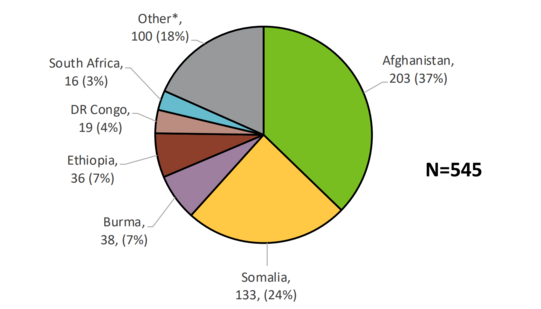 Among these 545 arrivals, 503 were eligible for a post-arrival refugee health assessment and 491 (98%) received a health assessment. Select results from the RHA are highlighted in the table below.
Health Status of New Refugees, Minnesota, 2025
|
Health Condition
|
No. infected among screened (%)
|
|
TB infection*
|
77/464 (17%)
|
|
Hepatitis B infection**
|
6/453 (1%)
|
|
Hepatitis C antibody
|
4/450 (1%)
|
|
Parasitic infection***
|
114/403 (28%)
|
|
Syphilis infection
|
3/403 (1%)
|
|
HIV infection
|
1/459 (<1%)
|
|
Elevated Blood Lead****
|
35/193 (18%)
|
|
Positive Mental Health Screening*****
|
20/257 (8%)
|
Total number of health screenings: 491 (98% of 503 eligible refugees)
* Persons with LTBI (QFT+ or ≥ 10mm induration w/ normal CXR) or suspect/active TB disease
** Positive for hepatitis B surface antigen (HBsAg)
*** Positive for at least one intestinal parasite infection
****Children <17 years old (208 screened); Lead level ≥3.5 ug/dL
***** Adults 18+ years old (NMinnesota= 278 screened); Screened positive for mental health concerns using any mental health screening tool(s)
Health summaries and additional demographic information for 2025 refugee arrivals can be accessed at Refugee Health Statistics: Minnesota Refugee Health Report.
2026 arrivals
From Jan. 1, 2026, through June 30, 2026, 80 individuals arrived to Minnesota as refugees (N=68) or derivative asylees (N=12) (2026 data are preliminary). All 68 individuals who arrived as refugees were from South Africa. The majority of these arrivals resettled in Hennepin County (N=45, 56%).
|