Rural Pediatric Care in Minnesota
Access to pediatric care is essential for communities to grow and thrive. However, pediatricians are the least likely medical professionals to be working and living in rural communities. While the number of pediatricians has increased by an estimated 6% nationwide, a 2023 JAMA study* showed that rural areas lost pediatric providers between 2010-2020. Now, nearly 60% of rural counties nationally do not have a pediatrician.
Several reasons have led to shortages of pediatricians in rural areas. A major issue is that pediatric practices are more commonly located near urban children’s hospitals, which employ pediatric subspecialists. As a result, pediatric clinical training also is more likely to take place in urban areas near those hospitals and subspecialists, too often encouraging medical students and residents to remain in those urban areas after moving into licensed practice. Further, low rates for reimbursement is also a factor in communities where there are high rates of participation in public programs.
The effects of these broad underlying causes can be seen in Minnesota, where most rural counties lack even one practicing pediatrician (see Figure 1). Large swaths of Minnesotans living in the northern, western, and southern parts of the state must drive long distances to access pediatric care. Moreover, as shown in Figure 2, in rural areas of Minnesota, there are 136,164 people for every one pediatrician, compared to 7,798 in urban areas.
Figure 1: Practice Locations of Pediatricians in Minnesota, 2026
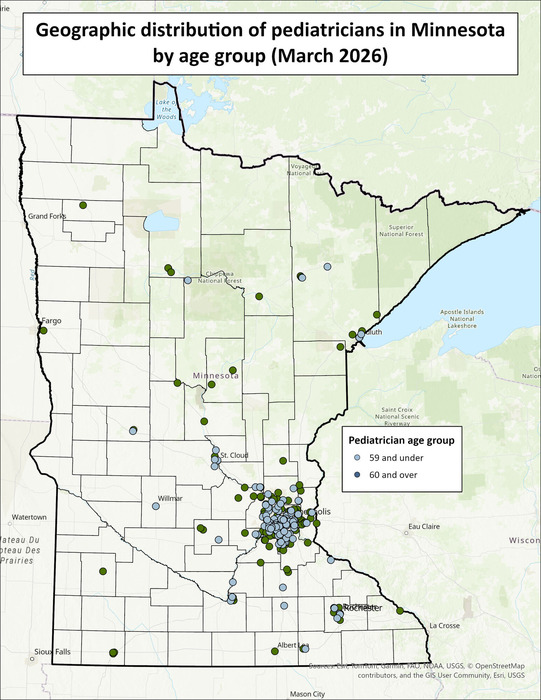 Data source: MDH analysis of practice address records from the Minnesota Board of Medical Practice.
Figure 2: Population-to-Provider Ratio, Medical Specialties, Urban vs. Rural areas of Minnesota
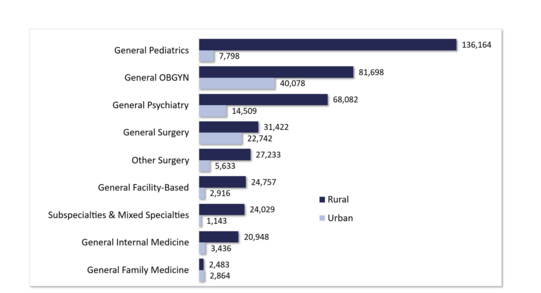 Data source: MDH analysis of address records from the Minnesota Board of Medical Practice, 2026. “Urban” areas include the RUCA categories “urban” and “micropolitan.” “Rural” areas include the RUCA categories “Small Town” and “Isolated Rural.”
What can be done?
Both nationally and in Minnesota, there are a variety of efforts aimed at increasing the number of physicians — including pediatricians — in rural areas.
-
As part of a broader effort to train rural medical specialists, Minnesota has a brand new rural residency pediatric pathway sponsored by University of Minnesota and CentraCare that combines urban training with a 17-month immersive rural community training.
-
Minnesota’s Rural Health Transformation Program is a multi-pronged effort designed to increase access to healthcare in rural communities by addressing workforce shortages and hospital closures and investing in technological infrastructure in rural communities.
For additional details related to the listings below, please visit ORHPC Healthcare Funding.
Community Clinic Grant
Application deadline: Friday, Oct. 30, 4:30 p.m.
Eligible Applicants:
- Nonprofit clinics established to provide preventative, medical, dental, or mental health primary care services to low-income or rural population groups.
- A government entity operating a clinic which provides preventative, medical, dental, or mental health primary care services.
- An Indian Health Services unit or Indian tribal government operating a clinic which provides preventative, medical, dental, or mental health primary care services; or,
- A consortium of these entities.
All applicant organizations must have a policy or procedure to ensure no person will be denied services due to inability to pay (e.g., sliding-fee scale).
Award Amount: Approximately $561,000 for 10 – 13 grants.
Period of Performance: April 1, 2027 – March 31, 2028
Maximum Funding Amount: $45,000
Contact: health.CommunityClinicGrant@state.mn.us
Rural Clinical Rotations Grant
Application deadline: Friday, Oct. 30, 4:30 p.m.
Eligible Applicants:
The following types of clinical training programs, which may be part of institutions of higher education, hospitals, or other entities located in Minnesota, are eligible to apply for this funding:
- Physician,
- Physician assistant,
- Advanced practice registered nurse,
- Pharmacy,
- Dentistry,
- Dental therapy, and
- Mental health professional programs.
All applicants must be able to demonstrate applicable membership and compliance with the corresponding accrediting bodies.
Award Amount: Approximately $2,000,000 for 4-8 grants.
Period of Performance: March 1, 2027 – Feb. 29, 2028
Maximum Funding Amount: $400,000
Contact: health.orhpc.workforcegrants@state.mn.us
Rural Residency Training Grant
Application deadline: Friday, Oct. 30, 4:30 p.m.
Eligible Applicants:
- Eligible applicants may include Clinics, Community Health Boards/Local Public Health, Institutions of Higher Education, Local Units of Government (cities, towns, counties), Nonprofit Organizations, and Tribal Governments that train or propose to train residents in select primary care specialties.
- Are accredited by the Accreditation Council for Graduate Medical Education (ACGME) or the American Psychological Association or present a credible plan to obtain accreditation.
Award Amount: Approximately $2,000,000 for 2-3 grants.
Period of Performance: March 1, 2027 – Feb. 29, 2028
Maximum Funding Amount: $250,000 per year
Contact: health.orhpc.workforcegrants@state.mn.us
Medical Education and Research Cost (MERC) Program
Application deadline: See grant materials for submission timelines
-
Institutions of Higher Education
Rural Hospital Capital Improvement Grant
Application deadline: Friday, Dec. 11, 4:30 p.m.
An eligible applicant for this grant program is a non-federal, general acute care hospital in Minnesota that:
-
Is located in a rural area, as defined in federal Medicare regulations, or in a community with a population of less than 15,000 according to U.S. Census Bureau statistics, outside the seven-county metropolitan area,
-
Has 50 or fewer beds, and
Award Amount: $1,755,000 for 18 grants
Maximum funding amount: $125,000
Informational webinar: Tuesday, Nov. 10 at 12 p.m.
Rural Hospital Planning and Transition Grant
Application deadline: Friday, Dec. 11, 4:30 p.m.
An eligible applicant for this grant program is a non-federal, general acute care hospital in Minnesota that:
-
Is located in a rural area, as defined in federal Medicare regulations, or in a community with a population of less than 15,000 according to U.S. Census Bureau statistics, outside the seven-county metropolitan area,
-
Has 50 or fewer beds, and
Award Amount: $300,000 for 10 grants
Maximum funding amount: $49,000
Informational webinar: Friday, Nov. 6 at 12 p.m.
The Office of Rural Health & Primary Care has awarded approximately $12.5 million of Rural Health Transformation Program (RHTP) funding to sole source and competitive grant program recipients. The sole source grants were funded directly to organizations and institutions that were named in the State’s initial application for RHTP funding submitted in November 2025. The competitive grants result from Requests for Proposals for transformational activities that were outlined in the State’s RHTP application, including investing in the technology needed to bring care closer to home for rural residents; improving health outcomes for Minnesotans with or at risk of developing cardiovascular disease, diabetes and chronic kidney disease; and expanding education and training pathways for the rural healthcare workforce. The grants range from $25,000 to $9 million.
The Rural Health Transformation Program Activities are supported by the Centers for Medicare & Medicaid Services (CMS) of the U.S. Department of Health and Human Services (HHS) as part of a financial assistance award totaling $193,090,618.14 with 100 percent funded by CMS/HHS. The contents are those of the author(s) and do not necessarily represent the official views of, nor an endorsement, by CMS/HHS, or the U.S. Government.
 NOSORH Grant Writing Institute Level II: Developing Competitive Grant Proposals
Registration is now open for NOSORH's Grant Writing Institute Level II: Developing Competitive Grant Proposals. The series launched on Oct. 15 and features six virtual sessions that will help participants strengthen their proposal development skills as they work through key components of a competitive grant proposal.
Have questions? Contact Cate Visser, NOSORH Applications Manager, at catev@nosorh.org.
|