Sustaining and Growing the Oral Health Workforce
Minnesota, and the nation as a whole, faces healthcare workforce challenges across a range of professionals—from personal care assistants to mental health clinicians and physicians. While workforce shortages and pipeline challenges among these professions often receive significant attention, the oral health workforce is less frequently included in broader discussions about the health care workforce. Yet dentists, dental therapists, dental hygienists, and dental assistants face many of the same workforce challenges as other health professionals, including maintaining a strong pipeline, ensuring an adequate workforce to meet community needs, and supporting providers to practice where they are most needed
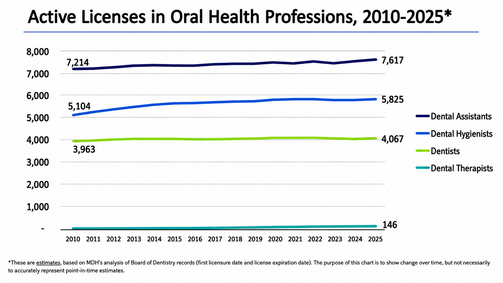
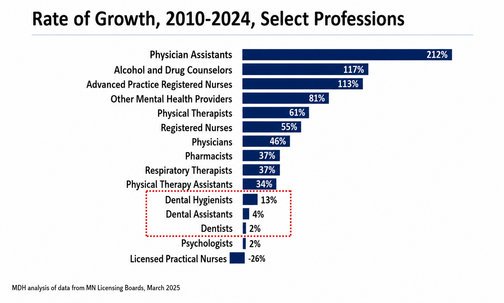
In Minnesota, there are approximately 130,000 registered nurses, 30,000 physicians, and 10,000 pharmacists compared to about 4,000 actively licensed dentists. As shown below, growth of the oral health workforce has been slow and relatively flat over the last 15 years in Minnesota.
 |
 |
Data from MDH’s Healthcare Workforce Survey indicates that approximately one in four dentists in small towns and isolate rural areas of Minnesota are over the age of 60. In the most rural areas of the state, about half of all dentists report that they plan to leave the profession within the next five years, exacerbating "dental deserts."
Several policies and programs are in place to grow the oral health workforce and expand its reach. Minnesota was one of the first states to license dental therapists and certify advanced dental therapists, professionals who are trained to provide a wide array of preventative and restorative oral health services and commit to working in underserved areas. Dental hygienists and dental assistants in Minnesota are statutorily permitted to enter into collaborative practice agreements with supervising dentists, which allow them to do certain preventative care procedures without a dentist being physically present, frequently in community settings such as schools or mobile clinics.
Additionally, the Minnesota Department of Health offers student loan forgiveness and repayment opportunities to dentists, dental therapists, and dental hygienists who commit to practicing for a certain period of time in dental shortage areas. Facilities that provide clinical training to students and residents in oral health programs can now receive support through MDH’s Site-based Clinical Training program. New support is also available to fund rural rotations for dentists and dental students to introduce them to rural practice.
Visit Oral Health Programs and Initiatives for more information about MDH’s oral health programs.
Visit ORHPC Healthcare Funding for more information about grant or loan forgiveness opportunities.
For additional details related to the listings below, please visit ORHPC Healthcare Funding.
Clinical Dental Education Innovation Grant
Program description: Under the authority of Minnesota Statutes Section Sec. 144.1913, the Commissioner of Health is authorized to award grants to sponsoring institutions and clinical dental training sites for projects that increase dental access for underserved populations and promote innovative clinical dental education or clinical training programs.
Eligible applicants include: Teaching institutions and clinical training sites that train dental professionals. The teaching institution or the clinical training site must provide accredited clinical training, an exception can be made if the organization is actively seeking accreditation with a reasonable assumption of success.
Application close date: Sept. 3, 4:30 p.m.
Indian Health Grant
Program description: The Indian Health Grant Program, authorized in Minnesota Statute 145A.14, provides assistance to eligible applicants to furnish clinical health services, including culturally informed preventive, medical, dental, and/or mental health care services, for American Indian people that reside off reservations.
Eligible entities include: Tribal Nations and nonprofit entities providing clinical health services to American Indian people that reside off reservations, with preference given to Tribal Nations and nonprofit organizations that were created for and specifically focused on serving American Indians.
Application close date: Sept. 3, 4:30 p.m.
Mental Health Safety Net Grant
Program description: Minnesota Statute 145.929 authorizes the Commissioner of Health to award grants to support eligible mental health providers who serve uninsured youth under age 21. Funds will be awarded each year proportionally among all eligible programs, based on the total number of uninsured patients under the age of 21 served.
Eligible applicants: Provider organizations that are either:
Additionally, eligible applicants must offer free or reduced-cost mental health care to low-income patients under the age of 21 with a family income below 275 percent of federal poverty guidelines and who do not have health insurance coverage.
Application close date(s):
- Letter of Intent Deadline: Aug. 27, 4:30 p.m.
- Application Deadline: Oct. 23, 4:30 p.m.
Minnesota State Loan Repayment Program (SLRP)
Program description: Minnesota’s State Loan Repayment Program (MN SLRP) aims to improve population access to outpatient clinic-based primary health care by assisting underserved communities with recruitment and retention of primary care providers.
Eligible licensed health professionals: OB/GYN, Women’s Health Nurse Practitioners, Certified Nurse Midwives, Dental Therapists, Registered Dental Hygienists, General and Pediatric Dentists.
Minimum service obligation: 2 years.
Annual repayment Amount: In order to receive loan repayment, a clinician must agree to practice either full-time or part-time as a primary care clinician (see Eligible Clinicians) for a minimum of two years at a program-approved site located within a federally designated Health Professional Shortage Areas (HPSAs).
2026/2027 Application close date: Sept. 9, 4:30 p.m.
Rural Improving Maternal & Perinatal Access, Care, and Teamwork (IMPACT) Sprint
The Minnesota Perinatal Quality Collaborative (MNPQC) invites rural hospitals to participate in the Rural improving Maternal & Perinatal Access (IMPACT) Sprint, a collaborative learning opportunity designed to help rural and critical access hospitals strengthen obstetric emergency readiness through evidence-based quality improvement strategies.
Built around the Alliance for Innovation on Maternal Health (AIM)'s Obstetric Emergency Readiness Resource Toolkit and the AIM Obstetric Care for Rural Communities (O-CARE) Guide, this interactive sprint will equip multidisciplinary participants with practical approaches to improve emergency recognition, communication, teamwork, stabilization, transfer processes, and sustainable systems of care.
Sprint Schedule
All Sprints will be held on Thursday afternoons, from 12:00 - 1:00 p.m. Participants are not required to attend every session.
- 9/17/2026: Foundations of Obstetric Emergency Readiness
- 10/15/2026: Recognition & Early Warning Signs
- 11/12/2026: Team Roles, Communication, & Drill Coordination
- 12/17/2026: Hemorrhage Readiness - Supplies & Systems
- 1/14/2027: Response & Transfer Coordination
- 2/11/2027: Sustainability, Data, & Culture
More information regarding MNPQC's Sprint program model can be found on MNPQC's Program Model Descriptions (external).
Sprint Audience
This Sprint is open to all interested participants. However, the content is specifically designed for physicians, nurses, advanced practice providers, hospital leadership, quality improvement professionals, hospital administrators, midwives, and doulas working in rural healthcare settings and Critical Access Hospitals.
We encourage professionals involved in Labor & Deliver, Emergency Departments, pre- & postpartum care clinics, midwifery groups and emergency medical services (EMS) to participate. Individuals working in other roles or care settings are also welcome to attend and learn from the educational content and discussions.
Register for the Rural IMPACT Sprint.
Questions
Please direct all questions to MNPQC at QI@minnesotaperinatal.org
Teaching Health Center Graduate Medical Education Program (THCGME) Funding Opportunities
Two forecasted funding opportunities for the FY27 THCGME grant program have been announced on grants.gov.
The purpose of both THCGME funding opportunities is to prepare residents to provide high-quality care, particularly in rural and medically vulnerable communities, and develop competencies to serve a wide range of populations and communities.
The HRSA-27-017 grant opportunity: Teaching Health Center Graduate Medical Education (THCGME) Program was posted on July 8.
- Applications were estimated to open on July 31, and are estimated to remain open until Sept. 29.
- HRSA will make up to 12 awards, each up to $2,880,000. Eligibility limited to currently funded THCGME programs as a funding continuation.
The HRSA-27-084 grant opportunity: Teaching Health Center Graduate Medical Education (THCGME Program) was posted on July 27.
- Applications are estimated to open on Sept. 14, and estimated to remain open until Nov. 16.
- HRSA will make up to 12 awards, each up to $960,000. Expanded eligibility.
Applicants for both THCGME opportunities may also benefit from the resources and tools available in the THCGME.org portal (registration required).
Rural Residency Planning and Development (RRPD) Program Funding Opportunity
One forecasted funding opportunity for the FY27 RRPD grant program has been announced on grants.gov.
The HRSA-27-046 grant opportunity: Rural Residency Planning and Development Program was posted on Aug. 7.
- Applications are estimated to be open on Dec. 18, and estimated to remain open until March 18, 2027.
- HRSA will make up to 15 awards, each up to $750,000, to improve and expand access to healthcare in rural areas by developing new sustainable rural residency programs, including rural track programs (RTPs).
Applicants for the RRPD opportunity may also benefit from the resources and tools available in the RuralGME.org portal.
|