Center of Excellence in Newcomer Health
|
|
|
View this as a webpage
June 2026
The Minnesota Center of Excellence in Newcomer Health (MN COE) is dedicated to developing resources to support healthcare providers, public health professionals, and resettlement partners in their efforts to better serve refugee and other newcomer families. We build on existing infrastructure and partners’ extensive experience to identify and monitor newcomer health issues and needs, contribute to evidence-based policies and guidance, and ultimately improve continuity of care and health outcomes for newcomers.
If you have questions or suggestions, please contact us at COENewcomerHealth@state.mn.us.
In this issue:

1. Which two years did immigrants make up 14.8% of the U.S. population (greatest percentage to date)?
A. 1850
B. 1890
C. 1920
D. 2024
For our clinical audience…
Frederik, a 42-year-old South African man, presents for his Domestic Medical Exam. He received an Overseas Medical Exam from a panel physician but was not given presumptive treatment for intestinal parasites. In these cases, you generally provide presumptive treatment, but there’s been a shortage of ivermectin, and no local pharmacy has the medication in stock.
2. What is your next best step?
A. Wait until ivermectin is back in stock and provide presumptive treatment
B. Ignore it for now and revisit if he becomes symptomatic
C. Draw a serology and do an ova and parasite test, if able. If positive, treat pursuant with guidelines.
Answers at the end of the newsletter.
|

The International Refugee and Migration Health Conference is just around the corner…
The Society of Refugee Healthcare Providers’ annual conference, the International Refugee and Migration Health Conference (formerly known as the North American Refugee Health Conference, or NARHC), will be held June 26-28, 2026, in San Diego, California.
Take a moment to review the 2026 International Refugee and Migration Health Conference: Program Agenda (PDF) and read about the impressive list of featured conference speakers!
Come see us at our booth and take our brief survey!
We are collaborating with Migration Health Institute to explore the needs facing newcomer communities and the professionals who serve them. Stop by to learn about our work and resources, and share what's motivating you, the challenges you're navigating, and ideas to improve newcomer health.
A sneak peak of some of what we’ll be featuring at the booth…

Keeping Kids Safe: A fun activity book is a printable activity book for children of all ages to learn ways to stay safe and healthy in their new home. Adults are encouraged to talk with children about the different lessons in this book and help them to complete the activities.
|

Newcomer Education for Wellness (NEW) Videos are translated health education videos for newcomers. The video series includes dental care, domestic medical exam, healthcare services, healthy eating, interpretation services, latent tuberculosis, stress management, and vision health. The videos are available in Arabic, Burmese, Dari, English, French, Haitian Creole, Karen, Pashto, Somali, Spanish, and Swahili.
|
MN COE Connect is a one-stop-shop for all MN COE clinical tools and resources.
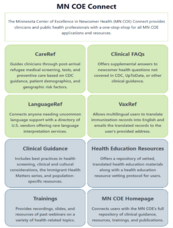
-CareRef is an interactive tool for clinicians on CDC’s Domestic Refugee Health Medical Screening Guidance.
-Clinical FAQs answer frequently asked questions, supplementing the CDC’s Domestic Refugee Health Medical Screening Guidance, UpToDate, and other clinical guidance resources.
-LanguageRef is a searchable directory of interpretation vendors across the U.S. for languages not commonly spoken in the U.S.
-VaxRef is a free online application that translates vaccine records into English. Available in Arabic, Dari, French, Pashto, Portuguese, Russian, Spanish, and Ukrainian.
|
You can also find us at our presentations…
Friday, June 26
-
2:30 p.m. Navigating Resources from the Minnesota Center of Excellence for Newcomer Health
-
2:30 p.m. Pilot and Evaluation of a Multilingual Video Messaging Model to Improve Newcomer Health Information Access
Saturday, June 27
-
10:45 a.m. Co-Creating Culturally Responsive Health Messaging: Newcomer Education for Wellness Video Series
-
4:30 p.m. Blood Lead Level Screening in Newcomer Children in the United States, 2020-2024
Poster sessions:
- Characteristics of newcomers diagnosed with varicella or pertussis, 2020-2025
- Refugees to Minnesota receiving medical care coordination upon arrival, 2012-2025
- Discordant interferon gamma-release assay (IGRA) results among refugee arrivals, 2017-2024
- Perinatal risk factors and birth outcomes of newly arrived refugees in Minnesota, 2012-2024
- Comparison of medical diagnoses of adult refugees at overseas and domestic medical examinations, Minnesota 2016-2024
REMINDER: MN COE Survey
Help Inform the Pediatric Developmental Screening Clinical Practices

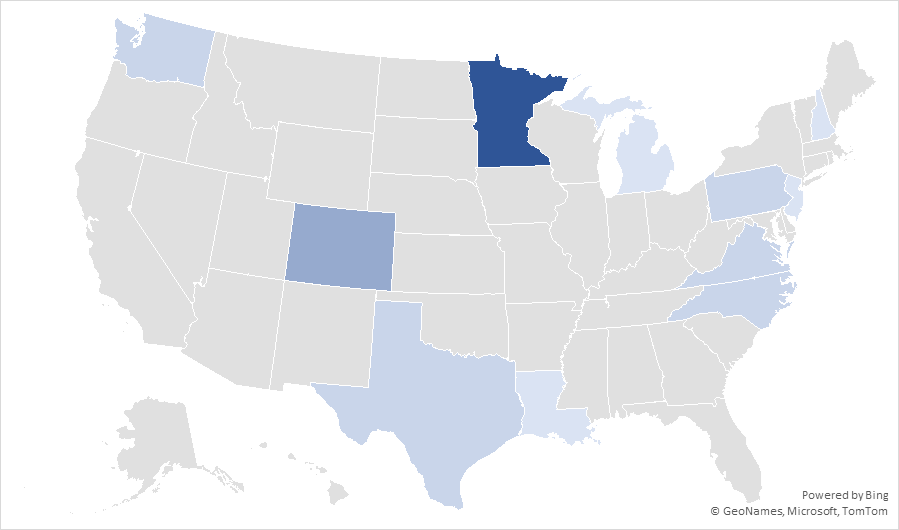
Thank you to everyone who has participated in our survey! So far, we’ve heard from professionals in the highlighted states. We’d like to hear from all 50 states! If this describes you and your role, take the survey: Pediatric Developmental Screening Clinical Practices.
Please continue to share among your colleagues who provide well child checks and standard physical exams for children.
Questions can be directed to the Minnesota Center of Excellence in Newcomer Health at MNCOENewcomerHealth@state.mn.us.
|
|
|
Ask the Expert: Ebola

We asked Sarah Lim, MBBCh, MPH, to gain some insight into this emerging health topic. Dr. Lim is an infectious diseases physician and medical epidemiologist at the Minnesota Department of Health (MDH), providing medical direction to the Infectious Disease Epidemiology, Prevention and Control Division and the Emergency Preparedness and Response Division. She is a member of the MDH High Consequences Infectious Diseases Clinical Team and works on emerging infections and high consequence infectious disease and medical countermeasures planning.
|
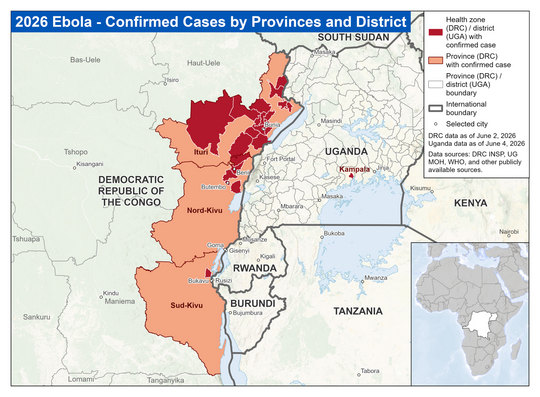
What is the current Ebola situation?
In May 2026, a large outbreak of Ebola Bundibugyo (Bun-dee-BOO-jah) virus disease was identified in northeastern Democratic Republic of the Congo (DRC) and Uganda. The Bundibugyo virus is one of the four types of orthoebolaviruses that cause Ebola disease in humans, with a death rate of between 25-50% in past outbreaks. Visit CDC: Ebola Outbreak: Current Situation for the latest information on confirmed cases and deaths. To date, no cases have been reported in the United States.
On May 17, the World Health Organization (WHO) determined this outbreak to be a public health emergency of international concern. The ongoing outbreak is occurring in a conflict-affected, remote region, with limited healthcare infrastructure, poor roads, population displacement and frequent cross-border travel, all of which increase the risk of further transmission and complicate contact tracing and delivery of medical supplies. In addition, there is no vaccine or specific treatment for the Bundibugyo strain of Ebola virus, so containment will rely on rapid case identification and isolation, contact tracing, and provision of personal protective equipment (PPE) and other healthcare resources.
 How is Ebola transmitted?
Ebola disease is spread through direct contact with the blood or body fluids of a symptomatic or deceased person; objects such as clothing, bedding, needles, and medical equipment that are contaminated with their blood or bodily fluids; or infected animals, such as bats and nonhuman primates.
Who is at risk for Ebola in this outbreak?
Healthcare workers who are providing direct care to patients with Ebola disease without proper infection control measures and PPE are at high risk. Family members and close contacts of someone infected with Ebola, such as those living with or caring for ill people and individuals who handle the remains of those who have died from Ebola disease — including healthcare workers, family members, and those who attend funeral services — are also at increased risk.
The risk to the general public, and even to travelers to the impacted regions, is low. However, CDC has issued alerts for affected countries and has provided recommendations to protect travelers.
What policies have been put in place to prevent importation of cases to the U.S.?
The risk of spread to the U.S. and other countries at this time remains low. CDC has issued a Level 3 Travel Alert for the DRC (reconsider nonessential travel) and a Level 2 Travel Alert for Uganda (practice enhanced precautions) and is conducting entry screening of all travelers arriving to the U.S. from the DRC, Uganda, and South Sudan. U.S. citizens returning to the U.S. are being routed to four airports (Dulles, Atlanta, Houston, and JFK) for screening by CDC personnel for symptoms of Ebola and potential exposures to anyone with Ebola. State health departments monitor travelers for 21 days post-arrival. To support the containment response on the ground, CDC and WHO are assisting with surveillance and contact tracing through country offices and partners in DRC and Uganda and providing resources for prevention and treatment.
As of May 22, non-U.S. citizens will not be allowed to re-enter until they have been out of the affected countries for 21 days. This order is set to expire after 30 days, and travelers should make sure they review current guidance before they leave for their trip.
Ebola resources
Stay up to date on the latest publications
Take a moment and review some recent publications on newcomer health:
- Vukovich M, Esala J, Beckman A, Northwood A, Vinson G, Letts J, Danner C. Cost Savings from Integrating Behavioral Health in Primary Care: A Pragmatic Randomized Control Trial with Karen Refugees. J Immigr Minor Health. 2026 Jun;28(3):560-567. doi: 10.1007/s10903-025-01806-7. Epub 2025 Nov 2. PMID: 41176745; PMCID: PMC13222308.
- Singal K, Cruickshank M, Ekong A, Robertson C, McDonagh Hull P, Williams D, Fairley T, Locock L, Kilonzo M, Ade M, Braithwaite L, Bick D, Devane D, Rzewuska Diaz M, Taylor G, Bhattacharya S, Black M, Brazzelli M. Experiences of women from ethnic minorities and underserved, marginalised and disadvantaged groups in communicating with health professionals during antenatal care: An overview of qualitative systematic reviews. NIHR Open Res. 2026 Jun 2;6:2. doi: 10.3310/nihropenres.14096.2. PMID: 41727906; PMCID: PMC12917361.
- Cénat JM, Farahi SMMM, Dalexis RD, Jean L, Lafleur N, Clorméus LA, Cénat A, Mauricette J, Beogo I, Derivois D. Severe depression among Haiti's internally displaced populations: Prevalence and correlates in the context of gang violence. Psychiatry Res. 2026 May;359:116998. doi: 10.1016/j.psychres.2026.116998. Epub 2026 Feb 4. PMID: 41687330.
- Tranby B, Sia I, Clark M, Novotny P, Lohr A, Pardo LS, Patten C, Iteghete S, Zeratsky K, Rieck T, Molina L, Capetillo GP, Ahmed Y, Dirie H, Wieland M. Self-Efficacy is Associated with Health Behaviors Related to Obesity and Cardiovascular Risk among Hispanic/Latinx and Somali Immigrants to the United States. Res Sq [Preprint]. 2025 Feb 19:rs.3.rs-6001516. doi: 10.21203/rs.3.rs-6001516/v1. Update in: J Immigr Minor Health. 2026 Jun;28(3):603-611. doi: 10.1007/s10903-025-01812-9. PMID: 40034444; PMCID: PMC11875296.
|
|
|
Please sign up now if you are not already subscribed to Minnesota Center of Excellence in Newcomer Health Updates and wish to receive future updates.
For more information or questions, please contact the Minnesota Department of Health Refugee Health Program at MNCOENewcomerHealth@state.mn.us or 651-201-5414.
The Minnesota Center of Excellence in Newcomer Health is supported by NU50CK000563 (MN) from the U.S. Centers for Disease Control and Prevention.
|
|
|
|