Vaccination Status Upon Completion of Domestic Medical Exam among Adult Refugee Arrivals to Minnesota
While most refugees are started or continued on age-appropriate vaccination series during their Domestic Medical Exam (DME), many may still require additional follow-up to complete those series. Table 1 describes the vaccination status of primary refugees to Minnesota aged ≥19 years at the time of DME completion, who arrived from Jan. 1, 2024, to Dec. 31, 2025.
Among adults born after 1956, 49% demonstrated serologic immunity to measles, mumps, and rubella at the time of their DME; 49% of adults born after 1979 demonstrated serologic immunity to varicella; and 71% of adults aged 19-59 years had the presence of hepatitis B antibodies (Table 1). These demonstrated immunities may be an acceptable alternative to vaccination records on Form I-693.
The series most likely to be complete upon DME finalization were MMR (90% of those without serologic evidence of immunity) and Pneumococcal (57% of adults ≥65). Only 43% of refugees were vaccinated for influenza upon DME completion; this lower rate likely reflects whether the DME occurred during the active flu season. The series most likely to require additional doses after the DME were hepatitis B, polio, and varicella. Notably, a high proportion of refugees demonstrated immunities to both varicella and hepatitis B.
While these data provide a snapshot of vaccination needs prior to adjustment of status, it is critical for providers to review each patient's record individually. This ensures all doses received meet vaccine recommendations for both vaccine type and the specific timing intervals between doses.
Table 1. Vaccine and Immunity Status* upon Domestic Medical Examination (DME) Completion, Primary Refugees** aged ≥19 years*** to Minnesota, 2024-2025†
|
Vaccine Type
|
Serologic Evidence of Immunity
|
3+ doses
without evidence of immunity
|
2 doses
without evidence of immunity
|
1 dose
without evidence of immunity
|
0 doses
without evidence of immunity
|
Total
|
|
MMR
(for those born after 1956)
|
982 (49%)
|
|
930 (90%)
|
67 (6%)
|
40 (4%)
|
2,019
|
|
Varicella
(for those born after 1979)
|
784 (49%)
|
|
91 (11%)
|
257 (31%)
|
531 (64%)
|
1,611
|
|
Tdap/Td‡
|
|
874 (43%)
|
356 (18%)
|
292 (14%)
|
507 (25%)
|
2,029
|
|
Hepatitis B
(ages 19-59 years)
|
1,346
(71%)
|
168 (31%)
|
169 (31%)
|
110 (20%)
|
100 (18%)
|
1,893
|
|
Polio
(tOPV or IPV)
|
|
90 (4%)
|
369 (18%)
|
904 (45%)
|
666 (33%)
|
2,029
|
|
Influenza
|
|
|
|
866 (43%)§
|
1,163
(57%)
|
2,029
|
|
Pneumococcal (ages ≥65 years)
|
|
|
|
43 (57%)
|
33 (43%)
|
76
|
*Includes vaccines received overseas and domestically through the time of the DME completion. Does not include self-reported disease history. Does not consider validity of vaccination doses based on age of patient or intervals between doses.
**Individuals who arrived with a refugee visa only and their first state of resettlement was Minnesota. Table only includes those who completed a DME.
***Age ≥19 years at the time of DME completion.
†Arrived to the U.S. from Jan. 1, 2024, to Dec. 31, 2025. 2025 data are still preliminary.
‡Received ≥1 dose of Tdap; additional doses may be Td.
§Depending on when the influenza vaccine was received, the individual may need an additional dose using the current season’s formulation when submitting Form I-693.
Adjustment of Status Health Exam for Refugees and Derivative Asylees: Vaccines
Refugees and derivative asylees apply for permanent residency one year after arrival to the United States. A derivative asylee is the spouse or unmarried child under the age of 21 of an asylee who enters the United States with a V92 visa.
Part of this application includes the completion of the I-693 form, Report of Immigration Medical Examination and Vaccination Record by a civil surgeon, a physician designated by the United State Citizenship and Immigration Services (USCIS). Refugees may also complete their I-693 at a public health department per the USCIS: Chapter 3 - Blanket Civil Surgeon Designation. Generally, the I-693 exam includes immunizations and disease screening; however, refugees and derivative asylees who do not have a class A condition are only required to complete an immunization review and update and do not need the full medical exam. For more information, refer to CDC: Technical Instructions and Medical Exams.
Refugees are offered vaccinations prior to arrival through the CDC: Vaccination Program for U.S.-bound Refugees, which provides vaccinations according to age, vaccine history, and eligibility. Vaccines generally offered through this program include hepatitis B, rotavirus, Hib, PCV, DTP, Polio, Td, varicella, MMR, COVID-19, and influenza. The program aims to administer two doses for those in a series. Derivative asylees receive similar vaccinations. However, unlike with refugees, there are certain vaccine requirements prior to travel. For more information, visit CDC: Vaccination Technical Instructions for Panel Physicians.
After arrival to the United States, refugees and derivative asylees receive vaccines as part of the domestic medical exam (Minnesota Initial Refugee Health Assessment). Minnesota guidelines recommend offering any vaccination due according to Minnesota Department of Health Immunization Best Practices at this exam.
The vaccines required for the I-693 medical exam were adapted from ACIP vaccine recommendations according to age at the time of the exam. Due to these opportunities to get vaccinated prior to the I-693 medical exam, refugees may only require few or no vaccines to be fully up to date. Civil surgeons should pay special attention to those vaccines that are seasonal (influenza) or part of a series, as refugees may have started the series but had not had time to complete them. Those who are up to date on their vaccines according to state guidance or I-693 vaccine recommendations will not need additional vaccines but will need a civil surgeon or local public health to review and confirm records.
For more information and a list of civil surgeons in Minnesota, visit Minnesota Civil Surgeons.
Mobile health is an innovative and evolving part of Minnesota’s refugee and international health landscape. Newcomers and Minnesotans alike may face barriers of cost, transportation, lack of trust, language needs, and scheduling conflicts that make accessing medical and dental care difficult. Mobile health can help to address many of these challenges. We are excited to highlight two partners involved in this work in Minnesota – including how they started, what they do, and what they’ve learned along the way.
CARE Clinic
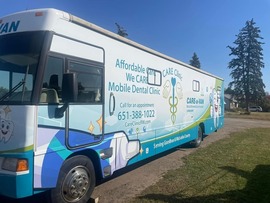
CARE Clinic, located in Red Wing, Minnesota, began its mobile health care services two years ago. Its mobile dental health unit, known as the “CARE-a-Van,” is equipped with four dental chairs and serves Goodhue and Wabasha counties. By bringing services directly into the community, the CARE-a-Van helps reduce common barriers to care for newcomer populations like those mentioned above.
For many newcomer families, for example, taking time off work for appointments can be challenging. CARE-a-Van helps to address this barrier by visiting all schools in its service area twice each year. This mobile approach allows CARE Clinic to see many children for routine dental cleanings and sealants during their school day. As a result, more children are able to access timely, essential dental services without disrupting their families’ work schedules.
While mobile health models like the CARE-A-Van face some hurdles, such as internet coverage, patient follow-up, parking, and the technical and mechanical logistics that come with operating a vehicle, the CARE team has identified solutions as well. They have secured high-speed broadband connections, work with volunteers who can assist with vehicle operations, and are part of a Mobile Healthcare Association that helps organizations to start and sustain mobile health.
We asked Julie Malyon, executive director at CARE Clinic, to share some of the lessons learned by bringing the CARE-A-Van to the families of Goodhue and Wabasha counties, as well as how these lessons are shaping the future of mobile health in our community. Here’s what she said:
“When you decrease barriers and bring care to the schools, workplaces, group homes, churches, and other community locations, it becomes much easier for people to access care. Trusted locations also provide a sense of safety and security for newcomers. Overall, it is a wonderful way to serve our community and to get care in rural locations where transportation can be a barrier to care.”
To learn more about CARE Clinic’s mobile dental health work and other services, you can visit CARE Clinic: Dental Care.
M Health Fairview MINI
|
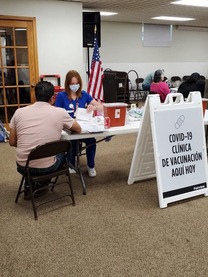
M Health Fairview’s Minnesota Immunization Networking Initiative (MINI) began offering its mobile vaccination clinics in 2006, alongside an incredible network of community partners. The program is in its 20th year, with many of the original partners still involved. St. Mary’s Health, for example, continues to partner with the MINI team several times a month. In addition to their original services like providing seasonal influenza and recommended childhood and adult vaccines, MINI has expanded its work over the years to also include additional health services like blood pressure checks, diabetes screening, dental support, harm reduction services, health education, and more.
Ingrid Johansen, director of community clinical care at Fairview, states that “by delivering services in a mobile model alongside trusted partners and by serving individuals in their own language, we can overcome some of these barriers and improve access for new immigrants and their families.”
We asked Ingrid to share some of the lessons the Fairview MINI team has learned in their past 20 years of mobile health care, as well as how these lessons are shaping the future of mobile health in our community. Here’s what she said:
“Mobile health care can be high quality, convenient, cost effective, and human-centered. It’s a model that works for a diverse range of communities including but not limited to seniors, new immigrants, school-aged children, and rural residents. The demand for mobile health care is only going to increase, and we need policies and funding streams that can support this growing model of care.”
Fairview MINI’s service area includes the urban Metro, Greater Minnesota communities around Princeton and Wyoming, and the rural Iron Range of Northern Minnesota. To learn more about Fairview MINI’s services and how to partner with them, you can visit M Health Fairview: Mobile Community Clinical Care or email the team at all-communityhealth@fairview.org.
|
Minnesota Center of Excellence in Newcomer Health (MN COE)
MN COE Survey: Pediatric Developmental Screening Clinical Practices
The MN COE would like to understand barriers and opportunities for developmental screening among children between 8 months and 5 years old whose caregivers who have a preferred language other than English to optimize clinical practices.
To assess current practices, we are seeking input from professionals who provide outpatient well child and standard physical exams for children. Medical doctors, nurse practitioners, physician assistants, advanced practice providers, registered nurses – in addition to clinic managers, developmental screening coordinators, quality improvement leads, or others with a direct role in supporting developmental screening – are invited to participate in this brief survey: Pediatric Developmental Screening Clinical Practices.
The Minnesota Department of Health's Institutional Review Board reviewed this project and determined it to be exempt from full comprehensive review due to minimal risk to study participants. All your responses will remain confidential, with the option to be anonymous.
Questions can be directed to the Minnesota Center of Excellence in Newcomer Health at MNCOENewcomerHealth@state.mn.us.
|